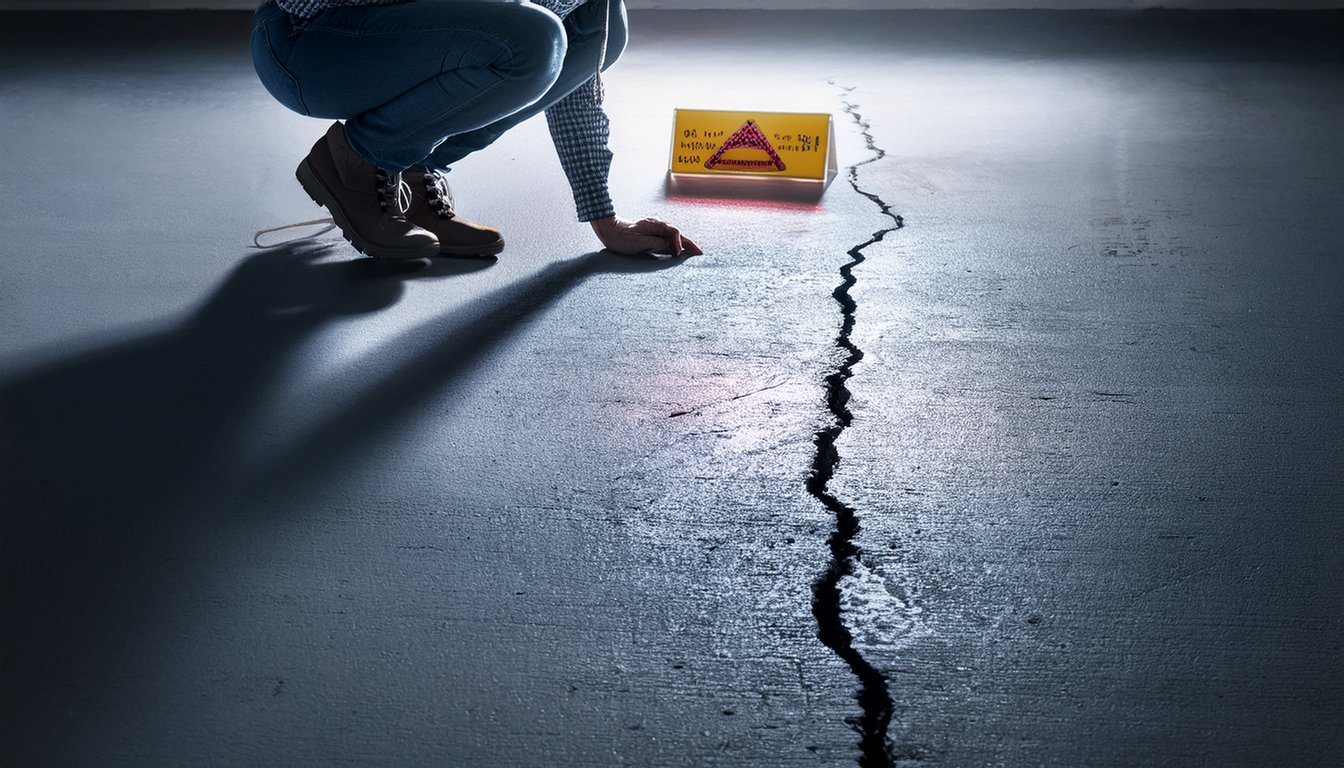
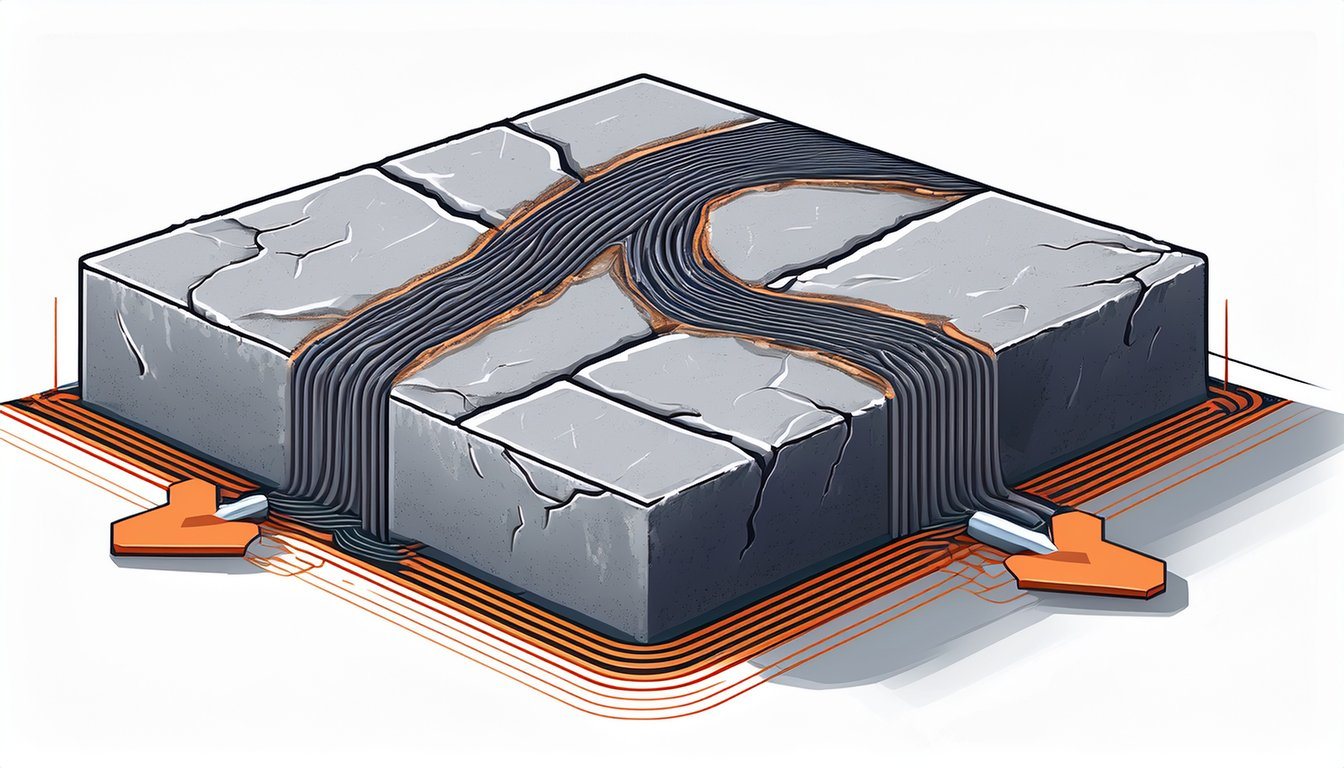
A homeowner notices a crack running across the garage floor and plans a weekend fix: open it up with a grinder, fill it, done. We most slabs that's a small job. We have post-tensioned slab, it's the wrong first move. Inside a post-tension slab are steel tendons, cables pulled tight after the concrete cures and locked off at the edges, and they carry enormous force. Sealing the crack is usually the easy part. The risk is what the repair touches on the way. Cutting, routing, coring or drilling into a post-tension slab is not a homeowner job. This guide explains why these slabs crack, why the tendons change the repair, what the repair options are, and which signs mean you need an engineer rather than a crack filler.
Quick answers
- Cracks happen: post-tensioning keeps cracks tight rather than preventing every one.
- The rule: never cut, route, core or drill a post-tension slab until the tendons have been located by a professional.
- Repairs: common crack repair techniques include surface sealing, injection, and routing and sealing; which one fits depends on the crack and its cause.
- Call an engineer: for rust stains along a line, bulging or spalling concrete or an exposed tendon at the edge, or a crack that keeps growing.
Why post-tension slabs crack, and why the cracks stay tight
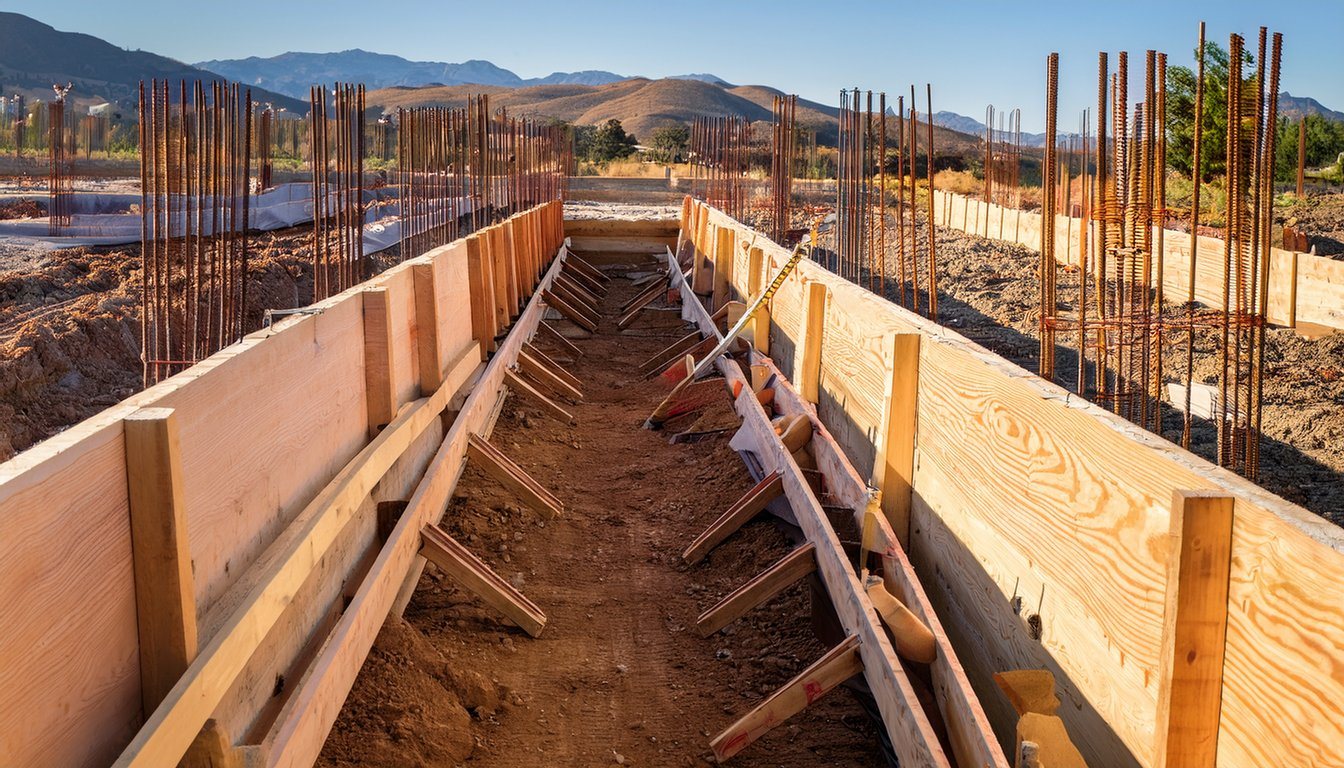
A post-tension slab is a concrete slab reinforced with high-strength steel tendons that are tensioned after the concrete hardens, squeezing the slab together. Concrete still shrinks as it dries, so cracks can form. What the tendons do is hold them closed. The Post-Tensioning Institute's page on slab-on-ground construction says "Post-tensioning will reduce cracking and keep any cracks that might form tight, preventing entry of insects and reducing possible water penetration, which can damage flooring and cause mold problems." Building new? Our guide to post tension slab cost per square foot covers pricing.
That's why a thin, tight crack in a post-tension slab is often a cosmetic issue. The question is whether the crack is just a crack, or a sign that something is wrong with the tendons. More on that below.
Cracks before stress and cracks after
Timing is the first thing worth knowing about any crack in one of these slabs. Pro Builder, a residential construction trade magazine, notes in "How to Avoid Cracks in Post-Tensioned Concrete Slab Foundations" that "Concrete naturally experiences some cracking as it shrinks during the curing stage." Those early cracks are supposed to be squeezed shut when the tendons are stressed. The same article explains what happens when that goes wrong: "At this point, the slab is too strong to allow the stressful operation to close any plastic cracks that opened up during curing." In other words, if stressing is done late, a crack can stay open even though the tendons are working.
Professional Engineering Inspections, a foundation inspection firm, makes a related point in "Cracks in Post Tension Slab?" It says "If movement occurs in the foundation prior to tensioning, cracks may occur due to the lack of any reinforcement at that time," and that "Small cracks do not normally create a significant concern other than for cosmetic reasons or those associated with pest control and are considered insignificant once the tendons are tensioned."
Both sources describe cracks that appear early in a slab's life. A crack that shows up years later, or one that was tight and has started to open, is a different question, and it is the one the engineer section below is about.
The one rule: know where the tendons are
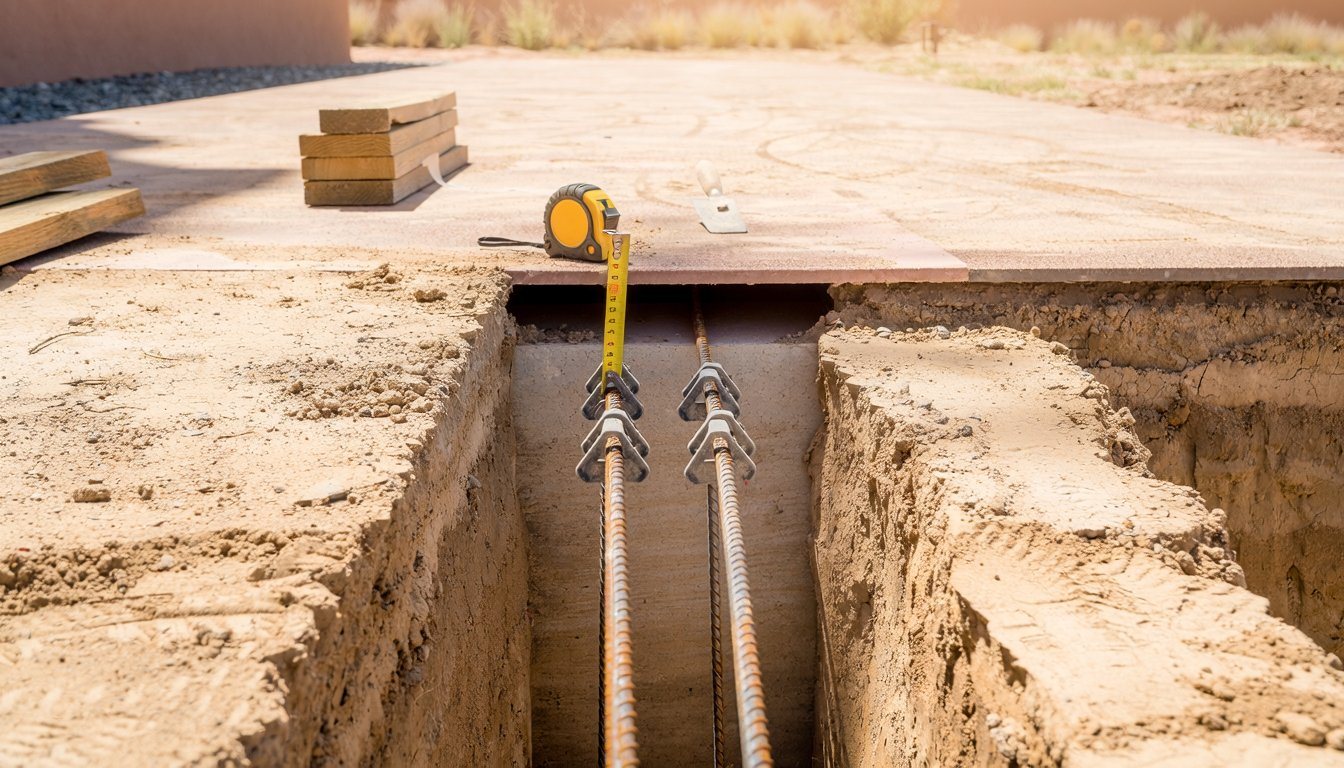
The tendons are what make a post-tension slab different to repair. Penhall, a concrete cutting and coring company, explains in its guide to post-tension slab cutting and coring that post-tension cables carry roughly 25,000 to 33,000 pounds of tensile force per strand, and that "Severing a cable causes explosive energy release, spalling concrete, and structural instability." GPRS, a concrete scanning company, puts it simply in its article on post-tension cable layout : "Drilling, cutting, or coring into a post-tension slab can be dangerous."
So any repair that goes into the concrete, rather than sitting on the surface, starts with finding the tendons. Penhall says that cutting or coring "requires pre-drilling GPR scanning to locate high-tensile steel cables and determine parabolic drape depth." Ground-penetrating radar scanning is specialist work; the scan tells the repair crew where it can and can't go.
If you're not sure whether your slab is post-tensioned, assume it may be and ask before anyone cuts into it.
Do not treat old plans as a substitute for a scan. In his guide to precision concrete coring in post-tension slabs , Penhall says that "field conditions, for sequence, and contractor installation variability mean actual positions frequently deviate from structural drawings," and that "GPR scanning resolves the actual installed condition, not the design intent." A drawing set from the original permit can tell you a slab is post-tensioned. It cannot be trusted to say exactly where each tendon ended up, and on an older house the drawings may not exist at all.
Reading the crack before choosing a repair
Before anyone picks a material, the crack itself needs describing. In our experience, a few plain observations save a lot of guesswork, and you can gather them without touching the concrete:
- When it appeared. A crack that has been there since the slab was new, and hasn't changed, points to shrinkage. A crack that appeared after a plumbing leak, a big storm or work nearby is a different story.
- Where it runs. A crack that starts at a corner, a column or a doorway, where the slab is restrained, is common. One that runs toward the slab edge at a tendon end deserves a closer look.
- Whether it is damp or stained. A crack that stays wet, or that shows rust or white mineral deposits, is letting water in, and water is the enemy of the steel inside.
- Whether it moves. A photo with a coin or tape measure beside the crack, retaken monthly, shows whether it is stable.
Water matters more than width in a post-tension slab because of how the tendons are built. Kryton, a concrete waterproofing manufacturer, notes in its post-tension slabs overview that "PT tendons are encased in sheathing that can transmit water longitudinally. Even a small leak can travel several meters." A crack that lets water in near one tendon can affect steel some distance away. It is also why contractors who work on these slabs, such as Gaje Contracting in Arizona, say that filling the cracks to keep out moisture and insects is the point of the repair, and that epoxy injection is the best option on a post-tension foundation. That is one contractor's view, not a code rule, so treat it as a reason to ask the question rather than as the answer.
Matching the repair to the crack
The standard industry reference on this subject is the American Concrete Institute's ACI 224.1R, "Causes, Evaluation, and Repair of Cracks in Concrete Structures," which, in its own words, says "The procedures used to evaluate cracking in concrete and the principal techniques for the repair of cracks are presented." Techniques commonly used in the industry include:
- Surface sealing, which fills or coats a crack at the surface without cutting into the slab.
- Injection, in which a resin such as epoxy is pumped into the crack to fill it. On a post-tension slab this is professional work, planned around where the tendons are.
- Routing and sealing, which widens the crack along the surface before filling it. Because it cuts into the concrete, it's one of the repairs that has to wait until the tendons are located, as above.
Which one fits depends on how wide the crack is, whether it's moving or leaking, and above all what caused it, which is why the cause should be understood before a repair is chosen. That's a call for a structural engineer or an experienced contractor who has looked at the slab. Our foundation crack repair guide covers the repair methods and what they cost in more detail.
When a crack is a sign of something bigger
Most cracks in a post-tension slab are not tendon problems. But tendons can fail, and that's a different kind of repair. The Construction Specifier's article "Failures: What's sticking out of my slab?" explains that "PT tendons are susceptible to corrosion from water and chloride (salt) ingress in similar ways as conventional reinforcing steel," and that "The effects of corrosion can result in the tendons losing tension and the concrete losing pre-compression." It also warns that "In some cases, this can happen suddenly and with sufficient force, a tendon can erupt from the slab."
Call a structural engineer if you see any of these:
- Rust staining seeping from a crack or running in a line across the slab.
- Bulging or spalling concrete, or a tendon or its end hardware exposed at the edge of the slab.
- A crack that keeps growing from month to month. Our foundation cracks guide explains how to track that.
The same article is clear about what to do: "Failure of PT tendons reduces the capacity of the structure, and erupted tendons or suspected loss of post-tensioning force should be evaluated by a structural engineer." Our foundation crack inspection guide explains what an engineer's visit should give you.
Who should do the work
Sealing or injecting a crack, once the tendons are located and the cause is understood, is work a qualified concrete or general contractor can do. Repairing or replacing a tendon is specialist work. The Post-Tensioning Institute offers certification in unbonded post-tensioning repair, rehabilitation and strengthening through its repair education program; ask whether the crew doing tendon work holds it.
Before you sign anything, these questions separate contractors who understand post-tension slabs from those who have simply done a lot of concrete:
- How will you locate the tendons, and who does the scan? The answer should name a method and say who reads the result. "We can see where they usually run" is not an answer.
- What do you think caused the crack? A contractor who quotes a repair without a cause is guessing.
- Is the work on the surface or does it cut into the slab? Surface sealing and injection carry different risks from routing.
- What happens if you find a tendon in the way? The right answer is that the plan changes, not that the cut moves a few inches.
- Is the scope in writing? It should say where the work will and will not go.
Licensing is worth a minute too. The California Contractors State License Board defines the C-8 concrete classification this way: "A concrete contractor forms, pours, places, finishes and installs specified mass, pavement, flat and other concrete work; and places and sets screeds for pavements or flatwork." That describes placing concrete, not evaluating why a post-tension slab cracked, so licensing alone does not settle who should assess the crack. Check the license on the CSLB site, and keep the cause question with a structural engineer.
Repairing a crack is a small job once the risk has been handled, and the order matters: scan first, understand the cause second, seal third. Medici Construction Group is one licensed option for concrete and foundation work, holding California A, B and C-10 licenses under CSLB #1114433.
Frequently asked questions
Can you repair cracks in a post-tension slab?
Yes. Cracks can be sealed or injected, but any repair that cuts or drills into the slab should start with locating the tendons, and signs of tendon trouble should go to a structural engineer first.
Are cracks normal in a post-tension slab?
Some cracking can occur. The Post-Tensioning Institute says post-tensioning will reduce cracking and keep any cracks that might form tight.
Is it safe to drill into a post-tension slab to fix a crack?
Not without locating the tendons first. Trade sources warn that drilling, cutting or coring a post-tension slab can be dangerous, and scanning is used to find the cables before any cutting.
What happens if a post-tension cable is cut?
Penhall, a concrete cutting and coring company, says the cables carry 25,000 to 33,000 pounds of tensile force per strand and that severing one causes explosive energy release, spalling concrete and structural instability.
Why did my post-tension slab crack?
Most often from shrinkage as the concrete cured, or from movement before the tendons were stressed. Pro Builder notes that concrete naturally cracks a little as it shrinks during curing, and later cracks are worth having an engineer look at.
Do the original plans show where the tendons are?
They show the design intent, not always the installed positions. Penhall says actual tendon positions frequently deviate from structural drawings, which is why a scan of the slab is used before any cutting.
Can I use epoxy on a post-tension slab crack?
Epoxy injection is a common crack repair technique, but on a post-tension slab it should be done by a professional who knows where the tendons are, after the cause of the crack is understood.
When should I call an engineer about a post-tension slab crack?
If you see rust staining, bulging or spalling concrete, an exposed tendon at the slab edge, or a crack that keeps growing. The Construction Specifier notes that erupted tendons or suspected loss of post-tensioning force should be evaluated by a structural engineer.