The slab quote comes back with a line most homeowners haven't seen before: a "PT package," plus a separate charge for a crew to come back days after the pour for "stressing." Neither one is concrete. A post-tensioned slab, reinforced with steel cables that are pulled tight after the concrete hardens, gets much of its price from decisions made before any concrete arrives: the soils report that calls for it, the engineer's cable layout, the cable and anchor package, and the specialist crew that tensions it. The per-square-foot figures below are a useful starting point, but the real number comes from the design.
Quick answers
- Published range: one 2026 cost guide puts installed PT slabs at $8 to $18 per square foot, with typical residential slabs at $11 to $14.
- Soil drives it: PT slabs are usually specified because a soils report finds expansive soil, and the engineer designs the slab to that report.
- Not just concrete: engineering, inspection, the cable package and the stressing crew are separate costs.
- Compare on the same design: quotes only line up when they price the same engineered drawings.
What PT slabs cost per square foot
Published figures come mostly from cost guides and estimators, so treat them as ranges to check against local bids. A 2026 guide from Concrete Slab Cost states that "The 2026 installed cost is $8 to $18 per sq ft, with the residential standard at $11 to $14 per sq ft." Terrapin, a general contractor and construction cost consultant, gives $9 to $16 per square foot for slab-on-grade, noting that elevated commercial decks cost considerably more, which is a different kind of project.
On sites where the soil is stable, a conventional reinforced slab is often the simpler option; our 30x40 concrete slab guide covers conventional slab pricing.
A worked example on 1,800 square feet
Per-foot ranges are easier to judge once they are multiplied out. Take a house with an 1,800 square foot slab. At the Concrete Slab Cost residential range of $11 to $14 per square foot, that is $19,800 to $25,200. The guide's wider $8 to $18 range gives $14,400 to $32,400, and Terrapin's $9 to $16 gives $16,200 to $28,800. Three published ranges, three different envelopes for the same slab, which is why a per-foot number is a screening tool and not a bid.
The PT-specific lines are a smaller slice. Adding the guide's engineering and inspection ($0.50 to $1.50), cables ($0.40 to $0.80) and PT labor ($2 to $4) gives $2.90 to $6.30 per square foot by our arithmetic, or $5,220 to $11,340 on 1,800 square feet. Everything else in the quote is the concrete, forming, finishing and site work any slab needs. These lines come from one guide's assumptions, so they show how a quote is built, not what your lot will cost.
Why the soil decides
In our experience, most residential PT slabs start with a soils report. As one structural engineering firm, APE Structures, puts it: "A structural engineer's first stop is always the geotechnical (soils) report." Expansive clay is soil that swells and shrinks with moisture, and a PT slab is designed to ride that movement as one stiff piece. The same firm describes a PT slab as acting "like a rigid boat, allowing the entire structure to float safely on top of the swelling and shrinking soil as a single, unbending unit."
That's why the soils report comes before the price: its findings shape how many cables go in and how the slab is shaped. Our soils report cost guide covers what that report involves.
The scale of the problem explains why this design work is standardized. A 2023 HUD USER Cityscape paper on house foundations cites the American Society of Civil Engineers, saying "one in every four residences in the continental United States has experienced disturbances by expansive soils", with yearly damage above $15 billion. The same paper names PTI DC10.5-19, a design standard for shallow post-tensioned foundations on expansive and stable soils, which is the kind of published method an engineer works from when sizing a PT slab.
The design also needs a building official's sign-off. In its Building Code Manual, dated 2014, Los Angeles County Public Works says "Slab-on-grade and mat-type footings for buildings located on expansive soils shall be designed in accordance with Section 1808.6 or such other engineering design based on geotechnical report(s) as approved by the Building Official." That manual is a County document; the City of Los Angeles and other cities set their own procedures, so confirm which office reviews your plans. Plan review and engineering revisions are real costs, and they arrive before any concrete does.
What's inside the price
A PT slab quote usually bundles several trades and services. Here's how one cost guide breaks out the PT-specific pieces, alongside the parts every slab has:
| Line item | What it covers | Published reference |
|---|---|---|
| Engineering and inspection | Cable design and PTI-certified inspection | Concrete Slab Cost: $0.50 to $1.50 per sq ft |
| Cables (tendons) | Sheathed steel strand and anchors | Concrete Slab Cost: $0.40 to $0.80 per sq ft |
| PT labor | Layout, tensioning and anchor installation | Concrete Slab Cost: $2 to $4 per sq ft |
| Concrete, forming and finishing | The slab itself | Priced like any slab; see our 30x40 slab guide |
| Coordination with plumbing and electrical | Pipes and sleeves placed before the pour | Priced per job |
The PT line items come from the Concrete Slab Cost guide. The last row matters more than its size suggests: in our experience, changes after a PT slab is poured are expensive, so plumbing and electrical layouts are settled before the pour.
The stressing visit
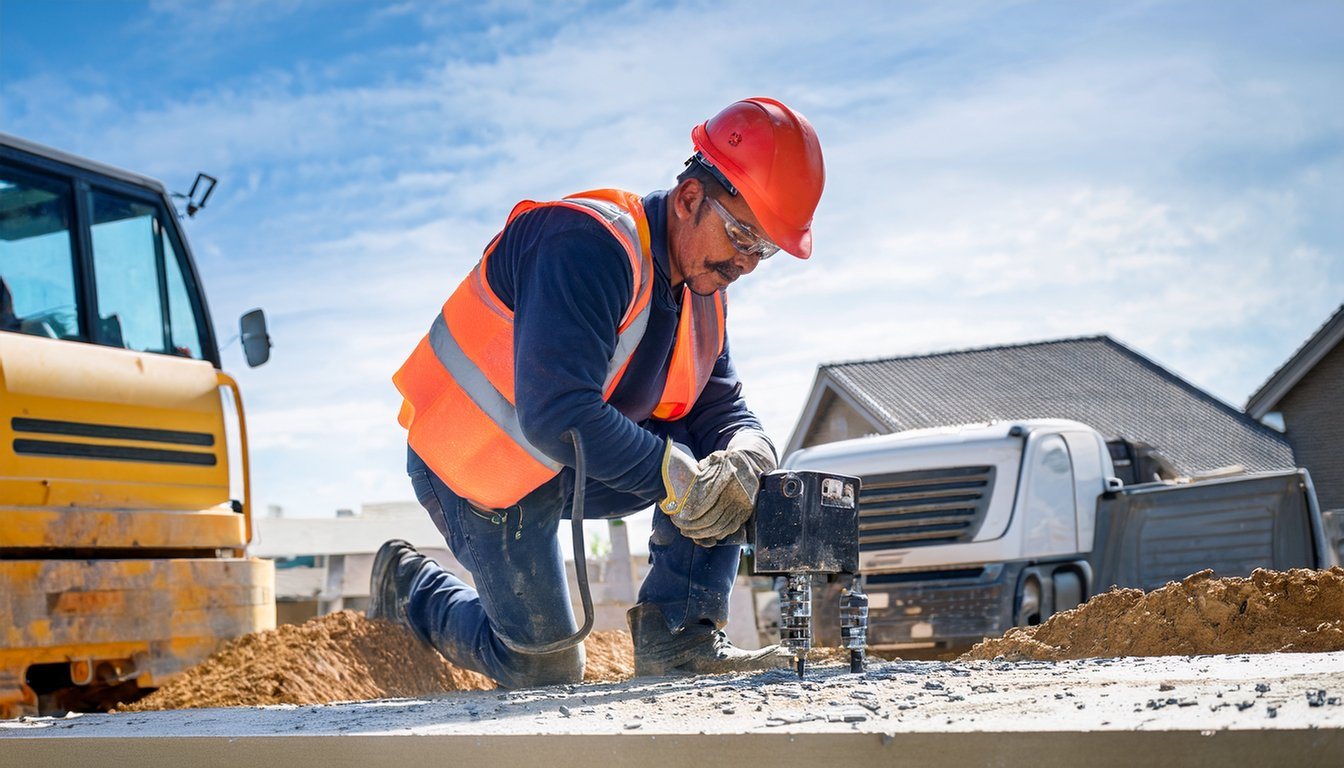
A PT slab isn't done when the concrete is placed. ConcreteNetwork explains that "Once the concrete has gained strength to 2000 psi, typically within the 3 to 10 days recommended by PTI, the tendons are stressed." It adds that "PT tendon placement and stressing is usually done by companies with certified workers who specialize in this work."
For the budget, that means a specialist crew, a return trip to the site and an inspection tied to the stressing, all of which show up as their own costs. In our experience, it's worth confirming in writing who performs the stressing and whether that visit is included in the price. Once stressed, those cables stay under high tension for the life of the slab, which is why later cutting or drilling needs care; our post tension slab crack repair guide explains.
Who should be doing the stressing
The Post-Tensioning Institute runs a certification program for this work. It describes its slab-on-ground workshop as "designed specifically for installation and inspection of single strand unbonded post-tensioning (PT) systems for residential and light commercial slabs-on-ground." Participants can earn Level 1 or Level 2 credentials as an installer or an inspector.
A 2026 article in Concrete Facts magazine lists who should hold which credential: a Level 1 installer as crew foreman for installation, a Level 2 installer as foreman for tensioning with Level 1 for the rest of the crew, and a Level 2 inspector overseeing the work. The author warns that "Materials and workmanship from non-certified plants and personnel are inferior, as they do not comply with code requirements and do not support overall project objectives for quality, durability, safety and productivity." That is one trade writer's view, and your local building department's rules control, but it explains why certified crews are priced into PT bids. In our experience, a bid far below the others is worth a question about whether the certified crew and inspector are in the number.
Inspections and paperwork that carry a cost
PT slabs usually add inspection steps that a conventional slab does not, and each one has a fee or a schedule cost. The City of Palo Alto's Building Division publishes a PT slab inspection guideline (revised January 2018) as one example of what a California city asks for. It says "All special inspection activities shall be performed and written field reports complete prior to the arrival of the Building Inspector." The same guideline lists checks on tendon placement, support bars, anchor placement and profiles, and its special inspection list includes the item "Verify in-situ concrete strength, prior to stressing of tendons in post-tensioned concrete" before the cables are pulled.
Palo Alto is one city, and Los Angeles-area jurisdictions have their own checklists, so treat this as an example and ask your building department what applies. For budgeting, the takeaway is that a PT slab has more people to schedule: an engineer who stamps the tendon drawings, a special inspector, a stressing crew and the city inspector. A delay by one holds up the others, and idle days can show up as change orders. In our experience, asking a bidder to list each inspection in the quote and who pays for it avoids surprises.
How to compare PT slab quotes
- Same drawings: make sure every bidder prices the same engineered slab design based on the same soils report.
- What's included: check whether engineering, cables, stressing, inspection and concrete are all in the number, or split between companies.
- Who stresses: ask which company performs the stressing and whether its crew is certified.
- Stamped drawings and inspection: ask who provides the engineer-stamped tendon drawings and who pays for special inspection and any re-inspection.
- Coordination: ask how plumbing and electrical rough-in will be placed before the pour.
Two habits help once quotes arrive. First, put the per-square-foot figure aside and line the bids up item by item, using the table above as a checklist, so a missing line shows up as a gap and not as a bargain. Second, ask how a change will be priced if the engineer revises the tendon layout after plan review or the soils engineer updates a recommendation. In our experience, the bids that hold up best are the ones that name their assumptions, such as slab area, edge beam depth and who handles inspection, so that any later change can be measured against something written down.
Medici Construction Group is one licensed option for post-tension slab foundations, holding California A, B and C-10 licenses under CSLB #1114433.
Frequently asked questions
How much does a post tension slab cost per square foot?
One 2026 cost guide puts installed PT slabs at $8 to $18 per square foot, with typical residential slabs at $11 to $14. A cost consultant gives $9 to $16 per square foot for slab-on-grade. Your price depends on the engineered design and site.
Why are post tension slabs used?
Most often because of expansive soil. A PT slab is designed to move as one stiff piece as clay swells and shrinks, and the design starts with a soils report.
When are the cables tensioned?
After the concrete gains enough strength. ConcreteNetwork says tendons are stressed once the concrete reaches 2,000 psi, typically within 3 to 10 days as recommended by PTI.
What is included in a post tension slab price?
Usually engineering and inspection, the cables and anchors, PT labor for layout and stressing, and the concrete, forming and finishing. Check each quote to see which of those are included.
What are the downsides of a post tension slab?
The main one for homeowners is that cutting or drilling into the slab later takes care, because the cables inside are under high tension. Our guide to post tension slab crack repair explains why.
Who is allowed to stress post tension cables?
Rules vary by jurisdiction, but industry practice is a crew led by PTI-certified installers, with a PTI-certified inspector overseeing the work. Ask for copies of the certifications and confirm what your building department requires.
Does a post tension slab need special inspection?
Often yes. One California city, Palo Alto, asks for special inspection reports before the city inspector arrives and verification of concrete strength before tendons are stressed. Check with your own building department for local requirements.
How much does it cost to repair a post tension slab?
It depends on the problem; a surface crack and damage to a cable are very different jobs. Our post tension slab crack repair guide covers what repairs involve.