Search "yard drainage specialist" and every result sounds like a licensed trade. It isn't one. California's contractor licensing board issues classifications, not a specialty by that name. If you haven't figured out why your yard holds water yet, our yard drainage guide covers that first, with two quick tests. Once you know what the fix actually is, what covers the person doing it depends on what the job involves, and getting that wrong is how homeowners end up with an unpermitted regrade, a French drain tied illegally into the street, or a fix that solves their water problem by creating their neighbor's.
There's no license called "drainage specialist"
The California State License Board (CSLB) issues license classifications, each with its own legal scope of work; "drainage specialist" isn't one of them. A business advertising under that name is operating under one of a handful of real classifications, and which one actually applies changes what they're legally allowed to do, and what recourse a homeowner has if the job is done wrong.
Match the job's scope to the license that covers it
CSLB's own classification definitions spell out what each license is meant to cover. For a yard drainage job, four classifications matter:
- Class A, General Engineering: the classification whose own scope names the work outright. CSLB's definition of a general engineering contractor covers fixed works including "irrigation, drainage... sewers and sewage disposal plants and systems... excavating, grading, trenching". This is the license to look for on anything involving real cut-and-fill grading or a piped drainage system.
- C-42, Sanitation System: the one classification whose text explicitly names storm drains. CSLB defines a sanitation system contractor as one who "fabricates and installs cesspools, septic tanks, storm drains, and other sewage disposal and drain structures."
- C-27, Landscaping: covers grading a yard for looks and installing plants. CSLB's definition has a landscape contractor "prepares and grades plots and areas of land for the installation of any architectural, horticultural and decorative treatment", but the classification's own scope never mentions drainage systems. A landscaping license isn't proof a contractor has cleared a drainage-specific bar, because the classification doesn't set one, whatever the business calls itself.
- B, General Building: CSLB's general building classification applies once a project needs two or more unrelated trades, which grading, piping and landscaping together clear easily. A B-licensed general contractor can take that kind of project on as the prime contractor and self-perform whatever they hold, subcontracting or holding the classification for the rest.
What happens when the wrong license does the job
The C-27 gap above isn't just paperwork trivia. A capable, experienced landscaper can still be the wrong license for a job that turns out to need real grading or a piped system, not because the work is beyond them, but because the classification they hold was never scoped to cover it.
The stakes are concrete. Under California Business and Professions Code Section 7031, a contractor without the license required for the work generally can't sue to collect payment for it, and the homeowner can sue to recover everything already paid, regardless of how good the workmanship was; mechanics liens tied to that work are unenforceable too. Section 7059 only lets a license holder do work outside their own classification when it's incidental and supplemental to the trade they're actually licensed for. Courts have reasoned that a contractor working outside their licensed classification is, in effect, acting without a license for that scope of work; as one California appellate court put it, that's "just like a specialty contractor who labors at a task for which he or she has no expertise nor license," leaving the consumer unprotected (Buzgheia v. Leasco Sierra Grove (1997) 60 Cal.App.4th 374).
Permits a real yard drainage job needs
Scope isn't the only thing that trips people up. Los Angeles requires specific permits for the kinds of work that fix a drainage problem, and the exemptions are narrower than they look:
- Grading: LAMC Section 91.106.1.2 requires a grading permit, with a narrow exemption for small cuts and fills. That exemption explicitly does not apply once the work "changes the existing drainage pattern." A regrade meant to fix a drainage problem is, by definition, changing how water moves across the lot, which is exactly the kind of change the exemption doesn't cover, whatever the cubic yardage involved.
- French drains and subsurface piping: LADBS lists subsurface drainage piping among the plumbing work whose plans must be filed and approved as a plumbing plan check before any permit is issued.
- Tying into the public storm drain: The Bureau of Engineering states that "A Storm Drain Permit is required if connections are made from the property line to a catch basin or a storm drain pipe in the public right-of-way." That is its own permit, separate from the plumbing permit for the piping itself.
Ask whoever bids the job which of these apply to your project, and confirm they're the one pulling them, not assuming a homeowner or a sub will handle it. A bid that skips permits entirely, especially on a job that clearly involves grading or new piping, is worth a second look before you sign.
Don't let the fix become your neighbor's problem
California's rule on surface water isn't "get it off my property by any means." Under Keys v. Romley, a 1966 California Supreme Court decision, a landowner can be liable for altering drainage in a way that sends water onto a neighbor's land if the alteration is unreasonable, weighing the foreseeable harm against the utility of the work. The court put it plainly: it is "incumbent upon every person to take reasonable care in using his property to avoid injury to adjacent property through the flow of surface waters."
The same logic shows up in the building code for foundation drainage: the California Residential Code's Section R401.3 requires surface water to be diverted to "a storm sewer conveyance or other approved point of collection," not just moved somewhere else on the property. It's a general grading provision, not a French-drain-specific rule, but the underlying idea applies with even more force when the "somewhere else" is a neighbor's yard.

What a drainage bid should show
License and permits are the first filter. The bid itself is the second. In our experience, a drainage proposal you can hold a contractor to has these parts:
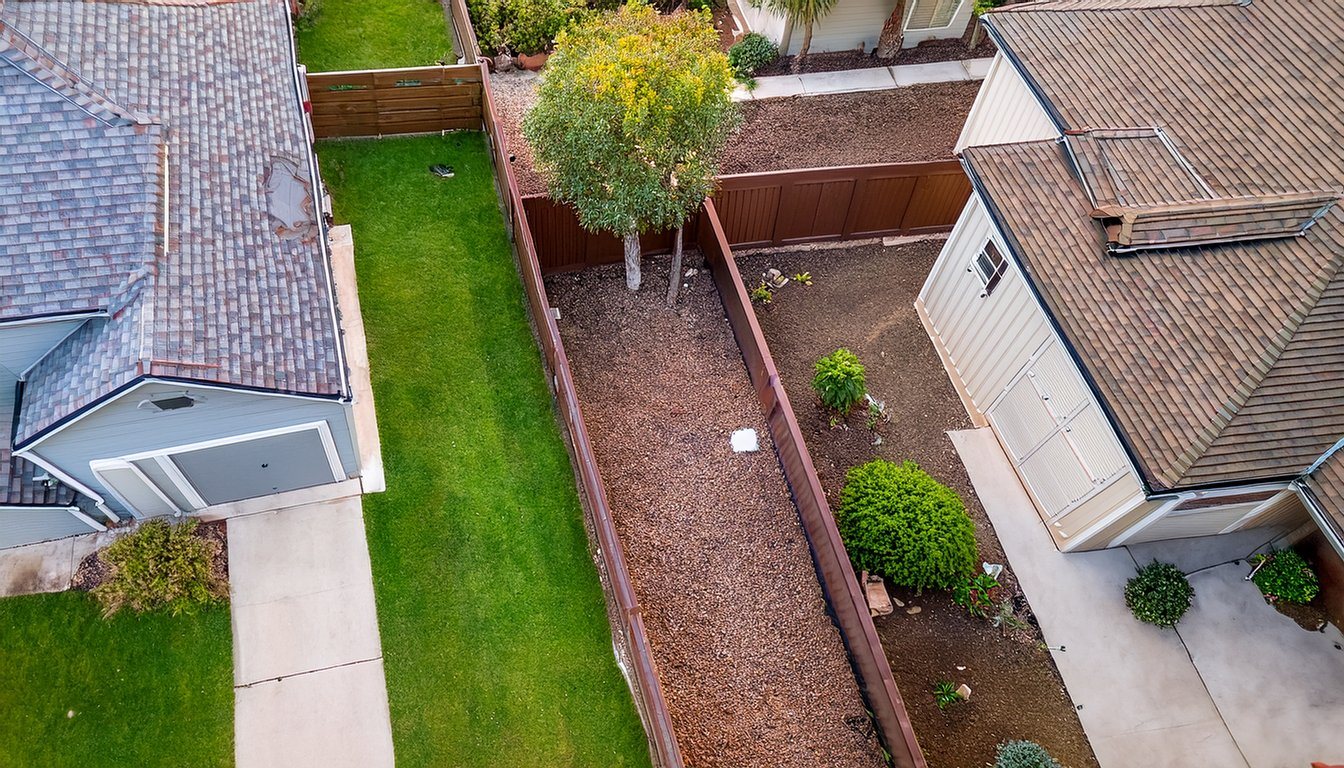
- A site sketch with flow arrows. Where water collects now, where each inlet or drain goes, and the route the water takes off the lot. A bid with no drawing leaves the most important decision, where the water ends up, unwritten.
- Pipe size, material and slope. The diameter and type of pipe, how deep it runs, and a minimum fall along its length. Pipe laid flat or with a dip holds sediment and clogs.
- Inlets and cleanouts. The number and type of catch basins or grates, and where cleanouts go so the line can be cleared later without digging.
- The discharge point. Curb outlet, approved collection point, dry well or other, and whether the connection needs its own permit.
- Grading quantities. Roughly how much soil will be cut, filled or hauled off, since that drives both cost and the permit question above.
- Restoration. What happens to the lawn, planting, irrigation and any concrete cut to install the system.
- Warranty and a water test. How the contractor will show the system works, such as running water through it before backfill, and what is covered afterward.
When two bids differ widely in price, comparing them on these lines usually shows that they are not pricing the same job.
When an engineer belongs on the team
Most yard drainage fixes don't need one. In our experience, a civil or geotechnical engineer earns a place on the job in a few situations: the lot is on a hillside or next to a slope; water is getting under the house or into a crawl space and the soil is moving; the work needs a grading permit with engineered plans; or the water has to be carried a long way, or under a driveway, to an approved discharge point. In those cases, the engineer designs the system and the contractor builds it. Ask a contractor up front whether they think your job needs an engineer and why. A contractor who says "never" on a hillside job, or "always" on a simple downspout reroute, is telling you something about how they work.
What to ask before you hire
None of this means every yard drainage job needs an engineer or a specialty-licensed crew. A downspout extension or a small regrade a landscaper handles as part of routine yard work is a different scope than piped drainage or grading that changes how water moves across the lot. The point isn't to over-hire for a simple fix; it's to know which category your project actually falls into before you ask for bids, so you're not comparing a landscaper's regrade quote against a general engineering contractor's piped-system quote as if they're interchangeable. If the plan includes a dry well, our guide to dry well installers adds the soil-test and overflow questions to ask.
Before signing anything, run through this:
- Which license classification are you working under, and does its scope match what you're asking me to do?
- Which permits does this job need, and are you pulling them?
- Where does the water actually go once it leaves my yard?
- If more than one trade is involved, who's doing which part, and are they licensed for it?
You can check any contractor's classification and status directly on the CSLB license lookup. And if you're still not sure what your yard actually needs fixed, our yard drainage guide walks through the two tests that tell you first. If you just need a quick answer on which type of pro to call before getting into license classifications at all, our who-to-call guide covers that first step.
Medici Construction Group is one licensed option for drainage and grading work, holding California A, B and C-10 licenses under CSLB #1114433.
Frequently asked questions
Is there a license specifically for drainage work in California?
No single classification is named "drainage." Depending on scope, the closest matches are Class A (General Engineering), whose scope explicitly names drainage and grading, and C-42 (Sanitation System), whose scope explicitly names storm drains.
What is a C-42 contractor license?
Sanitation System Contractor. It's the one CSLB classification whose scope directly names storm drains, along with cesspools, septic tanks, and other sewage disposal and drain structures.
Do I need a permit for a French drain in Los Angeles?
Yes. LADBS lists subsurface drainage piping among the plumbing work that needs an approved plumbing plan check before a permit is issued, so plan on a plumbing permit.
Can a landscaper legally install yard drainage in Los Angeles?
A C-27 landscaping license covers grading a yard for aesthetic and planting purposes, but its official scope doesn't mention drainage systems. Whether a landscaper is the right license depends on the specific job; work that goes beyond cosmetic grading into a real drainage system may fall under a different classification.
What happens if my drainage fix sends water onto my neighbor's property?
California follows a reasonableness rule from Keys v. Romley, not a "get it off my property" rule. An upper landowner can be liable if altering drainage to send water onto a neighbor's land is unreasonable given the foreseeable harm.
Does regrading my yard always need a permit?
If the regrade is meant to fix a drainage problem, yes. LA's grading permit exemption for small cuts and fills doesn't apply once the work changes the existing drainage pattern, and a regrade meant to fix drainage is, by definition, exactly that kind of change, regardless of the cubic yardage involved.
What should a yard drainage bid include?
In our experience, a sketch showing where water collects and where it will go, the pipe size, material and slope, the number of inlets and cleanouts, the discharge point, grading quantities, restoration of the yard, and how the system will be tested and warranted. Bids without these are hard to compare.