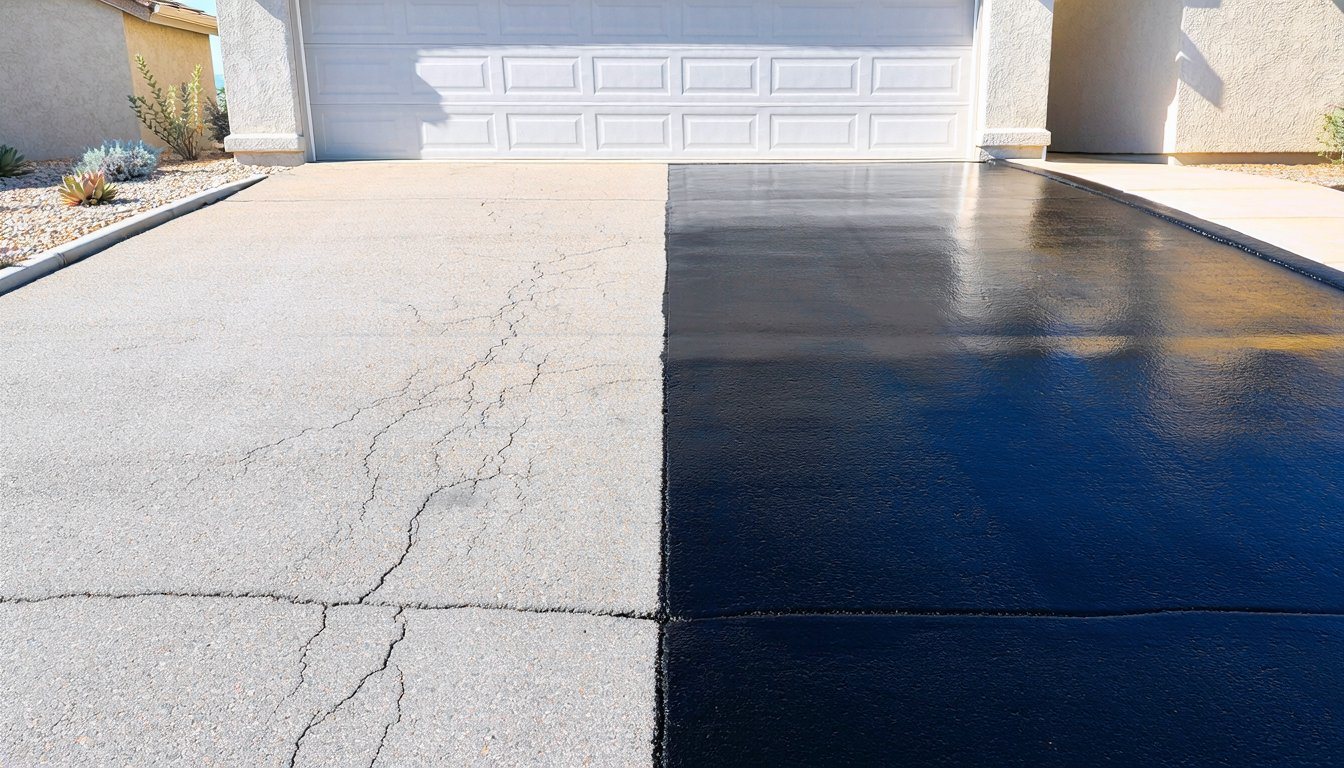
Here are two outcomes we see often. An owner pays for an overlay, and a year later the new black surface has cracks in the same places the old one did. Another owner pays for a sealcoat over pavement that's already breaking up, and it looks brand new until the first hot summer, when the same web of cracks reappears through the coating. In both cases the product was fine. It was applied to the wrong pavement.
That's the real question behind asphalt overlay vs seal coat. A seal coat protects pavement that's still sound. An overlay replaces a worn surface over a base that's still sound. Neither one fixes a base that has failed. So the choice starts with reading the pavement, not comparing the two prices.
Quick answers
- Seal coat: a thin protective coating for pavement that's sound but weathered. It adds no strength.
- Overlay: a new layer of hot asphalt over existing pavement, for a worn or widely cracked surface over a sound base.
- Neither: alligator cracking, potholes and soft spots mean the base needs repair first, whichever finish goes on top.
Surface vs structure: what each one does
A seal coat is a surface treatment. A 1992 FHWA overview of surface rehabilitation techniques describes their job as restoring pavement characteristics "such as skid resistance, ride quality, and water proofing," and is blunt about their limit: "Generally, no structural improvement is developed in the pavement through the application of these surface rehabilitation techniques." The same guidance says such treatments "should be considered for only those pavements that possess the necessary remaining strength to support the design vehicular loads."
That's the logic of pavement preservation in general. The National Park Service, writing about park roads, describes it as "applying a series of low-cost treatments every few years to a road segment, at a minimum in good condition, to halt further deterioration." Sealcoat belongs to that family: it's maintenance for pavement in good shape.
An overlay is a bigger step. Riley Asphalt, a paving contractor, describes it as "Applying a new layer of asphalt over an existing pavement to restore its smoothness, improve its appearance, and extend its lifespan." It replaces the wearing surface, but it still sits on whatever is underneath, which is why the base decides whether it succeeds. Rebuilding the base itself is a different job, covered with its pricing in our asphalt driveway cost guide. For a commercial lot, our guide to parking lot repair companies covers which license covers coatings and which covers paving.
Read the pavement first
In our experience, most driveways and small lots fall into one of three conditions, and each points to a different answer.
Sound but weathered: seal coat territory. The surface has faded from black to gray, fine stones are loosening, and any cracks are thin. This is the condition surface seals are made for. Caltrans's fog seal guidelines, citing the industry definition of a fog seal (a lighter cousin of driveway sealcoat), describe it as a light spray of dilute emulsion used to seal an existing surface "to reduce raveling and enrich dry and weathered surfaces."
Worn or widely cracked over a sound base: overlay territory. The surface is rough, cracked in many places or patched so often it's uneven, but it isn't sinking or breaking into pieces. An overlay can give it a new surface, after preparation. The Texas Department of Transportation's overlay practice is that "Failed sections of the existing pavements should be patched or replaced and existing pavement cracks should be filled."
Failed base: repair first. Alligator cracking (a pattern of small connected pieces), potholes, ruts and soft or sinking spots mean the problem is below the surface. FHWA's checklist for thin asphalt overlays states that "The pavement must be structurally sound with no fatigue (alligator) cracking or potholes." Those areas need patching or reconstruction before any finish goes on. Our parking lot repair cost guide explains how to read that damage on larger pavement.
What a dry, sunny climate changes
Much of the overlay and sealcoat advice online is written for places with hard winters, where water freezes in cracks and pries pavement apart. In our experience, sun and heat do more to Southern California pavement than freeze-thaw. Surfaces here often oxidize, turn gray and brittle, and lose fine stones before they fail structurally. That makes the sound-but-weathered condition common, and it's why a well-timed seal coat can make sense here. The flip side, in our experience, is that in hot weather softened asphalt lets heavy trucks, parked trailers and turning tires scuff or rut the surface, and those marks aren't something a coating can fix. Tree roots are a common culprit too, in our experience; a lifted, cracked strip over a root is a base problem, not a surface one.
Is an overlay worth it?
When the base is sound, an overlay is often the most direct way to get a new surface without tearing out the pavement. When the base has failed, it's usually money spent on a layer that will crack again. Whether an overlay or full replacement is the better call for your pavement gets its own guide; the short version is that it depends on how much of the base is still good.
Is sealing pointless?
No, on sound pavement. A seal coat is a cheap way to protect a surface that's still in good shape from sun and water. Yes, mostly, on pavement that's failing, because a coating can't hold together what's already broken.
What goes wrong when you pick the wrong one
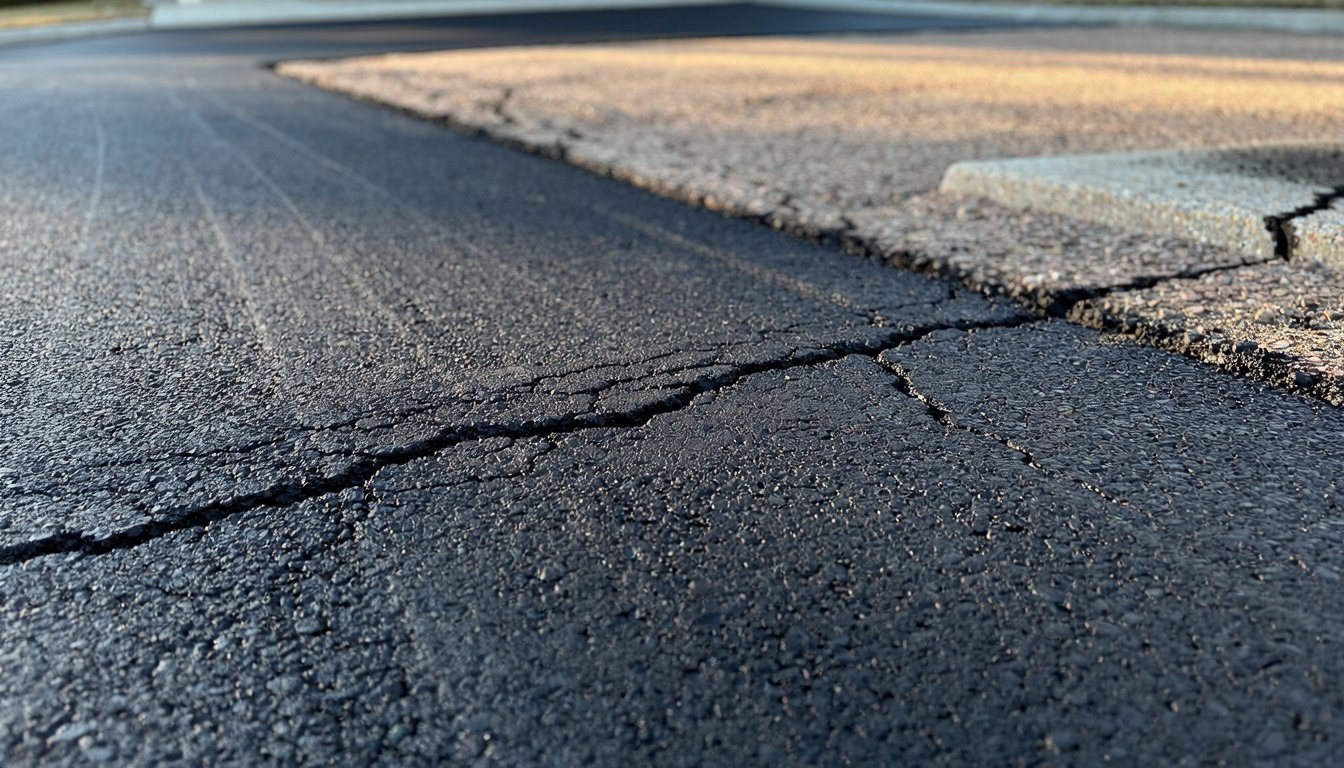
An overlay on cracked pavement. The most common failure is reflection cracking. Pavement Interactive, an engineering reference, defines it as "Cracks in a flexible overlay over an existing crack or joint. The cracks occur directly over the underlying cracks or joints." The cause is "Differential movement across the underlying crack or joint," and the result "Allows moisture infiltration, roughness". That's why the same reference says "Generally, the existing pavement should be structurally sound, level, clean and capable of bonding to the overlay." In our experience, the overlays that crack early are almost always the ones laid over cracks nobody filled and failed spots nobody dug out.
A seal coat on failing pavement. A coating goes on thin and follows the surface below. The Caltrans fog seal guidance puts it plainly: "Fog seals will not correct distresses such as cracking, base failures, excessive stone already lost, or any other severe pavement defects." Driveway sealcoats are typically heavier than a fog seal, but the principle holds. In our experience, sealcoat over alligator cracking looks good for a season, then the cracks show through and the owner has paid for appearance, not repair. Our parking lot sealcoating guide covers when sealcoat won't help on larger lots.
Where slurry seal fits
Between a seal coat and an overlay sits slurry seal, which in our experience is used on streets and parking lots more than on driveways. Pavement Interactive describes it as "A homogenous mixture of emulsified asphalt, water, well-graded fine aggregate and mineral filler that has a creamy fluid-like appearance when applied." The same reference notes it can fill existing pavement surface defects and serve as a wearing course or a preparatory treatment. In our experience, it suits pavement that's still structurally sound, so the same rule applies: it doesn't fix a failed base.
The side effects of an overlay
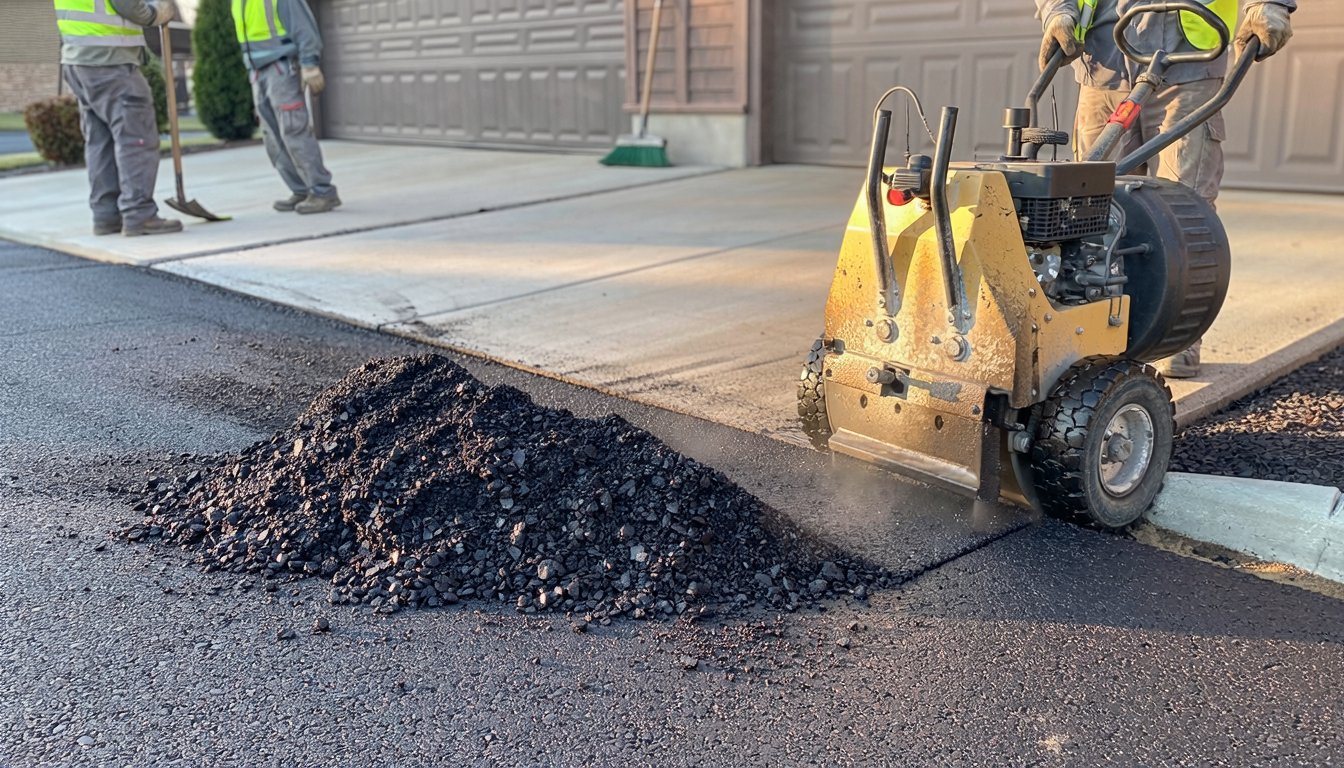
An overlay adds height. That's easy to overlook until the new surface meets something that didn't move: a garage slab, a curb, a gutter, a drain inlet, a gate or a walkway. In our experience, an overlay run straight up to a garage door can leave a lip, trap water against the slab or change how water reaches a drain.
A common fix is to remove some of the old asphalt at the edges so the new layer ties in flush. Pavement Interactive notes that "Milling (also called grinding or cold planing) can be used to smooth an existing HMA pavement prior to HMA or PCC overlays". On a driveway, that edge work is where good and poor overlay bids often differ. An overlay generally follows the existing grade, so it usually won't correct drainage; if water pools today, it will likely pool on the new surface too. Corrective grading can be part of the scope, so ask.
Doing both, in the right order
The two aren't rivals over a pavement's life. A common sequence is to repair the base where it has failed, overlay the worn surface, and then protect the new surface with sealcoat once it has cured. New asphalt shouldn't be sealed right away; one supplier explains that "Fresh asphalt is softer and more flexible due to the oils that need to evaporate." How long to wait is covered in the FAQ below.
Comparing the two quotes
If you have one quote for sealcoat and one for an overlay on the same pavement, these questions show which one addresses your actual condition:
- What condition did each contractor see? Ask each to name the problem they're solving: weathering, surface wear, or base failure.
- What happens to the failed areas? Neither quote should cover alligator cracking or potholes without saying how they'll be repaired first.
- What crack preparation is included? Filling, routing or patching, and where.
- For the overlay: how are edges handled? Milling at the garage, curbs, drains and walkways, and what the finished height will be.
- For the seal coat: what product and how many coats? And what prep happens first.
- What won't this fix? A good contractor will tell you plainly.
- How long is the surface closed? Both jobs need time before cars go back on, so plan around the schedule each contractor gives you.
The bottom line
Seal coat and overlay solve different problems, and both fail when the base underneath has failed. Read the pavement, repair what's broken, then choose the finish that fits what's left. Medici Construction Group is one licensed option for asphalt overlay and paving work, holding California A, B and C-10 licenses under CSLB #1114433.
Frequently asked questions
Is an asphalt overlay worth it?
It can be, when the base underneath is still sound and the surface is worn, rough or widely cracked. Over a failed base, with alligator cracking, potholes or soft spots, an overlay tends to crack again in the same pattern. Whether it's worth it depends on what's under the surface, not the new layer.
Can you sealcoat instead of overlaying?
Only if the pavement is still sound. Sealcoat protects and refreshes a surface that's faded or lightly weathered, but it adds no strength and doesn't bridge wide cracks or broken areas. If the pavement needs an overlay, a sealcoat mostly changes how it looks for a while.
Can you overlay over cracked asphalt?
Yes, if the cracks are prepared first and the base is sound. Texas DOT practice, for example, is to fill existing cracks and patch or replace failed sections before an overlay. Cracks left untreated tend to show through the new layer, a problem called reflection cracking.
How long does an asphalt overlay last?
It depends mostly on what's underneath: the condition of the base, how well cracks and failed areas were repaired first, drainage, and traffic. The same overlay can perform very differently over a sound base and a failing one, which is why preparation matters more than the new layer.
Is sealing your driveway pointless?
Not on sound pavement, where a sealcoat protects the surface from sun and water and keeps it looking fresh. On pavement that's already failing structurally, it is mostly cosmetic, because a sealer can't correct cracking or base failure. The condition of the driveway decides which case you're in.
How soon can you sealcoat a new overlay?
New asphalt needs time to cure first. One sealcoat supplier recommends waiting at least 90 days and, if possible, nine to twelve months, because fresh asphalt is still releasing oils. Ask your contractor which guideline they follow for your climate.
Does an overlay fix drainage problems?
Usually not. An overlay generally follows the existing grade, so water that pools or runs the wrong way will usually keep doing so on the new surface. Drainage has to be corrected in the base or the grading first; our yard drainage guide covers the options.