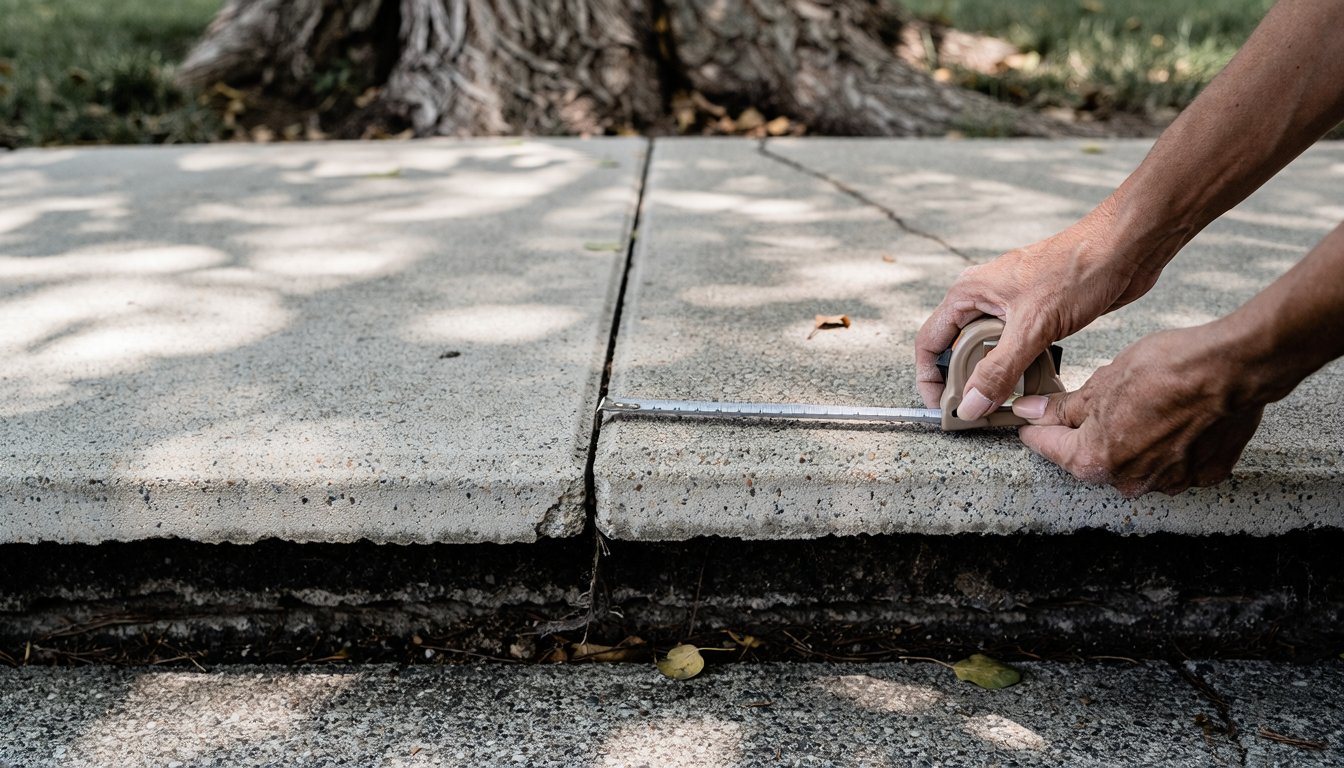
A homeowner kneels on the sidewalk under the street tree out front with a tape measure. There's a crack running across the panel, but that's not what caught their eye. One side of the crack sits noticeably higher than the other, enough that the mail carrier stubbed a toe on it last week. That raised edge, the lip, is what decides the repair. A wide crack with both sides level may need nothing structural at all. A thin crack with a raised edge can be a trip hazard that needs grinding, lifting or a new panel. And if a tree root did the lifting, the tree limits your options. This guide explains why sidewalks crack and lift, how to measure the lip, and how to match the repair to what you find.
Quick answers
- Measure the lip, not the crack: the height difference between slabs is what makes a sidewalk a trip hazard.
- A common benchmark: the ADA standards for accessible routes allow up to 1/4 inch vertical and require a bevel between 1/4 and 1/2 inch; local sidewalk rules vary.
- Match the fix: small offsets can be ground down, sunken slabs can often be lifted, and heaved or broken panels usually need replacing.
- Trees change the plan: cutting roots can destabilize a tree, so many cities limit root pruning and may reroute the sidewalk instead.
Why sidewalks crack and lift
Concrete cracks as it dries and shrinks. An article by Caltrans engineers on controlling shrinkage cracking, published in the American Concrete Institute's Concrete International magazine, notes that "a major source of cracking is concrete shrinkage." That's why sidewalks have joints: they give the concrete a planned place to crack.
Lifting is a different problem. Roots are the usual culprit near street trees. The City of Portland's urban forestry program puts it bluntly in an article on trees and sidewalks: "Tree trunks and roots growing in these conditions inevitably cause damage to concrete sidewalks." In our experience, soil that shrinks and swells with moisture, poorly compacted base under the slab, and cars or trucks parking on the sidewalk also crack and tilt panels.
Step one: measure the lip
A crack on its own, with both sides level, is mostly a cosmetic issue. The number that matters is the vertical offset: how much higher one edge sits than the other.
For accessible routes, the federal ADA standards give a widely used benchmark. The U.S. Access Board's ADA Standards, chapter 3, say: "Changes in level of ¼ inch (6.4 mm) high maximum shall be permitted to be vertical." And: "Changes in level between ¼ inch (6.4 mm) high minimum and ½ inch (13 mm) high maximum shall be beveled with a slope not steeper than 1:2." These rules govern accessible routes, so a lip on any given residential panel isn't automatically a legal violation, but they're a useful yardstick for how serious an offset is.
Cities set their own sidewalk thresholds, and they differ. Portland's sidewalk repair manual uses "A guideline of ½-inch vertical separation for all sidewalk and driveway areas" to decide whether a raised edge is hazardous. Denver's sidewalk guide uses three-quarters of an inch. Check your own city's standard.
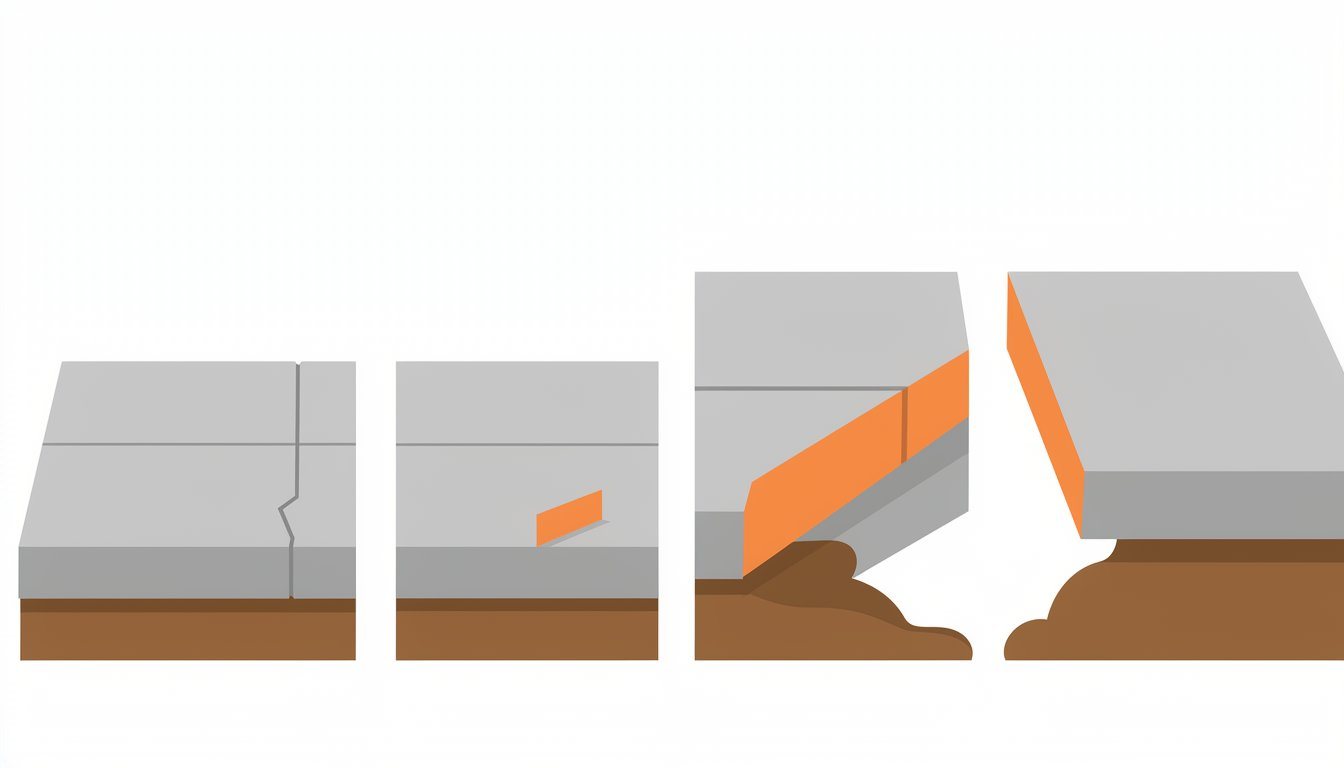
Matching the fix to the problem
| What you find | Typical repair | Notes |
|---|---|---|
| A crack with both sides level | Often monitor, or seal to keep water out | In our experience, not a structural repair on its own |
| A small lip | Bevel or grind the high edge | Portland's manual limits grinding to 1 inch of rise |
| A slab that has sunk | Lift the low slab back to level | Mudjacking or polyurethane foam |
| A slab heaved by roots, or broken into pieces | Remove and replace the panel | Tree work may be needed first |
Grinding down a raised edge
Grinding shaves the high side of a joint down to meet the low side. It works for modest offsets. Portland's manual says "Concrete grinding is one method used to remove 'stub toes' that are 1 inch high or less" and "Grinding repairs shall not exceed 1 inch vertically." Beyond that, grinding would thin the slab too much, and lifting or replacement makes more sense.
Lifting a sunken slab
When one slab has sunk rather than the other rising, it can often be raised back to level. The University of Florida's extension service describes slabjacking: it "consists of pumping a new base material (grout) under the sunken concrete, raising and supporting it." Denver's guide describes the foam version, where "polyurethane foam is injected through holes drilled in the sidewalk panel to raise sinking or settling slabs." Lifting only helps if the slab is still in one piece and the cause of the sinking has been addressed.
Grout or foam: choosing a lift method
Both methods fill the void under a sunken slab, but they behave differently. Grout lifting uses a cement-based slurry. The University of Florida's extension describes the process: "One or two holes 1.5 to 2 inches diameter are drilled in the slab to be raised and grout injected at 600psi." Foam uses smaller holes and a lighter material that expands in place. In our experience, the practical differences are these:
- Weight. Grout adds weight to soil that may already be soft. Foam adds very little, which can matter where the ground settled in the first place.
- Holes. Foam holes are smaller and easier to hide after patching. Grout holes are larger and more visible on a decorative or colored slab.
- Control. Both are injected in stages while the crew watches the slab rise. Foam tends to reach final height quickly; grout can need more passes.
- Use right away. The extension notes that with slabjacking, "Pedestrians can walk on the raised slab immediately." Foam is typically walkable soon after too, so either beats waiting for a new pour to cure.
Lifting has limits. The same source cautions that "More than one section of sidewalk may need to be raised to provide a gentle slope." And a slab that is cracked through into loose pieces will lift unevenly, which points back to replacement.
Replacing the panel
Panels that are broken into pieces, badly tilted or heaved by roots usually need to be removed and poured again. Where roots are involved, the repair can grow: Portland's manual notes that "it may be necessary to replace additional concrete, depending on the size and location of tree roots that are not allowed to be removed."
Repair or replace: how to decide
One of the most common questions is whether it is better to fix a slab or tear it out. In our experience, three facts decide it. First, is the slab still in one piece? A single panel with one crack and a small lip can be ground or lifted; a panel broken into several pieces cannot be held together by either method. Second, what moved it? A slab that sank because the soil washed out or compacted is a good lift candidate. A slab pushed up by a root will be pushed up again unless the root is dealt with, so grinding or lifting only buys time. Third, how many panels are involved? One bad joint is a small repair. A run of tilted panels along a tree line is usually a replacement job, often paired with a new layout around the tree.
Patching a crack with a surface compound can make it look better, but it does not change the lip. If the lip is what makes the sidewalk a trip hazard, a patch alone does not fix the problem.
When a tree is the cause
It's tempting to cut the offending root and pour new concrete. That can go badly. The University of Florida's extension warns about roots lifting sidewalks: "Cutting these roots has resulted in toppled trees and severe damage to people and property."
Cities that own street trees set rules for this. The City of Los Angeles' street tree policy for its sidewalk repair program says "Root pruning may be limited to the sidewalk-adjacent side of the planting area where the street tree is planted" and that "All street tree root pruning shall adhere to City root-pruning standards that comply with the International Society of Arboriculture (ISA) Tree Pruning Guidelines." It also notes that "In some locations, it may be possible to meander the sidewalk repair project around an existing street tree to allow additional room for root growth." If a street tree is involved, talk to your city's urban forestry office or a certified arborist before any roots are cut.
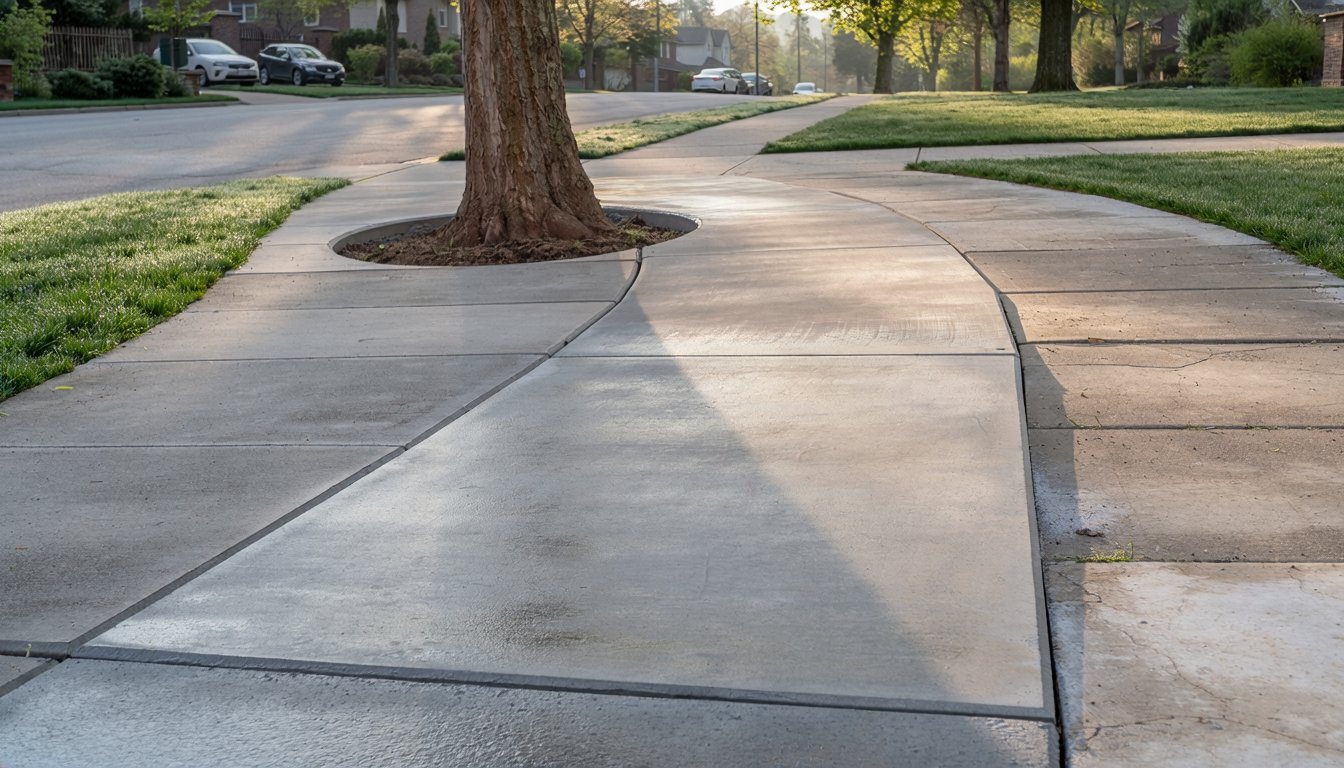
Designing the new section around the tree
When a panel is replaced next to a large tree, pouring the same slab in the same place often leads to the same lift. Portland's urban forestry program describes alternatives in which "the sidewalk is re-routed around an existing large tree, giving the tree roots more space to grow." It also notes that "Pavers and bricks are more flexible than concrete, allowing roots to grow underneath without cracking the surface." On a public sidewalk, the city decides which of these are allowed. On a private walkway, in our experience, a gentle curve around the trunk or a short run of pavers over the root zone often outlasts a straight concrete slab.
Permits and the public sidewalk
Most sidewalks in front of homes sit in the public right-of-way, which means work on them usually needs a city permit. In Los Angeles, the Bureau of Engineering's A-permit page states: "Los Angeles Municipal Code (LAMC), Section 62.105, requires a permit be obtained for construction in the public right-of-way." Who is responsible for repairing a given sidewalk varies by city, so check yours before starting. If the curb and gutter need replacing too, our curb and gutter cost guide explains per-foot pricing.
Los Angeles also runs a citywide Sidewalk Repair Program. Its Access Request Program "makes repairs requested by/for people with a mobility disability who encounter physical barriers such as broken sidewalks, missing/broken curb ramps or other barriers in the public right of way."
Before you call someone
- Measure the lip at its highest point and photograph it next to the tape.
- Note whether the slab rose or sank, and whether a tree is nearby.
- Check your city's sidewalk standard and permit requirements.
- If a street tree is involved, contact the city's urban forestry office or an arborist first.
Medici Construction Group is one licensed option for concrete and site work, holding California A, B and C-10 licenses under CSLB #1114433.
Frequently asked questions
How do you fix a cracked sidewalk?
It depends on the lip. A level crack may only need monitoring or sealing. A small raised edge can be ground down, a sunken slab can often be lifted, and a heaved or broken panel usually needs replacing.
When is a sidewalk crack a trip hazard?
When one side sits higher than the other. The ADA standards for accessible routes allow up to 1/4 inch vertical and require a bevel from 1/4 to 1/2 inch; cities set their own thresholds, such as Portland's 1/2 inch guideline and Denver's 3/4 inch.
Can you grind down an uneven sidewalk?
Yes, for modest offsets. Portland's sidewalk repair manual, for example, uses grinding for raised edges of 1 inch or less and says grinding repairs shall not exceed 1 inch vertically.
Can a sunken sidewalk slab be raised?
Often, if it's still in one piece. Slabjacking pumps grout under the slab to raise it, and a foam version injects polyurethane through drilled holes.
Can you cut tree roots to fix a sidewalk?
Sometimes, but carefully. The University of Florida extension warns that cutting these roots has toppled trees, and cities like Los Angeles limit root pruning and may reroute the sidewalk around the tree instead.
Do I need a permit to repair a sidewalk?
Usually, because most sidewalks are in the public right-of-way. In Los Angeles, LAMC Section 62.105 requires a permit for construction in the public right-of-way.
Is a cracked sidewalk a sign of foundation problems?
Not on its own. A sidewalk is a separate slab from your house's foundation. If you're seeing cracks and sticking doors inside the house, our house foundation settling guide explains what to check.