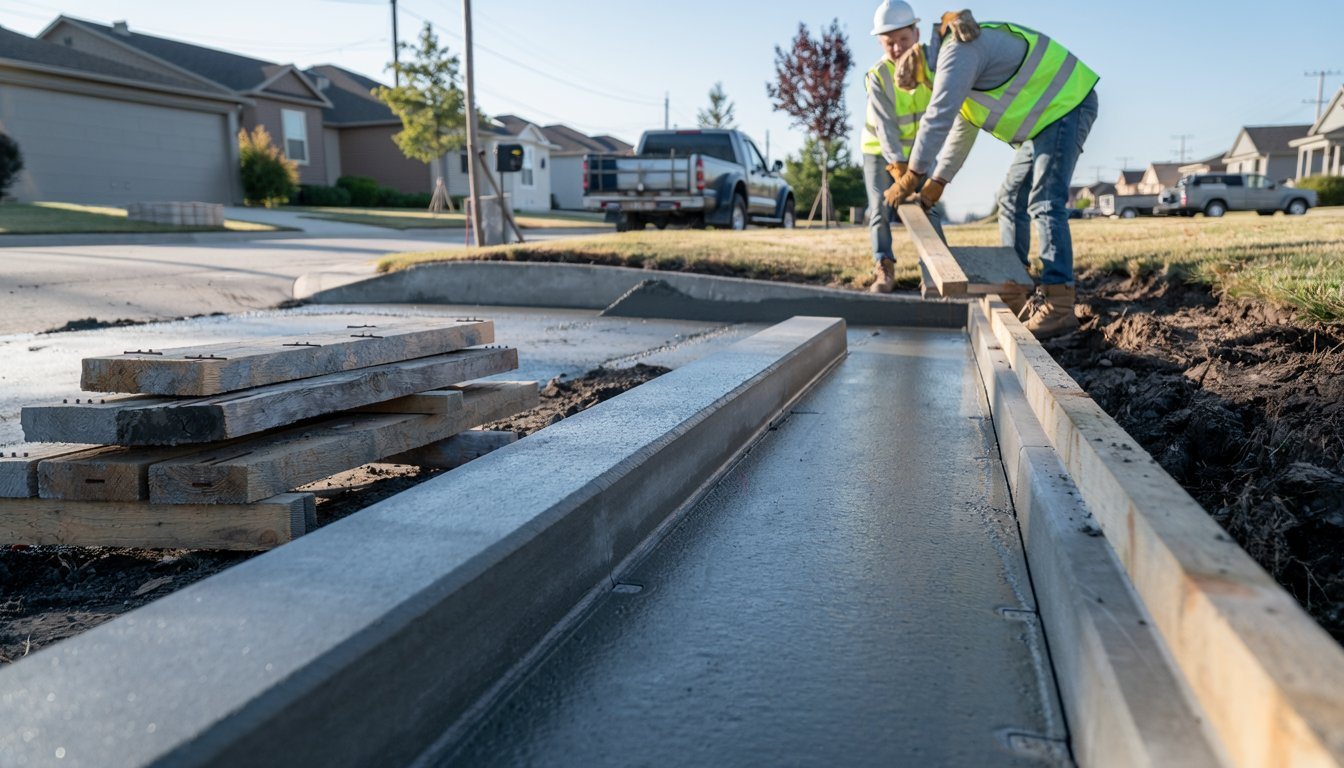
Put two curb and gutter prices side by side and they can look impossible. A city contract for thousands of feet of new curb comes in under $30 a foot. A homeowner's quote to replace 40 feet out front works out to several times that. Both can be fair. The city's price is spread across a long, open run with the crew and machines already on site; the homeowner's has to cover a crew, forms, removal and a street patch for a few dozen feet. (This guide is about street curb and gutter, the concrete edge and drainage channel along the road, not the rain gutters on your roof.)
Quick answers
- Consumer estimate: Homewyse puts installed curb and gutter at $64.84 to $79.59 per linear foot, before removal, excavation, markup and permits.
- Public bids run lower: contractor unit prices inside large city contracts can fall under $30 a foot, because the cost is spread across thousands of feet.
- The extras add up: removing the old curb, sawcutting, patching the street and permits are usually priced on top of the new curb.
- Check your city: work in the public street needs a permit, and some cities split the cost of curb replacement with owners.
What curb and gutter costs per foot
The numbers you'll find depend on who is pricing the work and what's included. Materials alone are a small slice: one concrete cost guide notes that "Concrete curb and gutter often costs $5 to $15 per linear foot for materials." The rest of an installed price is labor, forms, equipment and finishing.
For an installed consumer estimate, Homewyse's curb and gutter calculator puts the cost at $64.84 to $79.59 per linear foot as of September 2026. That covers materials, layout, forming, pouring and finishing. It leaves out excavation, demolition, contractor markup and permits.
Public bid documents show what contractors charge cities, and they come in lower. Keep in mind that these are unit prices inside large public contracts, not what a homeowner would be quoted for a small job:
| Source | Quantity | Price per linear foot | What it is |
|---|---|---|---|
| Homewyse (Sept 2026) | Not stated | $64.84 to $79.59 | Consumer installed estimate; excludes demo, excavation, markup, permits |
| Long Beach street project bid | 9,200 LF | $26.50 (low bid); others $33.50 and $55.00 | Contractor unit price in a large public contract |
| Long Beach, same project | 1,200 LF | $47.25 (low bid) | Smaller quantity of a wider gutter |
| Riverside engineer's estimate | 850 LF | $40.00 | City's pre-bid estimate for a public project |
| Riverside engineer's estimate | 250 LF | $48.00 | Same standard, smaller project |
The Long Beach figures come from the city's Studebaker corridor bid results, and the Riverside figures from a city engineer's estimate covering two street projects.
Why short runs cost more per foot
A crew, a truck, forms and a concrete delivery cost roughly the same to bring to a job whether they build 30 feet or 300. In our experience, on a short residential replacement that setup cost can be a large share of the bill, which is why small jobs often carry a minimum charge.
The forming method matters too. On long runs, contractors can use a slipform machine that extrudes the curb continuously. A trade article from Equipment & Contracting explains that "Slipform machines pour curb, gutter, and lane pavement at a pace fixed forms cannot match on a long, open run," but for short or interrupted work, "setting a few hundred feet of forms can beat mobilizing, stringlining, and demobilizing a slipformer for a handful of panels." A homeowner's 40 feet is typically hand-formed, not slipformed.
The bid data points the same way. Riverside's estimate prices the same curb standard at $40 a foot for 850 feet and $48 a foot for 250 feet. Long Beach's smaller item came in at $47.25 against $26.50 for the 9,200-foot item, though that smaller item was also a wider gutter, so it isn't a pure size comparison. Even on one project, bids for the same item ranged from $26.50 to $55.00 a foot, which is a reminder to get more than one price.
The work around the curb
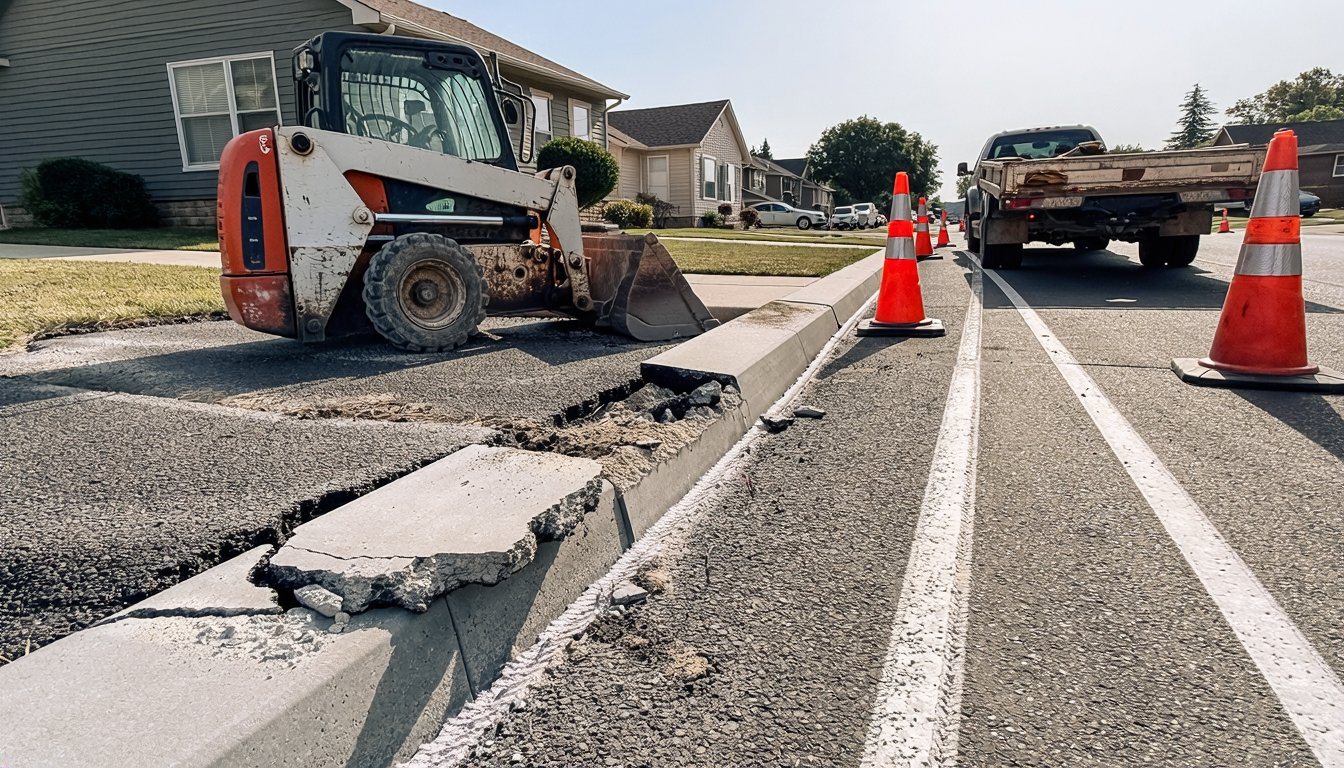
Replacing a curb isn't just pouring new concrete. The old curb has to come out, the street edge usually gets sawcut so the new gutter meets clean asphalt, and the strip of street disturbed during the work has to be patched. The concrete cost guide cited above flags subbase and drainage work, traffic control, sawcutting, hand forms versus slipform equipment, driveway crossings, and cure protection and cleanup as factors that push installed cost beyond materials.
Those are exactly the items a consumer per-foot range tends to leave out, as the Homewyse exclusions show. In our experience, on a short replacement the removal and street patch can rival the cost of the new curb itself. The curb's profile matters too: different curb types use different amounts of concrete and forming, and bid documents like Riverside's and Long Beach's show that cities specify the exact curb standard a contractor must build to.
Permits and who pays
Curb and gutter usually sit in the public right-of-way, so the city controls the work. San Mateo, for example, requires an encroachment permit for the "installation or repair of sidewalk, curb and/or gutter, or driveway approach." In the City of Los Angeles, curb work is generally permitted through the Bureau of Engineering; our asphalt driveway cost guide covers that permit and its fee.
Who pays for a damaged curb depends on the city. Some cities share the cost. Oakley runs a 50/50 program for curb, gutter and sidewalk replacement, "splitting the cost with the property owner 50%-50%, thereby saving the property owners half the cost of the repairs." Before you hire anyone, ask your public works department whether your city has a program like it. If the sidewalk next to the curb is also lifted, our cracked sidewalk repair guide explains what to check.
Why a 40-foot job can mean 50 feet of concrete
Curb and gutter is poured in panels separated by joints, and cities generally won't let a crew cut out a piece in the middle of a panel. Santa Barbara's construction standards, for example, say to "Remove and replace concrete curbs and gutters to the nearest score line outside the excavation area" and show contraction joints at approximately 10 foot intervals. Palo Alto's standards likewise call for existing concrete to be "saw-cut to full depth at concrete conforms and from cold joint to cold joint unless specified otherwise by the Engineer". Los Angeles-area cities each publish their own standards, so ask yours, but the pattern is common.
The practical effect is that the replacement length rounds up to whole panels. As an illustration, if the damage runs 34 feet and the joints fall every 10 feet, the crew removes and pours four panels, or 40 feet, and you pay for 40. If the break starts mid-panel at both ends, it can be 50. That extra concrete is billed at the same per-foot rate, which is one more reason a short job's total drifts above what a simple footage count suggests.
Palo Alto's standards add two details that show up as labor on a small job: dowels installed between new and existing concrete, and a cure of at least 72 hours with the surface kept damp or sprayed with a curing compound. In our experience, that cure period is when cones and barricades stay up and the street edge stays unusable, so it affects scheduling and traffic control, not just the concrete.
What public bids price as separate lines
The public bid documents above also show how cities separate costs. Riverside's engineer's estimate lists "Mobilization (P)" at $40,000 and "Traffic Control and Access" at $30,000, each as a single lump sum, and those amounts sit outside the $40 and $48 curb and gutter unit prices. Removal is likewise its own bid item: the Long Beach bid tab prices concrete removal by the cubic yard on a separate line from the curb it replaces.
That is the same structure a homeowner's quote should have. A contractor bidding a public project shows mobilization, traffic control, removal and new concrete as separate lines, so a per-foot curb price on its own is only one part of the total. When a residential quote gives a single per-foot number, ask what it includes before comparing it with any figure in this guide.
Permit paperwork for work outside the City of Los Angeles
Much of the Los Angeles area is unincorporated county land, and there the process differs from the City's. LA County Public Works issues a road permit for driveway approach, sidewalk, curb and gutter work. Owners or authorized applicants apply through EPIC-LA, and a "Letter of Authorization" is required when the property owner is not the applicant. The county page also says that an invoice may be generated during review and "must be paid before any further work will be performed," and that "Contractor license number and insurance required" while preparing the application. The page does not list fee amounts or timelines, so confirm both with the county before you set a start date.
City of Los Angeles lots go through the Bureau of Engineering instead, as covered above. Which agency has jurisdiction depends on the parcel's address and status, so check that before you sign a contract that assumes one permit or the other.
Worked example: a 40-foot residential replacement
Say 40 feet of curb and gutter in front of a house needs replacing. At Homewyse's installed range of $64.84 to $79.59 per foot, the new curb and gutter alone comes to about $2,590 to $3,180.
That figure does not include removing the old curb, sawcutting and patching the street, the permit, any traffic control, or a minimum charge for a small job. Get each of those priced separately, and ask the contractor to show them as their own lines so you can see what the full job costs.
Panel rounding can move the footage too. If the old curb's joints mean the crew has to replace 50 feet to remove your 40, the same Homewyse range gives about $3,240 to $3,980 for the new concrete alone. Ask the contractor where the joints are and how many feet they will actually pour, and confirm that the price is for poured feet, not measured damage.
How to compare curb and gutter quotes
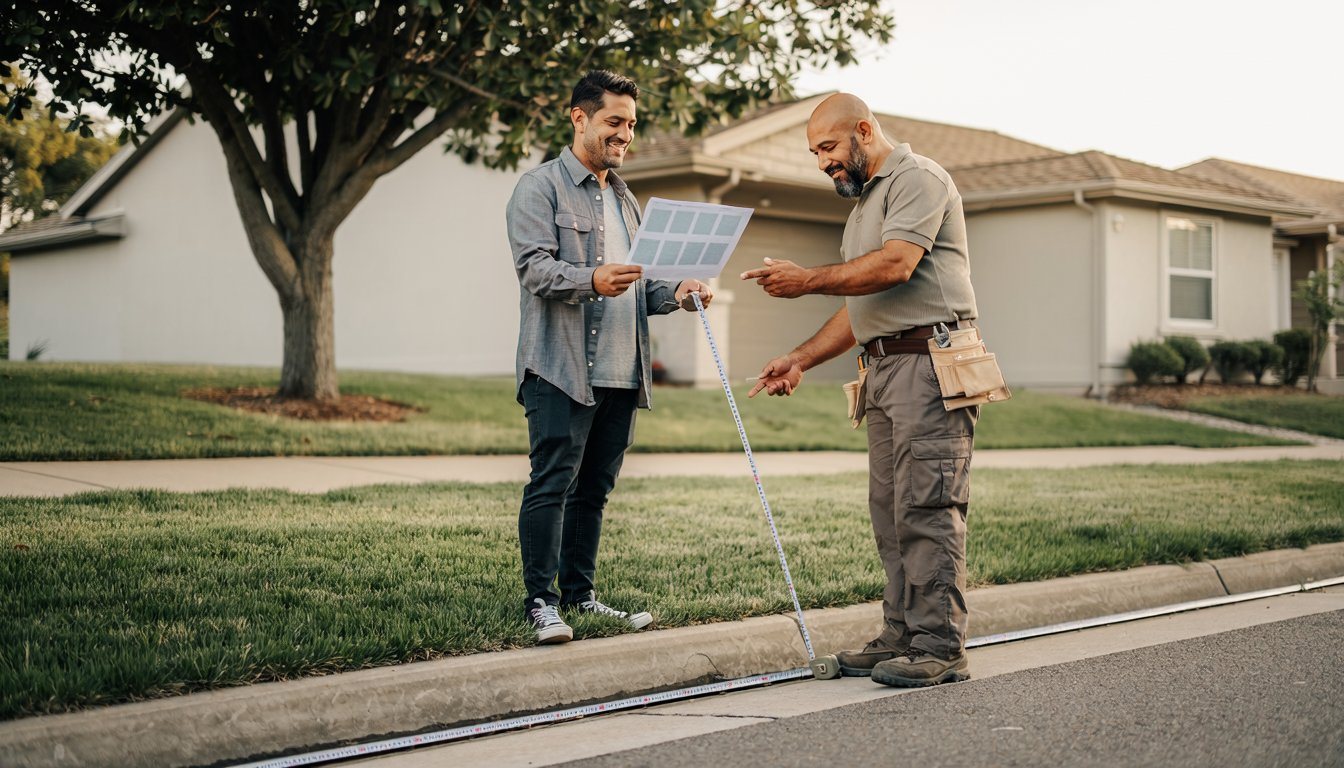
- Same length: confirm every bid measures the same number of linear feet.
- Removal included? Check whether demolition and haul-off of the old curb are in the price.
- Street patch: ask how wide the asphalt patch will be and whether it's included.
- Driveway tie-ins: if a driveway approach meets the curb, ask how that transition is handled and priced.
- Permit and inspection: find out who pulls the permit and whether its fee is in the bid.
- City standard: make sure the bid matches the curb standard your city requires.
Medici Construction Group is one licensed option for curb and gutter work, holding California A, B and C-10 licenses under CSLB #1114433.
Frequently asked questions
How much does curb and gutter cost per linear foot?
Homewyse estimates $64.84 to $79.59 per linear foot installed as of September 2026, not counting removal, excavation, markup or permits. Contractor unit prices in large public contracts can be much lower, such as $26.50 a foot on a 9,200-foot Long Beach project.
How much does it cost to replace a curb in front of my house?
For 40 feet, the new curb and gutter alone would be about $2,590 to $3,180 at Homewyse's range. Removal, sawcutting, the street patch, the permit and any minimum charge are added on top.
Why is my curb quote higher than online prices?
Online per-foot ranges usually leave out demolition, street patching and permits, and public bid prices reflect thousands of feet of work where setup costs are spread thin. A short residential job carries the same crew, forms and delivery for far fewer feet.
Who pays to replace the curb in front of my house?
It depends on your city. Some place it on the property owner, and some share the cost; Oakley, for example, splits curb, gutter and sidewalk replacement 50/50 with owners.
Do I need a permit to replace a curb?
Almost always, because curbs sit in the public right-of-way. San Mateo, for example, requires an encroachment permit for curb and gutter installation or repair.
Is slipform curb cheaper than hand-formed?
On long, open runs, usually yes, because slipform machines pour much faster. For short or interrupted work, setting forms by hand can cost less than bringing in and setting up a slipform machine.
Can a contractor replace just the broken part of the curb?
Often not exactly. Some city standards require replacement to the nearest joint or score line, such as Santa Barbara's, so the length you pay for can be longer than the visible damage. Ask your city or contractor where the joints fall.
Do I need a permit to replace a curb in unincorporated Los Angeles County?
Yes, LA County Public Works issues a road permit for driveway approach, sidewalk, curb and gutter work. Applicants apply through EPIC-LA, and the county page says contractor license number and insurance are required.