Most sewer cost guides assume your pipe ends at the curb. In Los Angeles it usually doesn't. LA Sanitation says property owners are responsible for the maintenance and repair of their "entire lateral", which covers both the upper portion on your lot and the lower portion. LA Sanitation describes the lower portion as running from your property line to the middle of the street, where it meets the city main. So the part of the job national averages rarely price, cutting and restoring a city street, is often yours to pay for.
That is why a Los Angeles quote can look nothing like the $3,319 national average Angi reports for 2026. The pipe itself is rarely the expensive part. The permits, the bonded contractor requirement and the street restoration are what move the number.
The short answer: what sewer line replacement costs
National guides agree on the per-foot range and disagree on the typical total, mostly because they assume different lengths and conditions:
| Source (date) | Typical total | Per linear foot |
|---|---|---|
| Angi (Aug 2026) | $3,319 average; $225 to $10,000 | $50 to $250 (average $150) |
| This Old House (Mar 2026) | $3,320 average; most pay $1,390 to $5,320 | $50 to $200 excavation; $60 to $250 trenchless |
| Forbes Home (updated Feb 2025) | About $4,000 average; $650 to $7,500 for a 30-foot replacement | $55 to $250 |
| HomeGuide (2026) | $6,000 average; $2,000 to $10,000 for 40 feet | $50 to $250 |
Treat these as a floor for a Los Angeles job that crosses into the street. Forbes Home notes that a full line to the street can run up to $10,000 for 30 feet and up to $20,000 depending on conditions. Those conditions (depth, pavement type, traffic, permits) are exactly what varies most in LA.
Signs your sewer line needs work
The warning signs are consistent across the major guides:
- Several fixtures back up or drain slowly at once, especially toilets and lower-level drains. This Old House says that pattern may indicate a blockage or break in the main line.
- Water shows up in the tub or shower when you flush, which Angi says likely points to a sewer line issue.
- Gurgling drains or a sulfur (rotten egg) smell, both on Angi's list of sewer line warning signs.
None of these tells you whether you need a spot repair or a whole new line. Only a camera inspection does that, which is why a CCTV video should come before any quote you take seriously.
In Los Angeles, you pay for the lateral all the way to the main
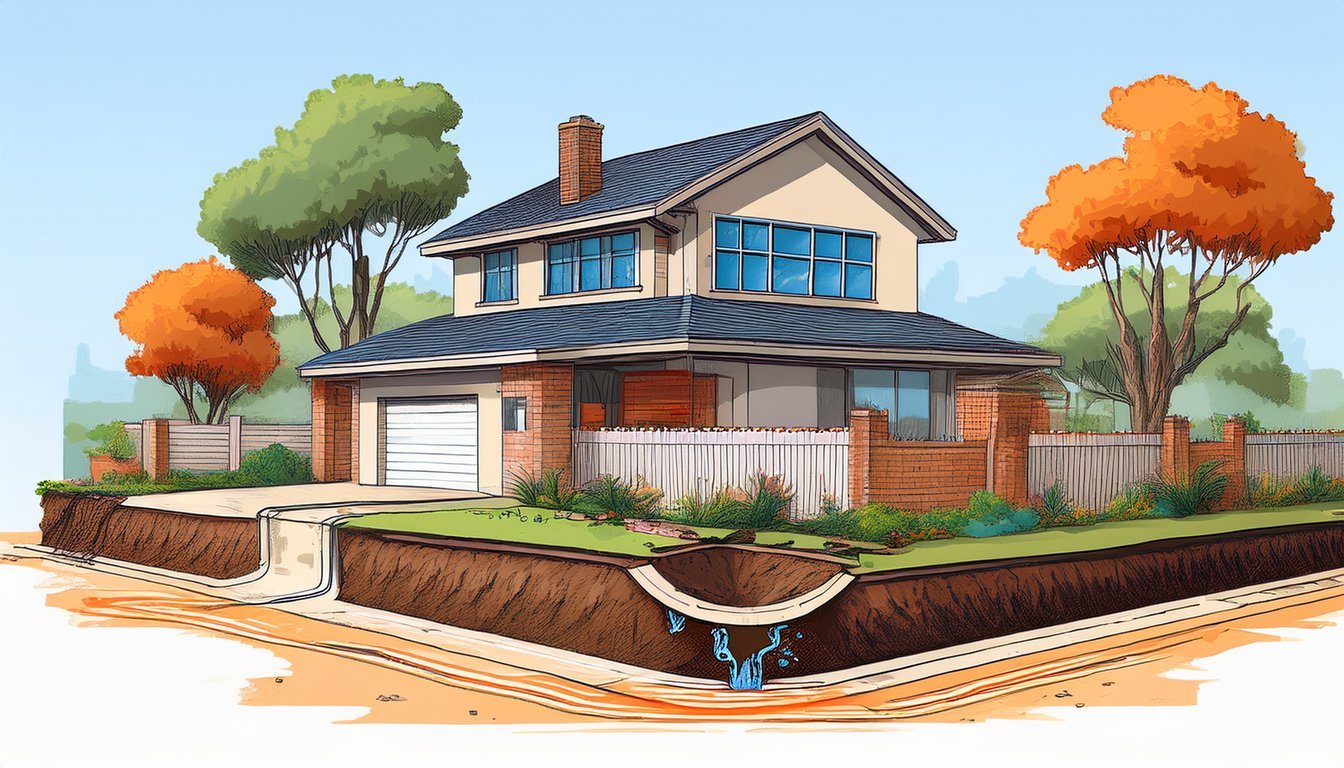
A house sewer lateral has two parts. The upper lateral runs from your building to the property line. The lower lateral runs from the property line to the middle of the street, where it connects to the public main. LA Sanitation assigns both to the owner, so a failure out past your front walk is still your repair. Other cities draw this line differently; our guide to who is responsible for sewer line repair compares the common models, plus condos and rentals. Homes still on septic go through a similar permit path to connect for the first time; our guide on switching from septic to sewer covers it.
This is the biggest reason LA quotes surprise people. In our experience, a crack under your lawn is a yard job. A break in the lower lateral can mean excavating a public street, and that brings in the Bureau of Engineering S-Permit and the city's street restoration rules. If your property is in unincorporated LA County rather than the City of Los Angeles, the rule is similar: County code requires house laterals to be maintained by the owner of the property served.
The line items in a real LA sewer quote
A complete Los Angeles bid should show most of these as separate lines. If one is missing, ask whether it is included or excluded.
1. CCTV inspection
In our experience, a camera run shows the pipe material, the break locations, roots, sags and the distance to the main, which sets the footage and the method. LASAN's repair rebate lists the CCTV video and inspection report among its required documents (more below).
2. Permits for work on your lot
Drainage work on private property goes through LADBS. The LADBS plumbing permits page lists drainage systems among the work it reviews. Your contractor should say who pulls the permit and whether its fee is in the price.
3. The S-Permit and a bonded sewer contractor for work in the street
Work on the lateral in the public right-of-way falls under a Bureau of Engineering S-Permit. Under LAMC 64.12, an S-Permit lets owners "make, construct, alter, or repair any house connection sewer," and the same page defines a house connection sewer to include "any sewer pipe line, or portion thereof, constructed in a street, alley, walk or other public place." The same page states that when a new lateral must be built from the main to the property line because no existing lateral is available, "Only a Bonded Sewer Contractor can apply for this permit and perform the work." Where an existing lateral is available, the page describes a separate property line connection S-Permit that does not require bonded sewer contractor status. Before you compare prices, confirm that whoever bids the street half is allowed to do it. Ask for the contractor's bonded sewer contractor status in writing. The Bureau of Engineering publishes a guide to becoming a bonded sewer contractor that shows what the status requires.
4. Street excavation permits and restoration
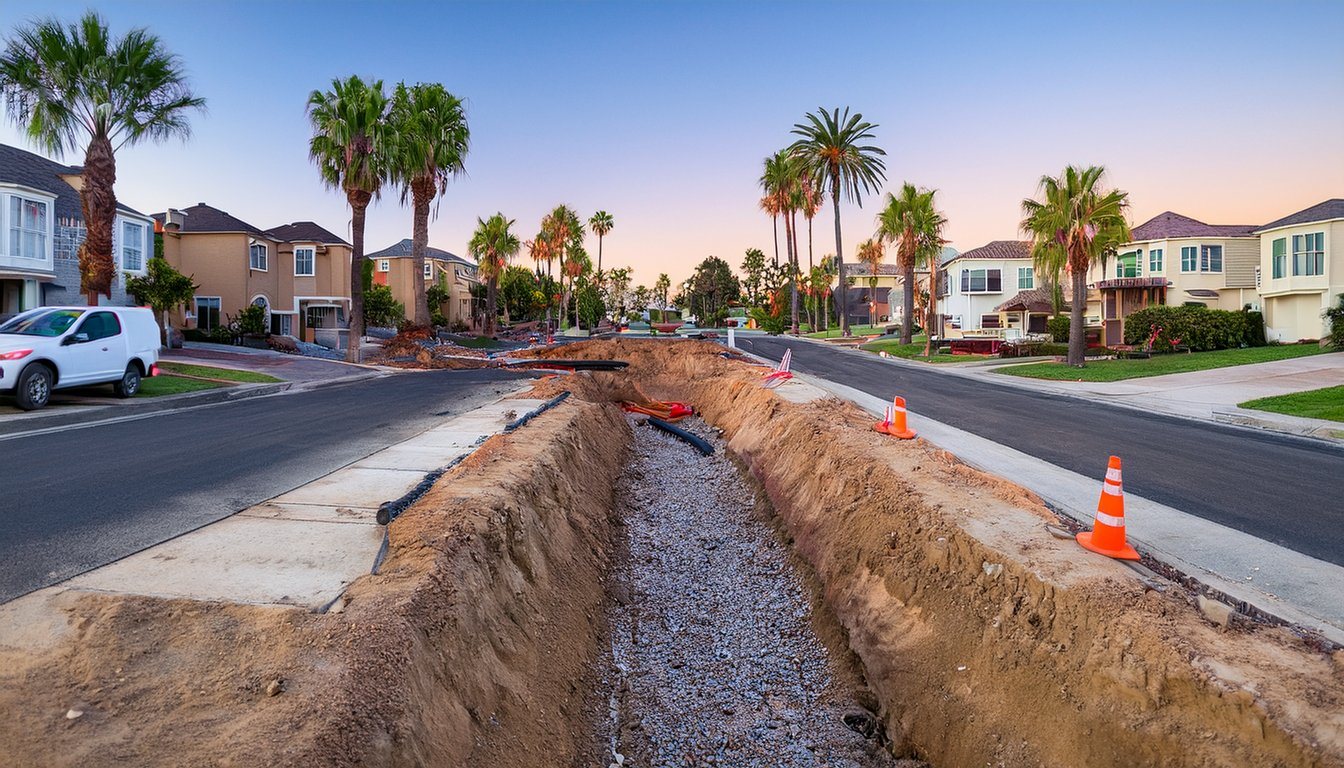
Cutting a public street also brings the Bureau of Engineering's excavation permit rules into play. Restoration is where LA rules can change the budget sharply:
- Recently paved streets. The Bureau of Engineering describes a One-Year Street Moratorium tied to the Street Damage Restoration Fee: in lieu of paying the fee, the permittee must repave the entire street block "from curb face to curb face".
- Concrete streets. The same Bureau of Engineering FAQ says full slab replacement is required for any excavation on a concrete street, instead of paying the fee.
Ask every bidder whether your street is inside the moratorium window and whether it is asphalt or concrete. The answer can change the price more than the pipe choice.
5. Excavation, shoring and traffic control
Trenching labor alone runs about $4 to $12 per linear foot nationally, before pipe and restoration. Deeper cuts, shoring and lane closures add to that when the job needs them.
6. Pipe and fittings
Materials are the smallest line. Angi lists PVC at about $4.50 per foot and ABS at about $6, compared with around $50 for cast iron. A contractor who pushes an expensive material without a reason tied to the site is worth questioning. (Replacing existing cast iron is priced differently again, mostly by where it runs; see our cast iron sewer pipe replacement cost guide.) If your line is old clay pipe, note that it doesn't have a comparable per-foot rate at all; our clay sewer pipe replacement cost guide explains why clay's cost shows up in labor and excavation difficulty instead of a material line item.
7. Inspection, CCTV verification and cleanup
The job is not done until the city inspector signs off; LASAN's rebate requires the final permit signed by the City's inspector. In our practice, a final camera run proves the new line is clean and properly sloped, and you will need it for the rebate.
How long it takes. HomeGuide puts the work at 1 to 5 days on average, depending on obstacles and length. In LA, add time for permits and scheduling inspections, especially when the street is involved.
Trenchless or open trench: what moves the price
In our field practice, trenchless methods replace or reline the pipe through small access pits instead of a continuous trench. HomeAdvisor lists pipe bursting at $60 to $200 per foot and CIPP lining at $90 to $250 per foot. HomeGuide gives the same ranges for bursting and lining. Per foot, trenchless can cost more than digging. It saves money when the dig would otherwise go through a driveway, landscaping or, in LA, a city street with expensive restoration.
The camera decides which methods are possible. Angi notes that trenchless methods are not suitable for pipes with major problems such as collapse or improper sloping. In our experience, that can mean digging up one bad section even if the rest of the line goes trenchless. Our trenchless sewer repair cost guide compares lining and pipe bursting prices, what trenchless quotes leave out, and whether trenchless is cheaper than digging.
Repair or replace? The average cost of each, and collapsed lines
Not every problem needs a full new lateral. Forbes Home puts the average sewer line repair at $2,150 (roughly $300 to $4,000), compared with about $4,000 for replacement. In our field experience, a single cracked joint or one root-damaged section is often a spot repair; Forbes Home describes minor localized repairs starting around $650.
Pipe age and material tip the decision. HomeGuide estimates 30 to 60 years for clay and Orangeburg pipe and 50 to 100 years for PVC, cast iron and copper. Roots are a frequent culprit in older clay lines. As a municipal public works FAQ from Traverse City, Michigan explains, roots penetrate cracks and pipe joints to reach the moisture inside, and clay tile pipe is especially vulnerable. For the cost of dealing with root intrusion at earlier stages, before it reaches this point, see our root intrusion sewer line cost guide.
Collapsed sewer line. Angi notes that when a pipe is collapsed, severely shifted, or has an improper slope, traditional excavation is usually needed instead of trenchless methods. We break down what specifically drives that price, and why a short collapse under hardscape can cost more than a longer one in open yard, in our collapsed sewer line repair cost guide.

Two LASAN rebates that can offset part of the bill
If you pay sewer service charges to the City of Los Angeles, two rebates are worth knowing before you sign:
- Sewer Lateral Repair Rebate: up to $2,500. LA Sanitation offers it when you have a licensed and bonded sewer contractor make the repairs to your private sewer lateral. The final permit must be signed by the City's inspector no more than 60 days before you complete the application, and funds are first-come, first-served until the year's allocation runs out. Required documents include the contractor's invoice with license number, the CCTV video and inspection report, the signed permit and a recent DWP bill.
- Sewer Lateral CCTV Rebate: up to $300. LASAN's CCTV rebate also requires a licensed and bonded sewer contractor. The CCTV work must be completed no more than 6 months before the application.
For the full list of ways to cover the cost, see how to pay for sewer line replacement.
LASAN describes the larger rebate as covering repairs to your private lateral. If your scope is a full replacement, confirm with LA Sanitation that it qualifies before counting the rebate in your budget. For the step-by-step process, see our guide to sewer lateral replacement in Los Angeles.
How to compare two sewer bids line by line
Lay the bids side by side and check each one against this list (our guide to choosing a sewer line repair company covers the rest of the selection):
- Footage. Is it measured from the camera run, and does it go to the main or stop at the property line?
- Method. Open trench, bursting, lining or a mix, and why that method fits your video.
- Material. Pipe type and fittings.
- Permits. Which permits (LADBS, S-Permit, excavation), who pulls them, and whether fees are included.
- Street work. Is the contractor on the City's bonded sewer contractor list if the job reaches the street?
- Restoration. Asphalt or concrete restoration to city standard, sidewalk and parkway, and what happens if your street is inside the one-year moratorium.
- Before and after video. Included, and delivered in a format LASAN accepts for the rebate.
- Exclusions. Rock, unknown utilities, extra depth. Get the unit price for each so a change order is predictable.
The cheapest bid often stops at the property line or leaves restoration as an exclusion. The most useful bid is the one that shows every line.
Medici Construction Group is one licensed option for sewer line replacement, holding California A, B and C-10 licenses under CSLB #1114433. Our guide on how to check a California contractor's license works for anyone you are considering.
Frequently asked questions
How much does it cost to replace a sewer line in Los Angeles?
National averages run about $3,300 to $6,000, or $50 to $250 per foot, according to Angi, This Old House and HomeGuide. An LA job that stays on your lot often lands near those figures. One that crosses into the street adds a Bureau of Engineering S-Permit, a bonded sewer contractor, excavation permits and city-standard restoration, and can land well above them. Get a camera inspection before you trust any number.
Who is responsible for the sewer line from the house to the street in Los Angeles?
The property owner. LA Sanitation says owners are responsible for their "entire lateral," which includes the upper portion on the lot and the lower portion from the property line to the main.
Can a plumber replace the part of the sewer lateral under the street?
Not in the City of Los Angeles. The Bureau of Engineering says only a Bonded Sewer Contractor can apply for the S-Permit and do the work between the main and the property line. A plumber can obtain the separate property line connection permit.
Does homeowners insurance cover sewer line replacement?
Usually not. The Insurance Information Institute says most homeowners policies do not cover sewer backup unless coverage is added through a rider. A backup rider covers damage from a backup. Whether it pays for replacing the pipe depends on the policy, so ask your insurer.
How long does sewer line replacement take?
The work itself averages 1 to 5 days according to HomeGuide. In Los Angeles, add time for permits and city inspections, especially when the lateral runs into the street.
How long do sewer pipes last?
HomeGuide estimates 30 to 60 years for clay and Orangeburg pipe and 50 to 100 years for PVC, cast iron and copper. Soil, roots and installation quality shorten or extend that range.