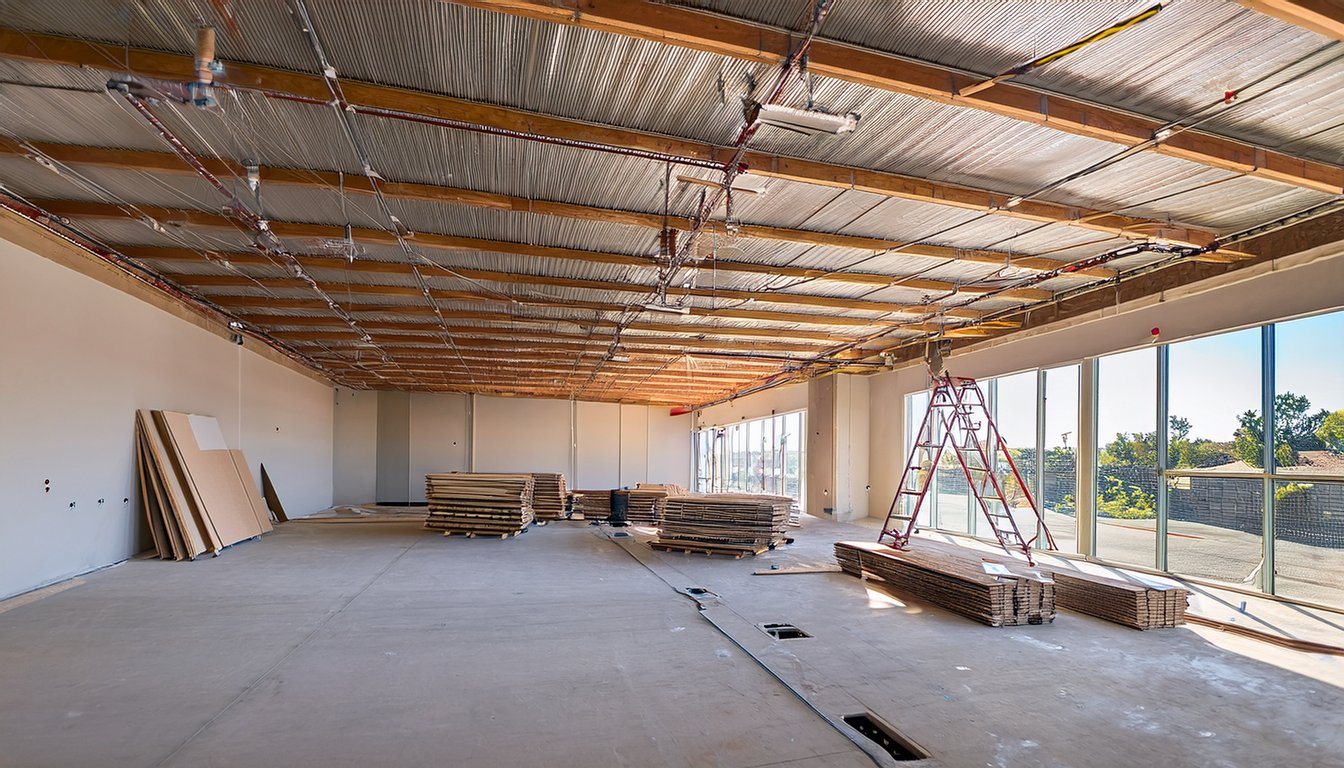
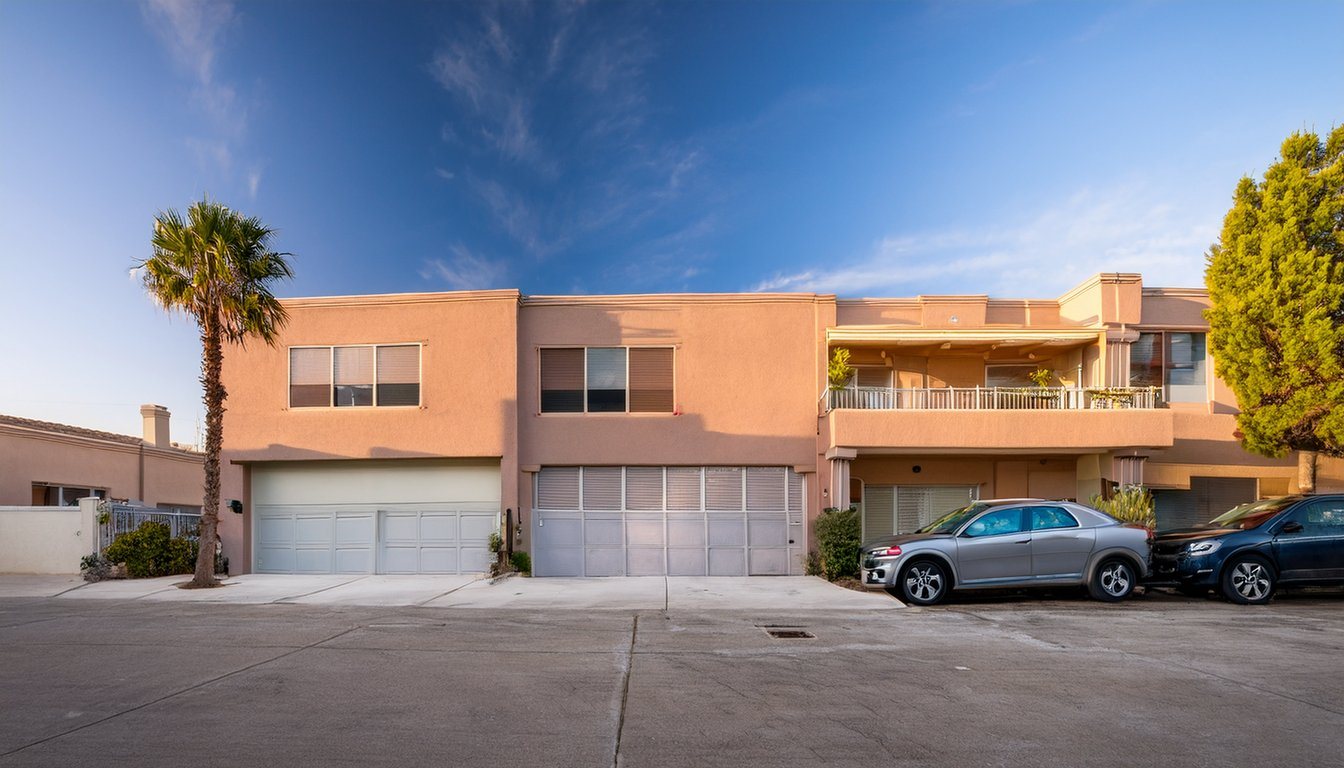
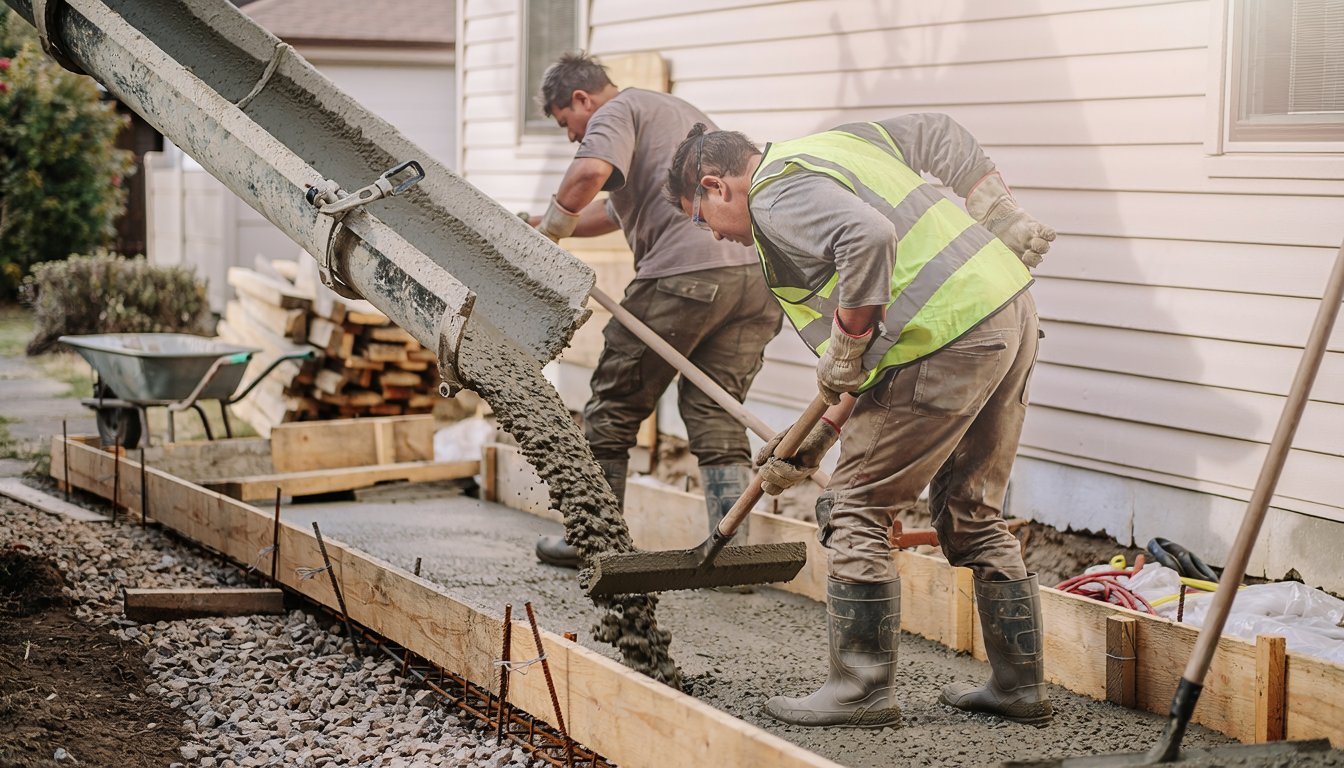
On the day a concrete ramp is poured, the truck is usually the shortest part of the job. Before a single yard of concrete arrives, the old steps may have to come out, the ground has to be dug and compacted, and forms, reinforcing steel and footings have to be set so the ramp lands at exactly the right slope. Railings go on after it cures. That's why a concrete ramp is priced more like a small foundation job than a length of sidewalk, and why the concrete itself is only part of what you're paying for.
Quick answers
- Published figure: Fixr puts concrete ramp material costs at $200 to $250 per linear foot, with labor on top.
- The rest of the quote: forming, reinforcement, landings, railings, demolition of old steps and permits often matter as much as the concrete.
- Short ramps cost more per foot: many of those items cost about the same whether the ramp is short or long.
- Best for permanent needs: concrete lasts, but changing it later means breaking it out.
What concrete ramps cost
Fixr's ramp cost guide states that "The average concrete ramp cost per linear foot is between $200 and $250," and frames that range as material costs. It adds that "the total cost of a concrete handicap ramp is often higher, with added labor for pouring and setting the concrete," and lists masonry labor at $60 to $90 per hour.
HomeAdvisor's ramp guide lists "$220–$275" per linear foot for concrete, a close match to Fixr, and says the "The ramp's size, type, material, and features impact the price most." Guides that price whole projects rather than single feet give wider ranges. Lifeway Mobility, a ramp supplier, puts the cost of a concrete wheelchair ramp at $2,000 to above $10,000. The two kinds of figure don't conflict. A per-foot price describes the ramp; a project price also includes the parts that don't scale with length.
Other guides report the same dollar range on a different basis, so read the fine print. Our ADA ramp cost guide compares concrete with wood and aluminum and explains why the height you need to climb sets how long the ramp has to be, which drives every number in this post.
What's inside a concrete ramp quote
A good quote breaks the job into pieces. These are the ones we'd expect to see, with published reference prices where they exist:
| Line item | What it covers | Published reference |
|---|---|---|
| Concrete | Ready-mix delivered to the site | Angi: $110 to $150 per cubic yard delivered |
| Placing and finishing | Pouring, finishing and curing flatwork | Angi: $8 to $18 per square foot for installation |
| Labor | Masonry crew time | Fixr: $60 to $90 per hour |
| Railings | Handrails along the ramp | Angi: $80 per foot on average, $50 to $230 by material |
| Forming and reinforcement | Forms, rebar or mesh, footings | Priced per job |
| Landings | Level areas at the top, bottom and turns | Priced per job |
| Demolition | Removing old steps or walkway | Priced per job |
| Permit and design | Plans and building permit where required | Priced per job |
The concrete figures come from Angi's concrete delivery cost guide, which puts delivered concrete at "about $130 per cubic yard, with a typical range of $110 to $150 per cubic yard" and installation at $8 to $18 per square foot. The railing figures come from Angi's outdoor handrail cost guide. How much concrete a ramp takes depends on its design, which the contractor works out before pricing the pour.
Finish and surface choices
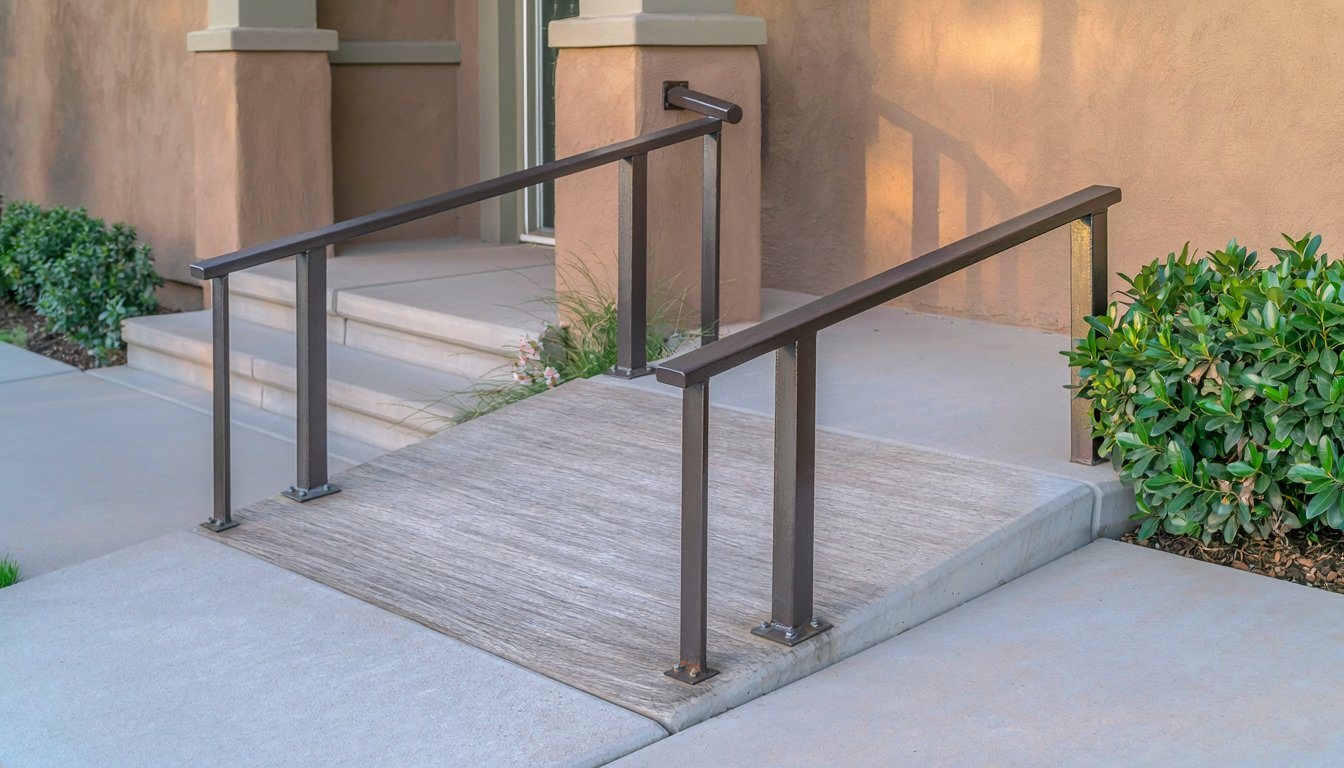
The surface is a quote line people often skip. Outdoor concrete gets wet, so texture matters for traction. A concrete prep company's cost guide says plain concrete is the cheapest option, while polymer-modified mixes and textured finishes cost more; it says to "Expect price bumps of 10%–25% for polymer-modified mixes and 20%–40% for textured finishes or anti-slip surfaces." That is one contractor-side guide, not a code or agency figure, so treat it as a rough indicator and ask your own bidder what the finish adds.
The same guide gives whole-ramp examples: a plain 8-foot-by-3-foot concrete ramp at $2,000 to $4,000 and a reinforced 16-foot-by-4-foot ramp at $4,500 to $8,500. Divide those by length and the small ramp works out to $250 to $500 per foot, while the larger one is $281 to $531. The ranges overlap heavily, which shows how much the site and the finish can move a price compared with length alone.
A worked example from published rates
To see how the pieces stack, take a hypothetical 12-foot concrete ramp with a railing on each side. This is an illustration built from published rates, not a quote, and the crew-hours are our assumption.
- Materials: 12 feet at Fixr's $200 to $250 per linear foot is $2,400 to $3,000.
- Labor: a two-person masonry crew for three 8-hour days is 48 labor hours. At Fixr's $60 to $90 per hour, that is $2,880 to $4,320.
- Railings: 24 feet (two sides) at Angi's $80 average is $1,920.
- Permit: HomeAdvisor lists building permits at $30 to $130, and notes the contractor may handle the process.
Adding the low figures gives $7,230 ($2,400 + $2,880 + $1,920 + $30). The high figures give $9,370 ($3,000 + $4,320 + $1,920 + $130). That range leaves out demolition of old steps, landings, design fees and any short-load charge, all of which depend on the site. Some guides' per-foot prices already include part of the installation, so stacking labor on top can overstate a total. Ask how any per-foot number was built.
Weather, curing and timing
Concrete work runs on the weather. Lifeway says concrete ramps typically take "a few days to pour and finish" and that weather can cause delays. It also states plainly that "Concrete can't be poured when it's raining". A rain day can push a crew to another job, and rescheduling is one reason quotes carry a start window rather than a fixed date.
Pouring is also not the end of the schedule. A Federal Highway Administration review of curing requirements notes that ACI 301-96 sets a curing period: "The general requirement is to cure for 7 days after placement (3 days for high early-strength concrete)", with exceptions when strength targets are met. That document is about paving, not ramps, so it shows the general practice rather than a rule for your project. In practice, ask the contractor when foot and wheelchair traffic can resume, and when railings will be installed.
If someone in the household uses the entrance daily, plan for that gap. A rental modular ramp, covered in our ADA ramp cost guide, is one way to bridge it.
Upkeep after the pour
Concrete is low-maintenance, not no-maintenance. Lifeway says "Maintenance is also required every few years to seal the concrete or patch cracks so that they don't expand." Budget a small amount for sealing, and look over the surface each year for cracks that let water in. That upkeep is a real, if modest, cost over the life of the ramp, and it is one reason to compare the total cost of ownership rather than only the price on the day of the pour. A cheaper material that needs replacing sooner can end up costing more. In our experience, a hairline crack caught early costs far less to patch than one that has been allowed to open up.
What to ask before you sign
- Is the quote itemized, with demolition, landings, railings and permits shown as separate lines?
- Who pulls the permit, and is its fee in the price?
- What surface finish is included, and what does a more slip-resistant one add?
- Is there a short-load charge? Lifeway cites a "short load charge" of $2,000 in Denver as an example, so charges like this vary by supplier and area.
- What happens to the schedule and price if rain delays the pour?
- When can the ramp be used, and when do the railings go on?
Why short ramps cost more per foot
Several pieces of a concrete ramp cost about the same whether the ramp is short or long. In our experience, the crew's setup day, the landings, tearing out old steps, the permit and a concrete delivery that may carry a minimum load charge don't get cheaper because the ramp is shorter. Spread across a short ramp, they push the price per foot up; on a longer ramp, the same items are divided among more feet.
Published examples do not always show the pattern cleanly. The same concrete prep guide lists smaller ramps of 6 to 8 feet at $2,500 to $4,000 and larger ramps of 16 to 20 feet at $6,000 to $10,000, and says the larger figures apply particularly when reinforcement, surface treatments, and railings are included. Dividing the extremes, the short ramp runs about $313 to $667 per foot (from $2,500 over 8 feet to $4,000 over 6 feet) and the long one about $300 to $625 (from $6,000 over 20 feet to $10,000 over 16 feet). The per-foot ranges nearly coincide, so a general guide will not settle whether your short ramp carries a penalty. Only an itemized bid will.
That's why a per-foot price is a starting point, not a quote. Ask for the fixed items to be listed separately so you can see what the ramp itself costs.
Permits
Whether a concrete ramp needs a permit depends on where you live and how the ramp is built; our guide to the residential wheelchair ramp code covers the rules a home ramp has to meet. One handyman company's guide to residential ramp permits describes the general pattern: "A permanent ramp attached to a dwelling, with footings, railings and a structure, is generally a building permit," while "A temporary modular ramp that sits on the ground and is not attached is generally not a building permit." Rules vary, so ask your building department before the forms go in.
When concrete is the right call
Concrete makes sense when the ramp is meant to stay. Fixr describes concrete ramps as "extremely durable, making it a good choice for permanent accessibility solutions." The trade-off is flexibility. As one safety equipment company puts it, "A concrete ramp, once poured, is permanent. Any adjustments require demolition and reconstruction."
If the need may change or be short-term, a modular ramp can be the better fit; our ADA ramp cost guide compares the options, our guide to how to build a wheelchair ramp covers the build sequence for each material, and the cost guide also covers tax credits and veterans' programs that can help pay for a ramp.
Medici Construction Group is one licensed option for concrete ramp construction, holding California A, B and C-10 licenses under CSLB #1114433.
Frequently asked questions
How much does a concrete wheelchair ramp cost?
Fixr puts concrete ramp material costs at $200 to $250 per linear foot, with labor added. Railings, landings, demolition and permits add to the total.
Is concrete cheaper than a wooden or aluminum ramp?
Usually not. Concrete tends to sit at the higher end of published ramp prices, but it's durable and permanent. Our ADA ramp cost guide compares materials.
Do I need a permit for a concrete ramp?
Often. Permanent ramps attached to a house with footings and railings generally need a building permit, while unattached modular ramps generally don't. Check with your building department.
Why is a short concrete ramp so expensive?
Setup, landings, demolition, permits and concrete delivery cost about the same regardless of length, so on a short ramp they make up a bigger share of the price per foot.
Can a concrete ramp be poured in the rain?
Not usually. Lifeway says concrete can't be poured when it's raining, so wet weather can delay the job and the schedule.
How long before I can use a new concrete ramp?
Ask your contractor. ACI 301-96, as summarized by the Federal Highway Administration, sets a general curing period of 7 days after placement, and your mix and weather may change that.
How long does a concrete ramp last?
Fixr estimates concrete ramps last 10 to 20 years, and describes concrete as an extremely durable choice for permanent access.