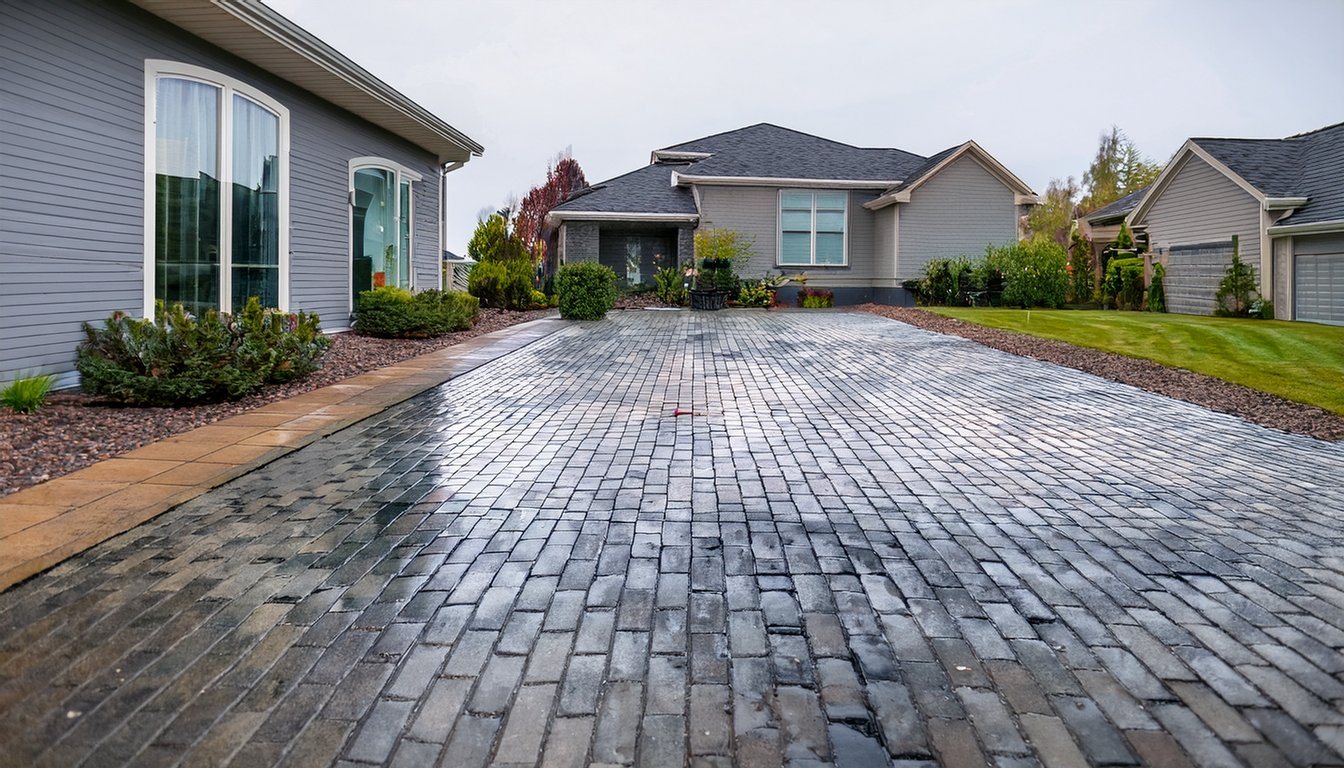
Two contractors can quote the same permeable paver for the same driveway and land thousands of dollars apart. Usually the difference is what's buried under it. A permeable driveway is a layer of open stone that holds water until the soil can absorb it, with pavers on top as the lid. How deep that stone goes, and what the soil below it can handle, moves the price more than the paver you pick.
Quick answers
- Per square foot: HomeGuide puts permeable pavers at $10 to $30 installed.
- Two-car driveway: HomeGuide's range is $5,500 to $17,000 for permeable pavers.
- Biggest swing factor: the depth of the stone base underneath, which soil and drainage conditions set.
- Ongoing cost: the surface needs periodic vacuum cleaning to keep draining.
Permeable pavers cost per square foot
National cost guides agree on the core range. HomeGuide says permeable pavers cost $10 to $30 per square foot installed, and Angi uses the same $10 to $30 range, with an average project of $9,511. Other permeable surfaces price differently:
| Surface | HomeGuide (installed, per sq ft) | Angi (installed, per sq ft) |
|---|---|---|
| Permeable interlocking pavers | $10 to $30 | $10 to $40+ |
| Pervious concrete | $8 to $16 | $8 to $16 |
| Porous asphalt | $7 to $13 | $7 to $15 |
| Concrete grid pavers | $4 to $12 | $6 to $18 |
| Plastic grid pavers | $5 to $9 | $5 to $10 |
Figures from HomeGuide's permeable pavement guide and Angi's permeable paver guide. Angi also notes that labor makes up 40% to 60% of the total, which is a hint that much of the money goes into the ground work, not the pavers.
Permeable paver driveway cost by size
HomeGuide breaks out driveway totals by size:
| Driveway | Permeable pavers | Pervious concrete | Porous asphalt |
|---|---|---|---|
| 1-car (288 sq ft) | $2,800 to $8,500 | $2,300 to $4,600 | $2,000 to $3,700 |
| 2-car (576 sq ft) | $5,500 to $17,000 | $4,600 to $9,200 | $4,000 to $7,500 |
| 3-car (864 sq ft) | $8,500 to $25,000 | $6,900 to $13,800 | $6,000 to $11,200 |
Old paving has to come out first on most replacements. HomeGuide adds $1 to $3 per square foot for removing an old driveway, and notes that some cities require a $50 to $200 permit.
What's underneath: the stone reservoir
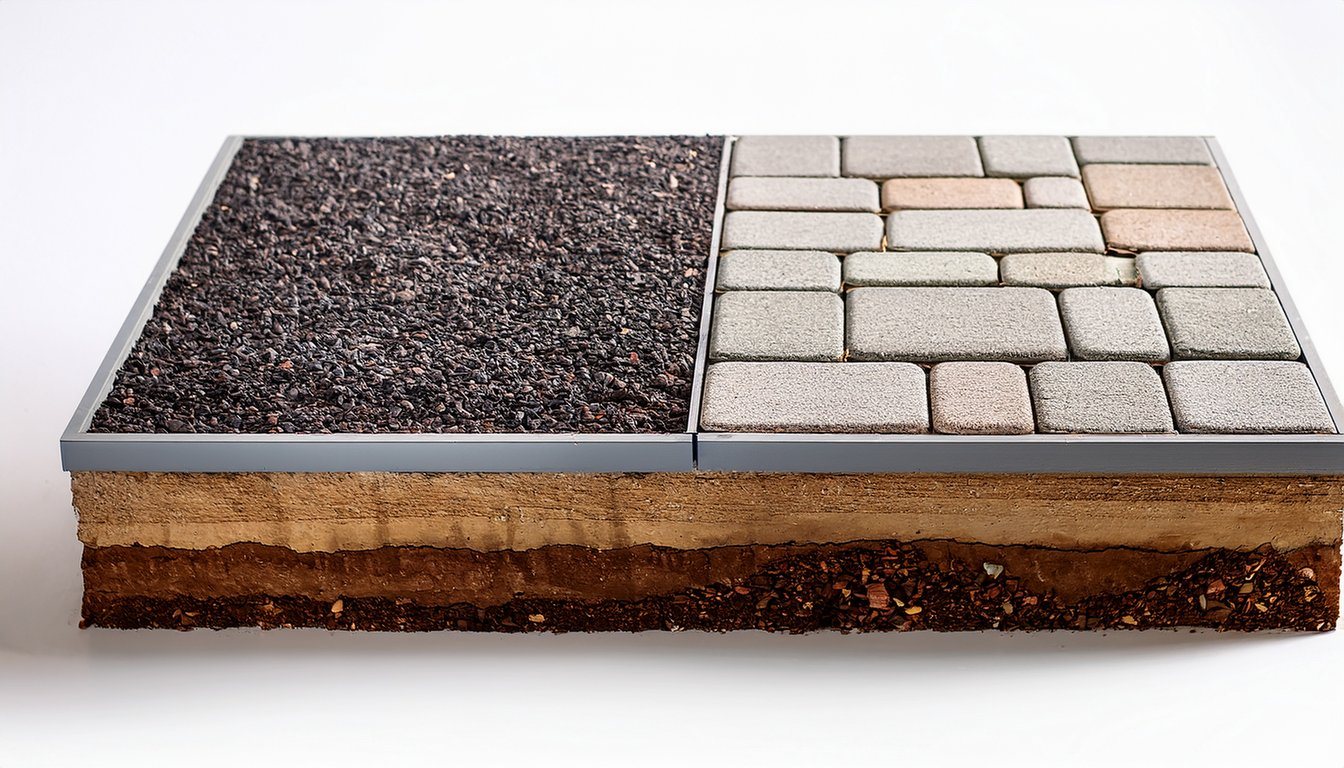
A regular paver driveway sits on compacted base that sheds water. A permeable one sits on open-graded stone with empty space between the pieces, so water can drain into it and wait. The Concrete Masonry and Hardscapes Association describes three layers: a bedding layer "typically placed as a 2 in. (50 mm) thick lift" of small stone, a base layer "typically 4 in. (100 mm) thick", and a subbase of larger stone, "typically ASTM No. 2, 3 or 4 stone."
The subbase is the part that varies. HomeGuide says most installations need 6 to 18 inches of crushed stone under the surface. Every added inch means more digging, more soil hauled away, and more stone brought in. Angi prices base layers at $40 to $86 per cubic yard, and HomeGuide puts excavation and grading at about $1 to $4 per square foot. On a large driveway, going from the shallow end of that depth range to the deep end can add a meaningful amount before a single paver is laid.
How much stone that depth adds up to
Depth is easier to judge in cubic yards. Take the same 400-square-foot driveway. A 6-inch base is 400 square feet times 0.5 feet, or 200 cubic feet, which is about 7.4 cubic yards. An 18-inch base is 600 cubic feet, about 22.2 cubic yards. Bob Vila says "one cubic yard containing approximately 1.5 tons" of crushed rock, so the shallow base is roughly 11 tons of stone and the deep one roughly 33 tons.
At the $40 to $86 per cubic yard that Bob Vila and Angi both quote for base material, the shallow base costs about $300 to $640 and the deep one about $890 to $1,910. The extra stone alone is roughly $590 to $1,270. That is a real number but not the biggest one. The rest of the gap is digging the extra 12 inches, hauling that soil away, and placing and compacting more stone, which is labor. Bob Vila says "driveway installation labor falls between $5 and $11 per square foot", or about $2,000 to $4,400 on 400 square feet. These are material-only arithmetic on national unit prices, not a bid. Local stone prices, haul distance and disposal fees move them.
Soil and site: what makes the reservoir deeper
The stone has to hold water until the ground below absorbs it, so slow soil means a bigger reservoir or a pipe to carry the extra away. The Minnesota Stormwater Manual notes that "HSG C or D soils usually require an underdrain, whereas HSG A and B soils often do not"; C and D are the slower-draining soil groups, which include clay. HomeGuide says clay soils often need a deeper base or an underdrain, which typically adds $1,000 to $3,000. An underdrain is a perforated pipe in the stone, similar in idea to a French drain.
Two other site conditions matter. The same manual calls for at least 3 feet between the bottom of the reservoir and the seasonal high groundwater table. And water running onto the driveway from roofs, lawns, or a slope adds load: the manual says the area draining onto permeable pavement "should generally not exceed twice the surface area of the permeable pavement" without pretreatment. In our experience, a downspout aimed at the driveway or a sloped lawn above it is often what turns a standard design into a deeper, more expensive one.
Finding out your soil before you compare quotes
Soil type is the input that sets the depth, so it is worth pinning down early. The Natural Resources Conservation Service sorts soils into four hydrologic groups. Group A soils "typically have less than 10 percent clay and more than 90 percent sand or gravel", and water moves through them freely. Group D soils "typically have greater than 40 percent clay, less than 50 percent sand, and have clayey textures", and their saturated hydraulic conductivity is "less than or equal to 1.0 micrometers per second (0.14 inches per hour)". Group C sits between, with "between 20 percent and 40 percent clay". Those are the C and D soils that the Minnesota manual says usually need an underdrain.
A soil map gives a starting guess, not a design value. West Virginia's stormwater manual, a state document that shows what careful testing looks like, says "The failure of stormwater infiltration devices is often attributed to an inaccurate estimation of the design infiltration rate and/or depth to the seasonal high water table or other limiting layer". For an infiltration area up to 2,500 square feet, it calls for "1 soil profile pit", dug to "3 feet below the bottom of the BMP" or deeper. Most home driveways are far smaller than 2,500 square feet, and many jurisdictions do not require formal testing for them. In our experience, though, a test pit dug before the quote is cheap insurance: it shows clay, fill or a high water table while the design can still change, instead of after the excavator is on site.
Compared with concrete and asphalt
HomeGuide puts regular concrete at $4 to $8 per square foot, against $8 to $16 for pervious concrete and $10 to $30 for permeable pavers. Those are surface-by-surface rates. Looking at a whole driveway instead, HomeGuide estimates a permeable driveway typically costs 20% to 50% more upfront than a comparable traditional one. The two figures measure different things, which is why the gap looks smaller in the second. For asphalt pricing, see our asphalt driveway cost guide. For how the gap compares with regular pavers, see are permeable pavers more expensive? For how gravel, chip seal, asphalt and concrete rank on upfront cost and cost per year, see cheapest driveway material. Our concrete driveway cost guide covers what a standard concrete replacement includes.
Maintenance is part of the price
Permeable paving only works while its joints stay open. The Minnesota manual says surfaces "should be cleaned with a vacuum sweeper at least two times a year." HomeGuide prices that maintenance at $0.25 to $0.50 per square foot, and Angi lists professional cleaning at $300 to $600 every 2 to 5 years. Skipping it has a cost too: HomeGuide says neglect can reduce infiltration rates by up to 75% over several years.
Put those unit prices on a real driveway. On a 576-square-foot two-car driveway, HomeGuide's $0.25 to $0.50 per square foot is $144 to $288 per cleaning. Twice a year, as the Minnesota manual recommends, that is about $288 to $576 a year. Angi's $300 to $600 every 2 to 5 years is a lower-frequency schedule, and the two guides do not describe the same service level. In our experience, the sensible budget is to plan for the higher yearly figure and treat any year you spend less as a bonus, because a clogged surface costs far more to restore than to keep clear.
Worked example: 400 square feet on clay
This is illustrative, not a quote. Take a 400-square-foot driveway replacing old concrete, on clay soil:
- Permeable pavers at $10 to $30 per square foot: $4,000 to $12,000
- Removing the old driveway at $1 to $3 per square foot: $400 to $1,200
- Underdrain for clay: $1,000 to $3,000
- Total: about $5,400 to $16,200, plus any permit
Installed prices normally include excavation and a standard base, so those aren't added again here. The removal and underdrain are the extras this site brings. A deeper-than-standard reservoir would push the result toward the top of the range.
Getting quotes you can compare
Ask each contractor to write down the depth of each stone layer, what they're assuming about your soil, whether an underdrain is included, and whether removal and haul-off are in the price. Quotes with those lines spelled out are comparable; quotes without them often hide the difference in the base. Medici Construction Group is one licensed option for permeable driveway and site drainage work, holding California A, B and C-10 licenses under CSLB #1114433.
Frequently asked questions
How much do permeable pavers cost per square foot?
HomeGuide and Angi both put permeable pavers at $10 to $30 per square foot installed, with Angi noting premium interlocking pavers can run $40 or more.
How much does a permeable paver driveway cost?
HomeGuide estimates $2,800 to $8,500 for a one-car driveway, $5,500 to $17,000 for two cars, and $8,500 to $25,000 for three. Removal of an old driveway and poor-draining soil can add to that.
How long do permeable pavers last?
HomeGuide puts permeable interlocking pavers at 20 to 35 years and says most permeable pavement lasts 20 to 40 years, depending on materials, installation quality, and maintenance.
Why do permeable pavers cost so much?
Mostly because of what's underneath. A permeable driveway needs a deep layer of open stone, often 6 to 18 inches according to HomeGuide, which means more excavation and more stone than a regular driveway. Clay soil can add an underdrain on top of that.
How much does it cost to maintain permeable pavers?
HomeGuide prices vacuum or pressure-wash maintenance at $0.25 to $0.50 per square foot, and Angi lists professional cleaning at $300 to $600 every 2 to 5 years. The Minnesota Stormwater Manual recommends vacuum sweeping at least twice a year.
Do I need a soil test before installing permeable pavers?
Requirements vary by city, but the design depends on how fast your soil drains. NRCS describes Group D clay soils as having a saturated hydraulic conductivity of 0.14 inches per hour or less, and a state manual attributes many infiltration failures to an inaccurate estimate of the infiltration rate. A test pit before quoting is inexpensive insurance.
How much stone does a permeable driveway need?
Bob Vila says base material is usually installed 6 to 18 inches deep. On 400 square feet that is about 7.4 to 22.2 cubic yards, or roughly 11 to 33 tons at about 1.5 tons per cubic yard.