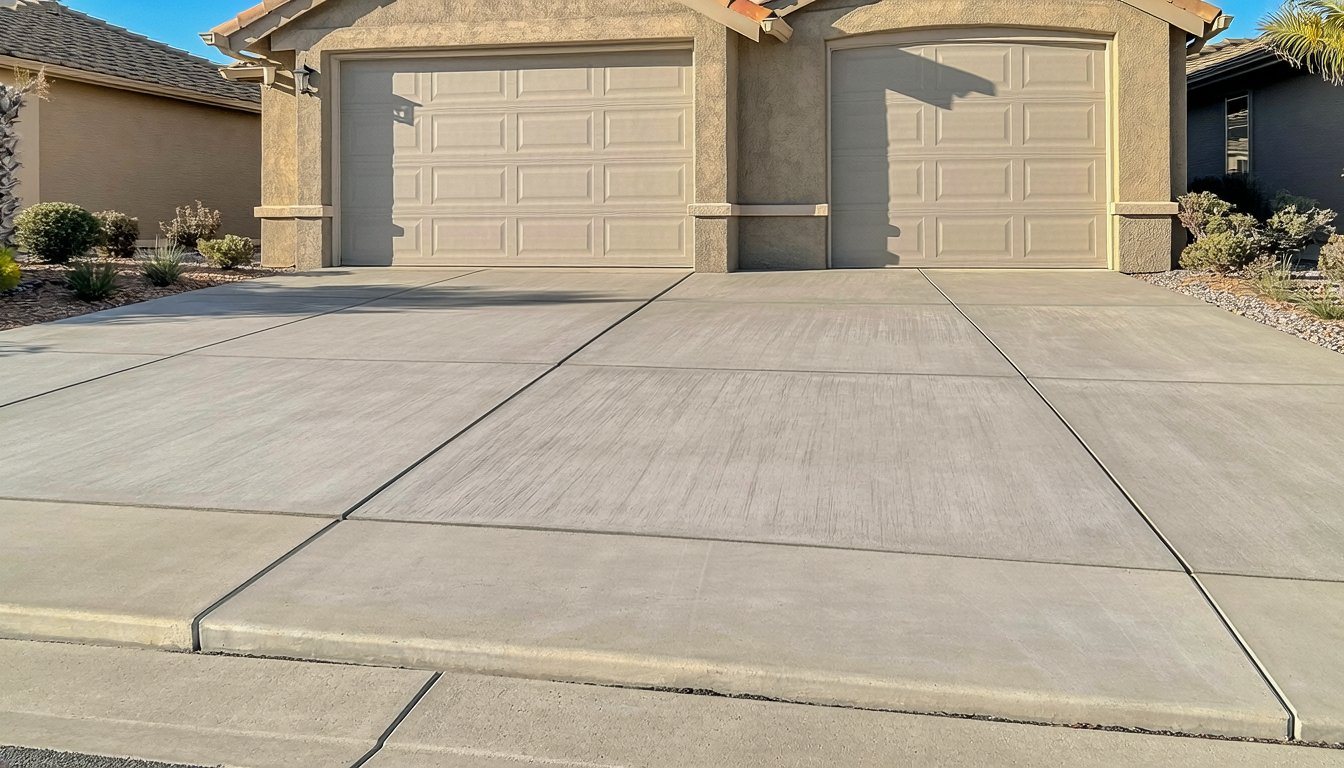
Picture two quotes for the same 20-by-20 concrete driveway replacement, one roughly twice the other. It's tempting to assume the higher one is padded. In our experience, the more common explanation is that the two quotes describe different jobs. The lower one prices a new slab. The higher one also prices breaking out the old driveway, hauling it away, reworking the base underneath, and matching the city approach at the street. Both can be honest.
A concrete driveway price is mostly everything around the concrete. Published per-square-foot figures describe pouring a slab. A replacement quote carries tear-out and haul-off, base work, reinforcement, finish and, in Los Angeles, any work on the approach. This guide shows the published figures, what each line in a quote covers, a worked example, and a simple test for comparing bids.
Quick answers
- New driveway: roughly $5 to $20 per square foot for plain to mid-range finishes in national guides.
- Replacement: add about $2 to $6 per square foot to remove the old one.
- Los Angeles: Angi estimates $7,200 to $13,200 for a 600-square-foot driveway.
- Two-car size: $2,400 to $8,600 for 400 to 576 square feet in standard concrete, per HomeGuide.
What published concrete driveway costs say
National cost guides agree on the broad range and differ on the details, mostly because they bundle finishes differently. These are national baselines, not Los Angeles prices, and they aren't meant to be averaged together.
| Source | Updated | What it says |
|---|---|---|
| Concrete Network, an industry website | January 2026 | Plain $5 to $8 per sq ft; basic decorative $8 to $14; mid-range $14 to $21; high-end $21 and up |
| HomeGuide | June 2025 | $6 to $15 per sq ft, or $2,400 to $8,600 for a two-car driveway |
| Angi | April 2026 | $8 to $20 per sq ft; typically $2,700 to $14,500 total; average $6,400 |
By size, HomeGuide's table for standard to basic decorative concrete runs:
| Driveway | Square feet | HomeGuide range |
|---|---|---|
| 10 x 20 | 200 | $1,200 to $3,000 |
| 20 x 20 | 400 | $2,400 to $6,000 |
| 24 x 24 | 576 | $3,500 to $8,600 |
Why do the guides disagree? In our experience, mostly because of what each one counts as "basic." One folds a textured or colored finish into its standard range; another prices only plain gray concrete there and moves everything else to an upgrade tier. None of them includes removing an old driveway in its base per-foot number, and none can know your slope, soil or access. Treat them as a starting line for the slab, not a quote.
For Los Angeles specifically, Angi's page gives an estimate of $7,200 to $13,200 for a 600-square-foot driveway. That works out to roughly $12 to $22 per square foot, higher than the national per-foot ranges above, and in our experience in line with local quotes.
Replacement vs new: the tear-out line
Most of the people searching this price already have a driveway. Removing it is its own line, and it's the one most often left out of published per-square-foot figures. HomeGuide says "Removing an old driveway adds $2 to $6 per square foot on average." Angi's removal guide gives the same range and says "Concrete removal is priced at $2 to $6 per square foot, which covers both labor and dumping fees." Concrete Network's figure is lower, about $1 per square foot for tear-out and removal, which in our experience is a floor rather than a typical Los Angeles price.
What moves that line is weight and access. Old concrete is heavy, it often has wire mesh or rebar in it, and every ton has to be loaded and hauled. In our experience, a thick slab, reinforcing steel, a long carry to the truck or a steep driveway all push removal toward the top of the range. Much of it doesn't go to a landfill: CalRecycle notes that "Recycled aggregate is produced by crushing concrete and sometimes asphalt," and in our experience clean broken concrete usually goes to a recycler rather than a landfill.
Tree roots are the other surprise. In our experience, roots that lifted the old slab have to be cut back before the new base goes in, and that work is rarely in the first number anyone quotes.
The line items inside a concrete driveway quote
Once the old driveway is gone, the new one is built in layers. These are the lines a complete quote should account for.
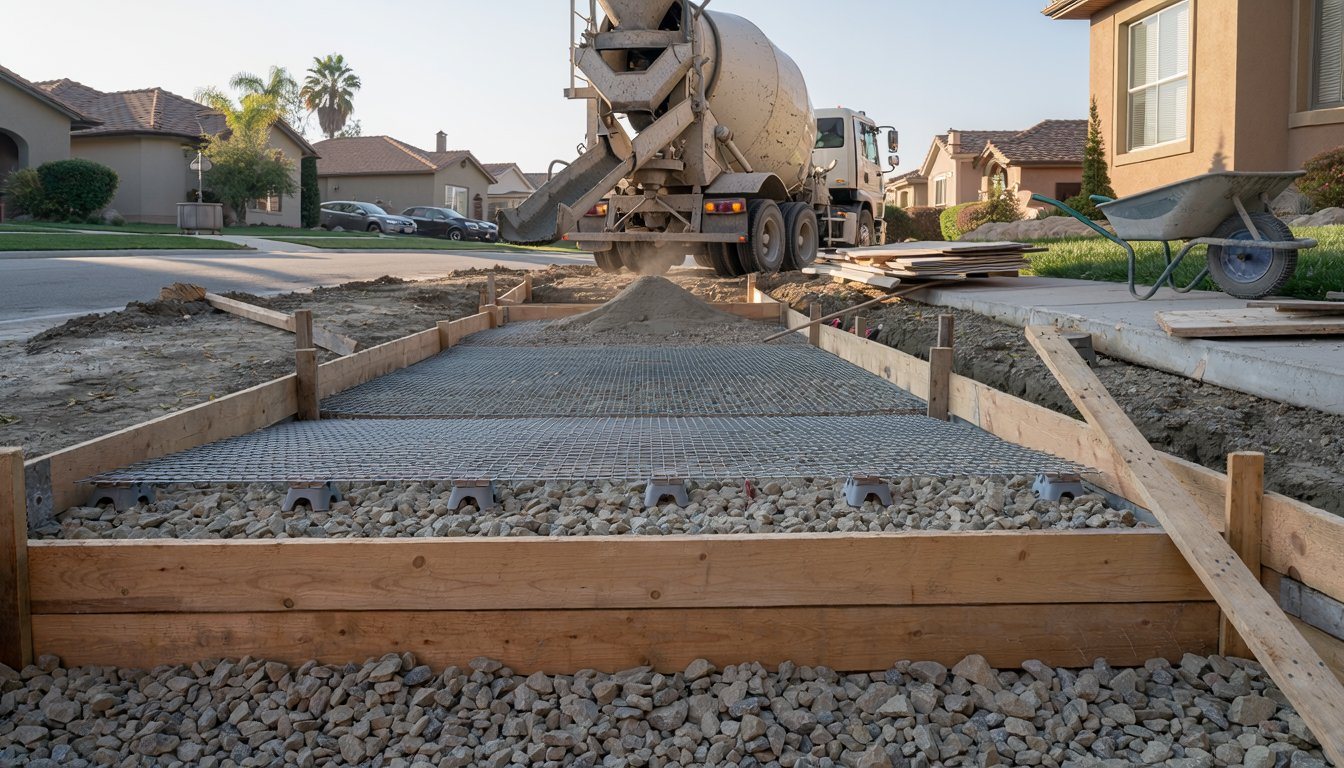
- Grading and base. The subgrade is shaped and compacted, and base rock goes down. In our experience, this is where cheap quotes save the most money and where driveways fail first. Our cheapest driveway material guide explains why the base matters under any surface.
- Forms and layout. Wood or steel forms set the edges and the slope. Curves and flares take more time than straight runs.
- Reinforcement. Wire mesh, rebar or fiber in the mix. The type and amount should be written in the quote, not assumed.
- The concrete itself. Ready-mix is priced by the cubic yard, and orders under a truckload cost more per yard. Angi lists "Short load fees of $40–$60 per cubic yard if you're buying less than the average capacity of a cement truck (about 10 cubic yards)." Our concrete ramp cost guide covers per-yard delivery pricing.
- Placing and finishing labor. Angi puts labor at "The cost of labor accounts for about half of your total concrete driveway project cost, or around $2 to $10 per square foot."
- Control joints. Concrete Network explains that "Control joints are planned cracks which allow for movements caused by temperature changes and drying shrinkage." Whether they're tooled or saw-cut, a quote should show that they're included.
- Finish. In our experience, a broom finish is the baseline. HomeGuide says "A stamped concrete driveway costs $8 to $26 per square foot, including pouring the slab and stamping the surface with a texture or pattern." Color, exposed aggregate and sealer add to that.
- Access, slope and pumping. In our experience, a truck that can't back up to the pour means a pump or wheelbarrows, and a steep driveway means more forming and slower finishing. Both show up in the price.
The city side in Los Angeles: the approach
The part of the driveway between the street and your property line, the approach, sits in the public right-of-way and follows city standards rather than your preferences. The City of Los Angeles street design manual says "The design standards used for the Y slope construction are based on Driveways Standard Plan (S-440-4)," and that the slope up to the property line may vary "from a minimum of 1 percent to a maximum of 6 percent." On the private side, the same page notes that the grade used for access to a garage or required parking "should not exceed 20 percent."
In our experience, replacing the approach adds permit time, city-standard construction and sometimes curb work, so it should be priced separately from the driveway. Our asphalt driveway cost guide explains which permit covers approach work and who pulls it, and our curb and gutter cost guide covers the curb side.
A worked example: replacing a 20-by-20 driveway
Here's how the published figures stack up for a 400-square-foot replacement in standard concrete, using our arithmetic on the cited ranges:
- New slab: HomeGuide's $2,400 to $6,000 for 20 by 20.
- Removal: $2 to $6 per square foot times 400, or $800 to $2,400.
- Together: about $3,200 to $8,400, before any approach work, root cutting, decorative finish or unusual access.
That's the widest span the two ranges allow, not a typical price, and it's a national baseline. Angi's Los Angeles estimate suggests local prices sit higher. A long driveway scales the same way: assuming a 10-foot width, a 100-foot drive is 1,000 square feet, or about $6,000 to $15,000 at HomeGuide's rate before removal.
Why Los Angeles runs higher is no mystery in the field. In our experience, local labor rates, disposal and trucking costs, permit steps for the approach, and tight access on older lots with narrow side yards all add to the national baseline. A quote that lands near the national low end for a replacement here usually deserves a closer look at what it leaves out.
What pushes a concrete driveway toward the top of the range
In our experience, the same few conditions account for most of the gap between a low published figure and a real Los Angeles quote:
- Slope. A hillside driveway needs more forming, more careful finishing and sometimes steps or a retaining edge. The steeper it is, the slower every stage goes.
- Drainage. Water that used to run under or along the old slab has to go somewhere. A trench drain or regrading at the garage adds cost; our drainage plan guide covers when the city wants to see how water is handled.
- Small size. A short driveway still needs a crew, a truck and setup. Minimums and short-load fees make the per-foot price climb on small jobs.
- Finish upgrades. Color, stamping, exposed aggregate and borders each add a line.
- The approach. Rebuilding the section in the right-of-way to city standards is its own piece of work.
How to compare concrete driveway quotes
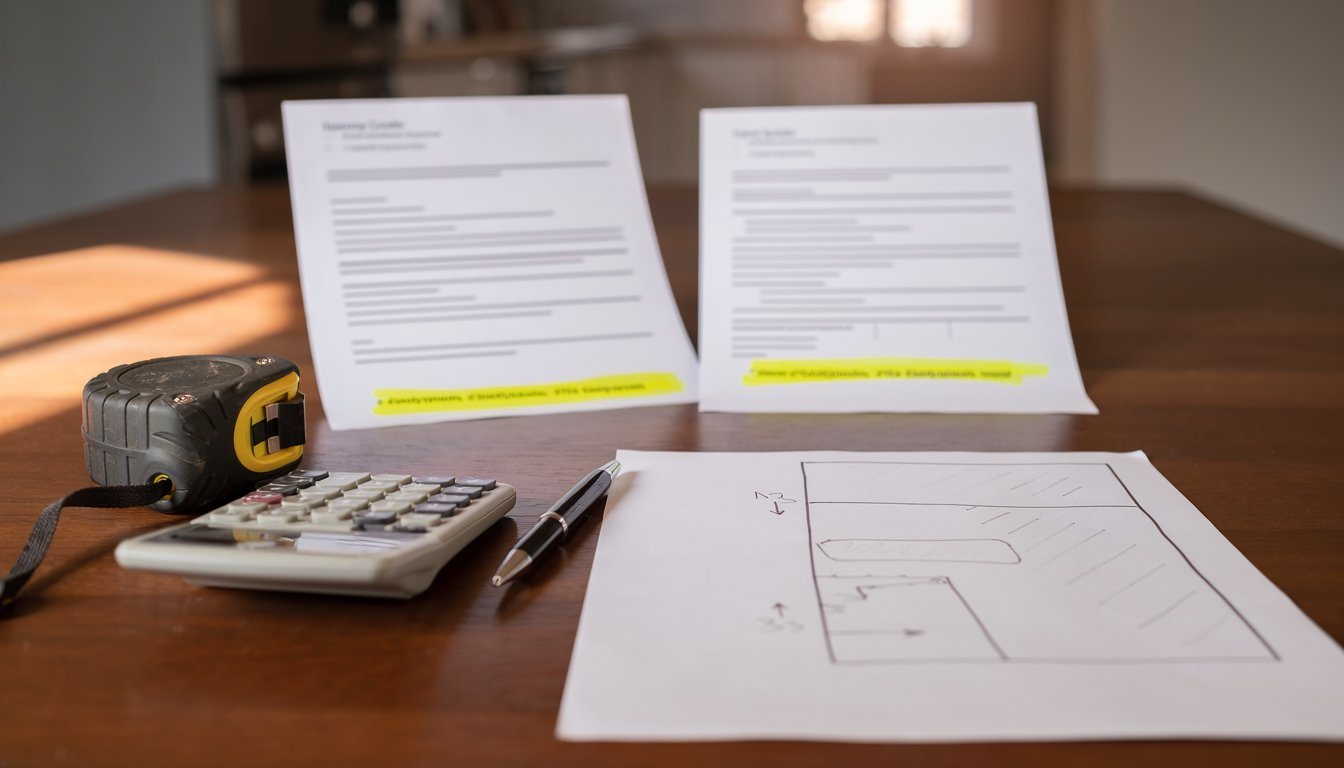
Start with the strip-out test. Take each quote, subtract the lines that aren't the new slab (tear-out and haul-off, root work, approach and permit, decorative upgrades), and divide what's left by the square footage. Now you're comparing like with like, and you can hold that number up against the published ranges above. In our experience, a quote that looks cheap often passes this test only because a line is missing entirely.
Then check that each quote answers the same questions in writing:
- Is removal and haul-off of the old driveway included?
- How deep is the base, and is it compacted?
- What is the slab thickness, and what reinforcement goes in?
- Where will the control joints go?
- What finish is included, and is sealer extra?
- Does the price include the approach, and who pulls the permit?
- What's the payment schedule? You can confirm a contractor's license with our guide on how to check a California contractor license.
The bottom line
The concrete is the predictable part of a driveway price; tear-out, base, access and the approach are what make quotes differ. Price those lines separately and the comparison gets simple. Medici Construction Group is one licensed option for concrete driveway work, holding California A, B and C-10 licenses under CSLB #1114433.
Frequently asked questions
How much does a concrete driveway cost?
National cost guides put a new concrete driveway at roughly $5 to $20 per square foot for plain to mid-range finishes. Angi's average is $6,400. Replacing an old driveway adds removal on top, and site work can add more.
How much does a 20x20 concrete driveway cost?
HomeGuide lists $2,400 to $6,000 for a 400-square-foot driveway in standard to basic decorative concrete, before removing an old one. The worked example above shows what tear-out adds.
How much does it cost to replace a concrete driveway?
The new slab plus removal. HomeGuide says removing an old driveway adds $2 to $6 per square foot on average, and Angi's removal range is the same. The worked example above adds the two for a 20x20 driveway.
How much does a 100-foot concrete driveway cost?
Assuming a 10-foot-wide drive, that's 1,000 square feet. At HomeGuide's $6 to $15 per square foot, our arithmetic gives about $6,000 to $15,000 before removal, grading or approach work. In our experience, long drives often need more base and drainage work.
How much does a stamped concrete driveway cost?
HomeGuide puts stamped concrete at $8 to $26 per square foot, including pouring and stamping. Concrete Network places stamping and multiple colors in its $14 to $21 mid-range tier.
Is concrete cheaper than asphalt for a driveway?
Cost comparisons vary by site and finish. Our asphalt driveway cost guide has the asphalt figures, and our cheapest driveway material guide compares surfaces over their life.
Do I need a permit for a concrete driveway in Los Angeles?
Work in the public right-of-way, such as the driveway approach, curb or sidewalk, typically involves a city permit; confirm with the city before the work is quoted. Our asphalt driveway cost guide explains which permit applies in the City of Los Angeles and who pulls it.