The cheapest driveway quote is easy to find. In our experience, the regret shows up two or three winters later: a gravel drive that washes out at the low spot, a thin asphalt layer that cracks over a soft base, or a city notice that the surface doesn't meet the local paving rule. The cheapest material and the cheapest driveway aren't always the same thing.
Even the price guides show the gap. HomeGuide's driveway cost page, updated December 19, 2025, says "The cheapest driveway material is gravel at $1 to $3 per square foot", and the same page puts an installed gravel driveway at $4 to $10 per square foot. The difference is the base, the grading and the labor, and it's the difference that decides what you actually pay.
Quick answers
- Cheapest material: gravel, by every published price list we checked.
- Cheapest paved surface: chip seal has the lowest midpoint price in both guides we checked, though the guides disagree on asphalt versus concrete.
- Cheapest to own: depends on lifespan and upkeep; on midpoint numbers, concrete and asphalt cost less per year than chip seal.
- Check first: some cities don't allow gravel for driveways or required parking.
The price list, from two sources
Here's how two national cost guides rank the common driveway surfaces per square foot. They don't agree, which is itself useful: it tells you how much local quotes can vary.
| Surface | HomeGuide (Dec 19, 2025) | Angi (updated Aug 1, 2026) |
|---|---|---|
| Gravel | $1 to $3 | $1.25 to $1.80 |
| Chip seal (tar and chip) | $2 to $5 | $5 to $10 |
| Asphalt | $3 to $7 | $7 to $15 |
| Concrete | $4 to $8 | $4 to $15 |
| Pavers | $10 to $30 | $10 to $50 |
Sources: HomeGuide's driveway cost guide and Angi's guide to driveway types. Both put gravel at the bottom; Angi says plainly, "Gravel is the least expensive driveway material." Past that, the order depends on which guide you read. In our experience, Southern California quotes for paved surfaces tend to land toward the upper half of national ranges, so treat these as a ranking, not a budget. For asphalt specifically, our asphalt driveway cost guide breaks down the three kinds of asphalt jobs and what each costs.
Installed cost is what you actually pay
A per-square-foot material price leaves out most of what makes a driveway last. In our experience, a real quote includes: For concrete specifically, our concrete driveway cost guide prices each line of a replacement quote.
- Removal and haul-off of the old surface, if there is one.
- Excavation and grading to the right depth and slope.
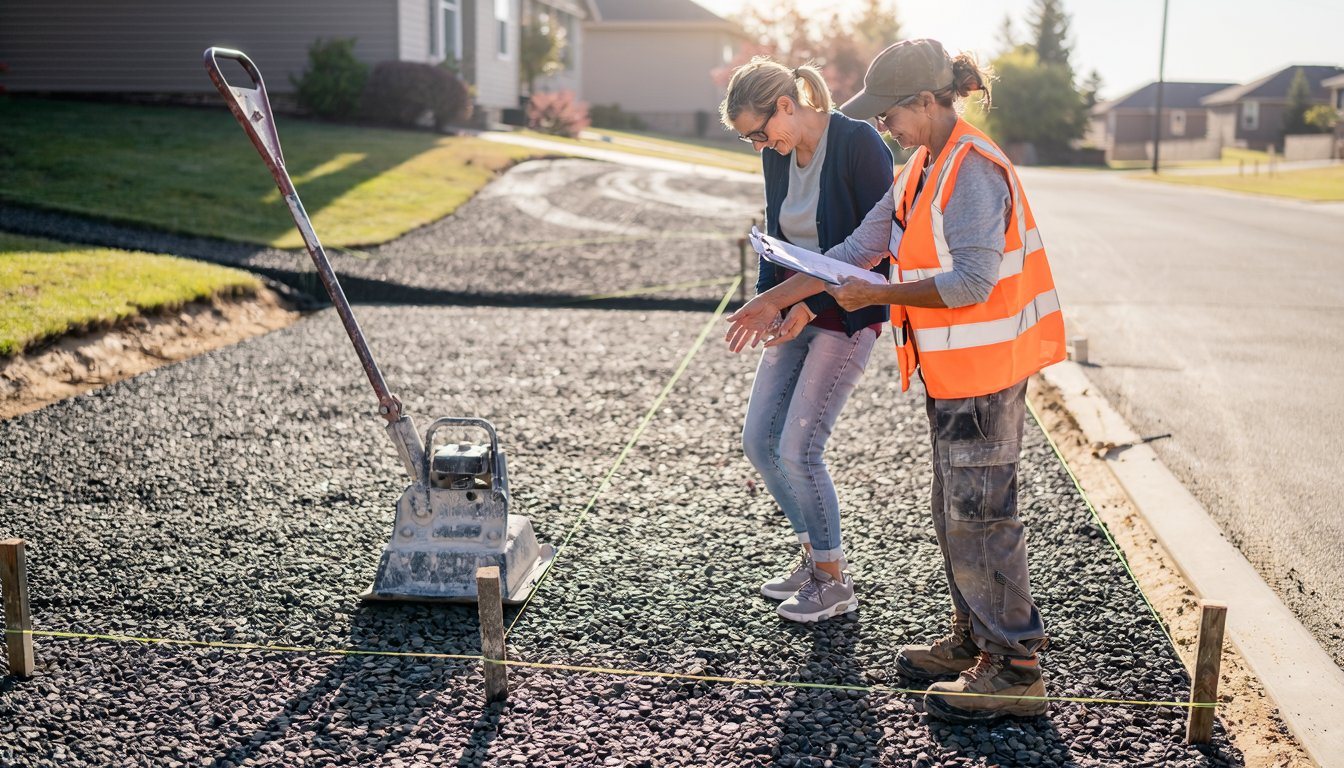
- A compacted base of crushed aggregate under the surface.
- Drainage, so water leaves the driveway instead of sitting under it.
- Edging to keep gravel or asphalt edges from spreading and crumbling.
The base is where cheap driveways usually fail, whatever the surface. The American Concrete Pavement Association puts it this way: "a pavement's foundation (base or subbase and subgrade) is one of the most critical design factors in achieving excellent performance". Concrete Network's driveway guide adds that "Uniformity, in both soil composition and compaction, is the key to a good subgrade." Those sources are written about concrete, but in our experience the same holds for asphalt and gravel: a thin surface over soft or uneven ground is the most expensive way to save money. For the digging side of the budget, see our excavation cost calculator.
Cost per year of service
A cheaper surface that wears out sooner can cost more over the years you own it. The table below divides HomeGuide's midpoint price by the midpoint of its lifespan range for each surface. The arithmetic is ours, it leaves out maintenance, and it's meant for comparison, not budgeting.
| Surface | Midpoint price per sq ft | Lifespan (HomeGuide) | Approx. cost per sq ft per year |
|---|---|---|---|
| Chip seal | $3.50 | 7 to 10 years | about $0.41 |
| Asphalt | $5.00 | 15 to 30 years | about $0.22 |
| Concrete | $6.00 | 30 to 40 years | about $0.17 |
| Gravel | $2.00 | up to 100 years | not comparable; depends on upkeep |
Gravel doesn't fit the formula. HomeGuide lists it as lasting up to 100 years, while Angi notes it "Needs top layer of fresh gravel every few years". So gravel's real yearly cost is mostly upkeep: new gravel, regrading and fixing ruts. The sources also disagree on paved surfaces; Angi, for example, lists a much longer concrete lifespan than HomeGuide does. In our experience, that's another reason to treat any lifespan figure as a range for comparison rather than a promise.
Here's what the table means for a typical 600-square-foot driveway, using the same midpoints. Chip seal at about $2,100 over roughly 8.5 years works out to about $247 a year. Asphalt at about $3,000 over 22.5 years is about $133 a year. Concrete at about $3,600 over 35 years is about $103 a year. Maintenance changes those numbers, and asphalt in particular benefits from periodic sealing, but the pattern holds: the lowest price per square foot isn't the lowest cost per year.
Upkeep: what each surface asks of you
The cost-per-year table leaves out maintenance on purpose, because upkeep depends so much on the site. In our experience, this is roughly what each surface asks for:
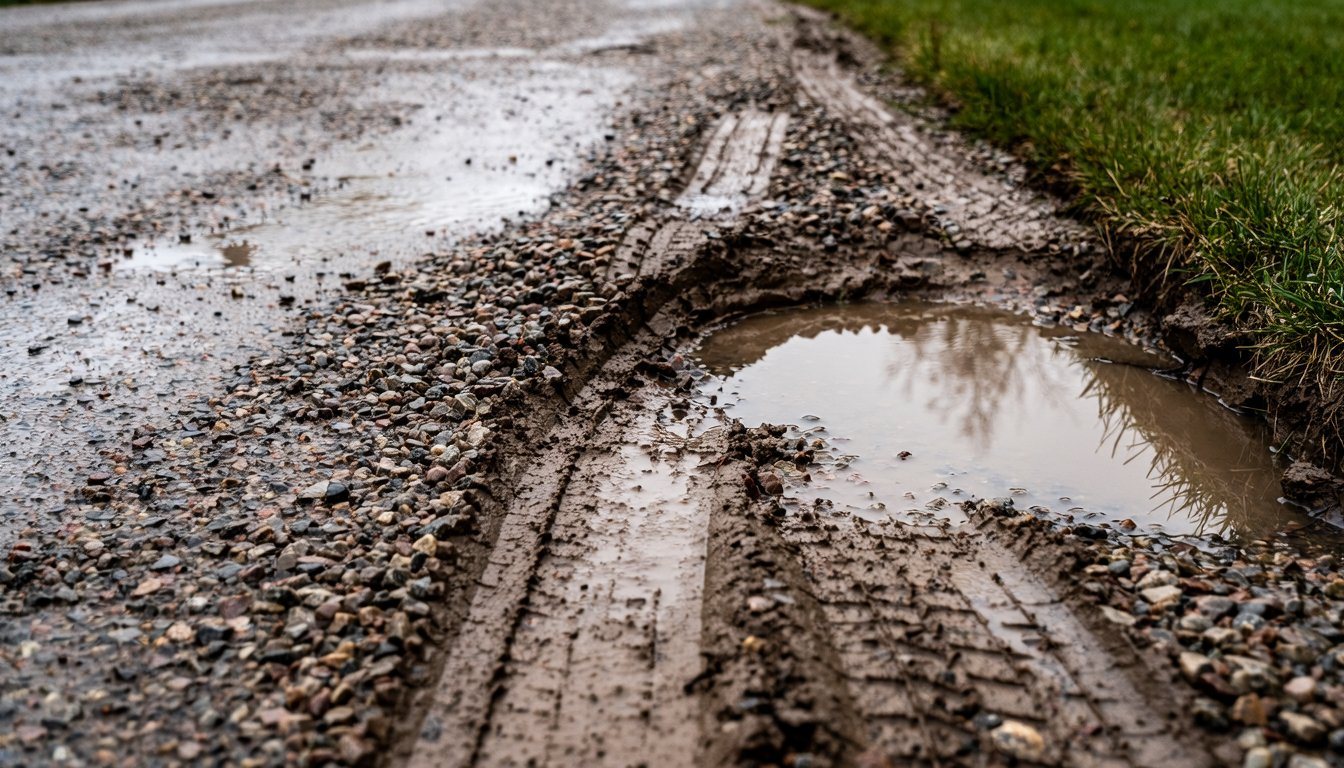
- Gravel: topping up, raking loose stone back into place, filling ruts and potholes, and regrading after heavy rain. Weeds and grass creep in without edging.
- Chip seal: a new chip seal layer when the old one wears, and patching where stones have come loose at turning spots.
- Asphalt: crack filling, periodic sealing, and patching at the edges, where unsupported asphalt tends to crumble first.
- Concrete: sealing joints, repairing cracks before water gets under the slab, and avoiding de-icing products that damage the surface in cold climates.
- Pavers: refilling joint sand, resetting settled units, and weed control between pavers.
None of these is expensive on its own. Over ten or twenty years, though, in our experience they add up enough that the ranking by upfront price and the ranking by total cost of ownership can look quite different, especially for gravel on a slope or asphalt that's never sealed.
Can you use the cheapest surface? Check the local rules
Before comparing prices, find out whether your city allows the surface at all. Some cities require driveways and parking areas to be paved. Stockton, California, for example, requires parking spaces and driveways to be "paved with a permanent surface, consisting of concrete, asphalt or other similar material authorized by the City's Standard Specifications", and states that "Compacted soil and/or gravel shall not be considered an acceptable surface." Fremont, California's code says "Every off-street parking, loading and driveway area shall be paved with asphaltic or Portland cement concrete", with limited exceptions.
Those are two cities, not a statewide rule. In our experience, requirements vary by city, by zone and sometimes by whether the driveway serves required parking, and homeowners associations can add their own rules. A quick call to your city's planning counter, and a look at your HOA rules if you have one, can save you from building a gravel driveway you later have to pave.
Surface choice also affects runoff. Virginia Tech's extension service notes that rain falling on hard surfaces such as driveways "quickly collects and flows off these surfaces to the nearest stream, river, pond, lake". If runoff is a concern on your lot, our permeable pavers cost guide covers a paved option designed to let water through.
When the cheapest surface makes sense
In our experience, these conditions push the answer one way or the other:
- Long, flat, rural or semi-rural runs: gravel is often the best value, if the city allows it and there's a plan for upkeep.
- Steep driveways: loose gravel tends to wash and migrate downhill, so a paved surface, or at least a paved steep section, usually costs less over time.
- Heavy vehicles: delivery trucks, RVs or construction traffic call for a thicker base and a paved surface, whatever the upfront price.
- A low spot where water collects: fix the drainage first; no surface lasts sitting in water.
- A short ownership horizon: if you'll sell within a few years, the lowest upfront cost that meets local rules and looks right to buyers may be the better choice.
Ways to cut cost without choosing the wrong surface
In our experience, the biggest savings come from scope, not from the cheapest material:
- Keep a sound base. If the existing base is in good shape, resurfacing over it can cost far less than a full rebuild. Our asphalt driveway cost guide explains how to tell which job you need.
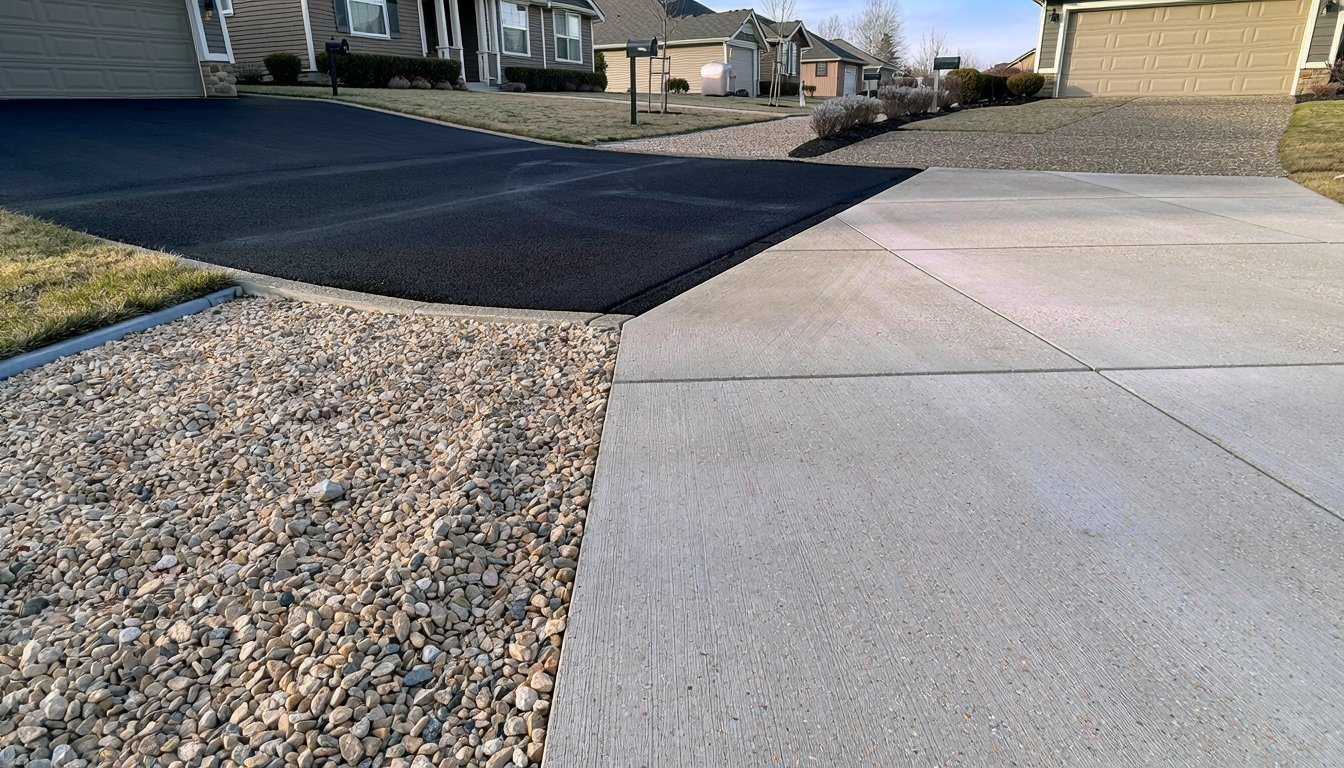
- Pave only what needs paving. A paved apron at the street with gravel beyond it, or two paved wheel strips, uses much less material than a full-width slab.
- Right-size the area. Every extra foot of width is material, base and labor you pay for once and maintain for years.
- Ask about recycled material. Recycled asphalt can lower material cost; our asphalt paving cost calculator covers what it saves.
- Get comparable quotes. Ask each contractor to state base depth, excavation, drainage and haul-off, so you're comparing the same scope.
When is it worth paying for the pricier surface? In our experience, when the driveway carries heavy vehicles, sits on a slope, serves as required parking under local rules, or when you plan to stay in the house long enough for a longer lifespan to pay back the difference. On the other hand, a driveway that's lightly used, flat and allowed to be gravel rarely needs a premium surface to do its job.
In our experience, the cheapest option that fails early is the most expensive one you can buy. Spending a little more on the base and drainage, and a little less on the surface or the area, usually gives the best value over the life of the driveway.
Medici Construction Group is one licensed option for driveway grading, base and paving work, holding California A, B and C-10 licenses under CSLB #1114433. Whoever you hire, ask them what's under the surface in their quote before you compare prices.
Frequently asked questions
What is the cheapest driveway material?
Gravel. HomeGuide lists it at $1 to $3 per square foot and Angi at $1.25 to $1.80, both calling it the cheapest option. HomeGuide also puts an installed gravel driveway at $4 to $10 per square foot, so ask what a quote includes.
What is the cheapest way to pave a driveway?
Among paved surfaces, chip seal has the lowest midpoint price in both HomeGuide's and Angi's ranges. In our experience, the cheapest paved driveway is often the one that reuses a sound existing base instead of starting over.
Is asphalt cheaper than concrete for a driveway?
It depends on the source: HomeGuide's ranges put asphalt below concrete, while Angi's put concrete's low end below asphalt's, and the gap varies by region and job. We'll compare the two in detail in a separate guide; our asphalt driveway cost guide covers asphalt pricing.
Is gravel cheaper over time?
It can be, but its cost over time depends on upkeep. Angi notes gravel needs a fresh top layer every few years, and in our experience slopes, heavy trucks and poor drainage raise that cost quickly.
Is chip seal cheaper than asphalt?
HomeGuide's ranges put chip seal a little below asphalt per square foot, but it also lists a shorter lifespan of about 7 to 10 years.
What's the cheapest option for a long driveway?
In our experience, gravel or a gravel driveway with a paved apron at the street is often the lowest-cost way to cover a long run, if your city allows it and the grade and drainage work. Paving only the parts that need it can cut cost further.
What is the cheapest paved driveway that lasts?
Using HomeGuide's midpoint prices and lifespans, concrete works out lowest per year of service before maintenance, with asphalt close behind. Your quotes, base condition and upkeep decide the real answer.