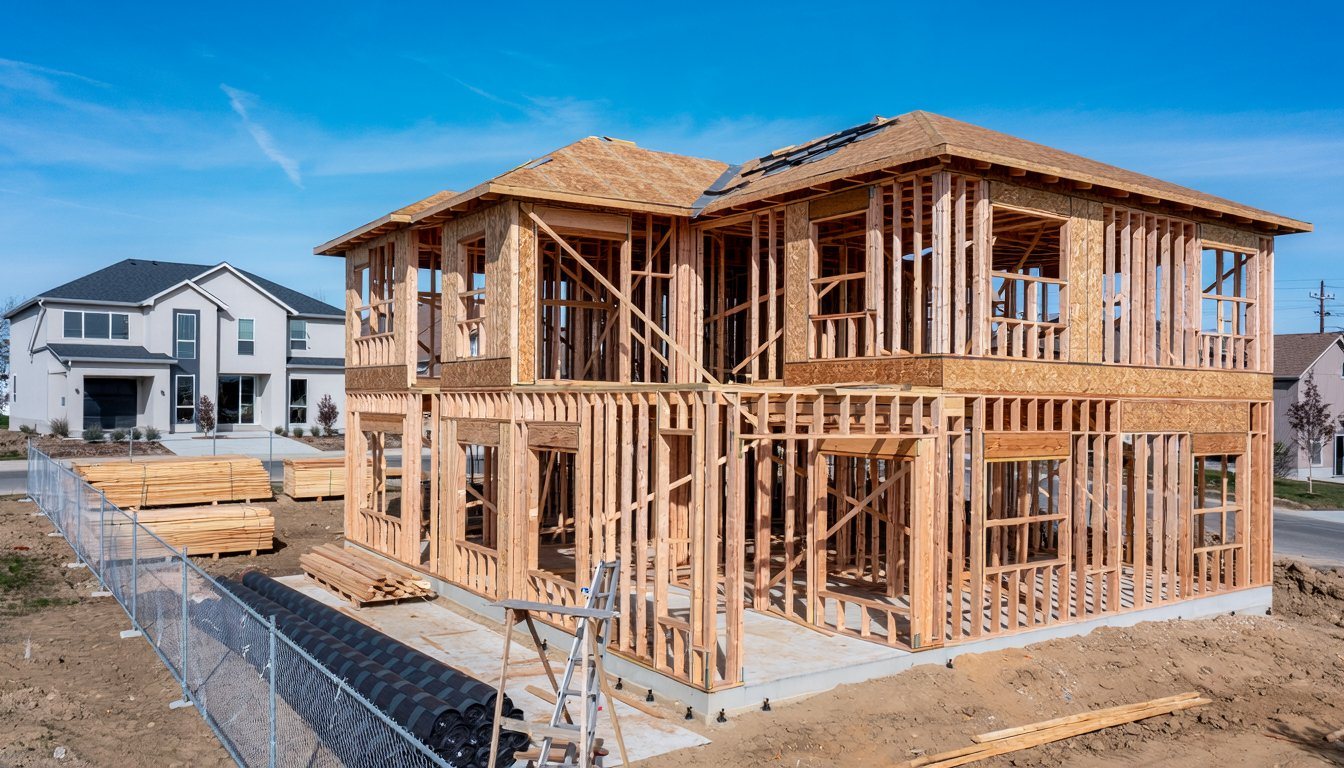
Two new houses can have the same square footage and very different price tags. One is a builder-grade home with standard finishes and a simple plan; the other is a custom design with an architect, complex framing, and high-end everything. Square footage sets how big the bill is. The build tier, how custom and how finished the house is, sets the rate per square foot, and that's often where most of the difference comes from.
Quick answers
- Builder-grade: HomeGuide puts standard-finish construction at $180 to $280 per square foot.
- Custom: HomeGuide lists $280 to $450 or more per square foot; Angi puts custom homes at $200 to $550.
- Luxury: one luxury home platform puts custom luxury at $300 to $800 per square foot, and ultra-luxury at $1,000 or more.
- Treat these as house-only figures: HomeGuide's range excludes land and site prep, so budget for those separately.
- The tier drives the rate: design fees, finishes, and complexity are what separate a luxury house from a builder-grade one of the same size.
Why size alone doesn't set the price
National averages blend every kind of house together. Angi, for example, reports that "building a house costs $322,924 on average, and most homeowners spend between $138,769 and $530,862." That's a useful reference point, but it covers modest and high-end homes in the same number, so it can't tell you what your house will cost.
It also helps to know what's inside the price of a builder's new home. The National Association of Home Builders' 2024 survey found that "construction costs accounted for 64.4% of the average price of a new home in 2024," with the finished lot and the builder's margin making up much of the rest. Those shares describe homes built by builders for sale; if you're commissioning a custom house on your own lot, you pay for land, design, and construction separately, so the mix looks different.
Cost by build tier
Published ranges don't line up neatly, because each source defines its tiers a little differently. Here they are side by side, each with its source, rather than blended into one number:
| Build tier | What it usually means | Published cost per square foot |
|---|---|---|
| Builder-grade | Standard plan and finishes | HomeGuide: "$180 to $280 per square foot" |
| Custom | Designed for the owner, upgraded finishes | HomeGuide: "$280 to $450+ per square foot"; Angi: "between $200 and $550 per square foot" |
| Custom luxury | Architect-designed, premium materials throughout | Pacaso: "$300 to $800 per square foot" |
| Ultra-luxury | One-off design, top-end everything | Pacaso: "$1,000+ per square foot" |
HomeGuide adds that its overall range for a new house, "$350,000 to $800,000," doesn't include "the land or site prep." Figures are as retrieved in September 2026, and all are national, so local labor and material costs move them up or down.
The same house size at each tier
To see how much the tier matters, apply each published range to one house size. This is simple multiplication of the ranges above, for illustration only, not an estimate for any specific project:
| Build tier (source) | Per square foot | 2,500 sq ft house |
|---|---|---|
| Builder-grade (HomeGuide) | $180 to $280 | $450,000 to $700,000 |
| Custom (HomeGuide) | $280 to $450+ | $700,000 to $1,125,000+ |
| Custom luxury (Pacaso) | $300 to $800 | $750,000 to $2,000,000 |
Same footprint, same number of bedrooms, and a spread of well over a million dollars between the low end of builder-grade and the high end of custom luxury. Pacaso quotes its range for larger homes of around 5,000 square feet, so treat that row as a rough rate. And treat all three as house-only figures; HomeGuide's range excludes land and site prep, which are covered further down.
Why the rate per square foot falls as the house gets bigger
Per-square-foot figures also shift with size inside a single tier. One builder explains that "Every home, no matter its size, needs the essentials: a foundation, plumbing, HVAC, electrical, permits, and (of course) a kitchen and bathrooms." Those items cost roughly the same whether the house is 1,200 or 3,000 square feet, so a small house spreads them over fewer square feet and shows a higher rate. The same builder adds that once the infrastructure is in place, "adding a little extra space doesn't add much to the total cost".
A hypothetical shows the effect. Suppose the kitchen, bathrooms, and mechanical systems cost $250,000 in either house, and every other square foot costs $150. At 1,500 square feet, the total is $250,000 plus $225,000, or $475,000, which is about $317 per square foot. At 3,000 square feet, it is $250,000 plus $450,000, or $700,000, about $233 per square foot. Those inputs are invented for illustration and are not published rates. The point is narrower: the larger house costs more in total but less per square foot, so compare rates only between houses of similar size and tier.
Allowances: where a tier is often decided on paper
The tier you choose has to survive contract signing. Many contracts are signed before every selection is made, so the contractor carries a placeholder. Building Advisor describes it this way: "Often, the choices are not known at the time a job is bid, so the contractor puts in an estimate of the cost, called an 'allowance.'" Cabinets, flooring, tile, lighting, and plumbing fixtures are typical candidates.
An allowance is where a builder-grade bid can quietly turn into a custom or luxury house. The same source warns that "low-balling allowances is an old trick to make a bid look attractive". Once you select finishes above the allowance, the difference is added to the contract. As Building Advisor puts it, "If you select more expensive materials, then the contract price will be adjusted upward", and the same page notes that some contractors add markup to those adjustments.
Here is a hypothetical. A 2,500-square-foot bid carries a $30,000 kitchen allowance, and you choose a $45,000 kitchen. The gap is $15,000 before any markup; at a 15 percent markup, which is an assumed figure, it becomes $17,250. Repeat that across flooring, tile, lighting, and fixtures and a house bid at one tier can finish at the next. The published advice is to "do research up front on realistic prices for the products you plan to use." Even better, in its words, "Whenever possible, eliminate all uncertainty (and all allowances) by making product selections before the bidding process." In our experience, allowances that match the tier you actually want are the easiest way to keep bids comparable.
Fixed-price or cost-plus: who carries the tier risk
The contract type decides who pays if the house comes in above the tier you priced. Building Advisor says that under a fixed-price contract "the final cost should come in close to the bid price" as long as you have done your homework and the contractor is competent and reputable. It describes cost-plus contracts as "pretty open ended" and says they place "all the risk of cost overruns on the owner", which is why it favors fixed-price bids on large jobs.
A fixed-price bid is only as firm as its drawings and selections. If the plans are still loose and allowances are thin, the contractor either pads the number or expects change orders later. In our experience, the more you settle on paper about the tier before bidding, the more a fixed price actually means.
A short pre-bid checklist follows from all of this. Fix the square footage and the tier in writing. Ask every bidder to price the same finish level, and ask each to list its allowances so you can see whether they match. Confirm whether the bid is fixed-price or cost-plus, and ask how change orders are priced and approved. In our experience, bids that differ by a large amount usually differ in allowances or scope rather than in the builder's efficiency, so line them up item by item before you compare the totals.
What makes a luxury house cost more per square foot
The jump from builder-grade to luxury isn't one big line item. It's several that stack up:
- Design and engineering. A custom house starts with a custom design. Angi puts "hiring an architect" at $10,000 to $60,000, with structural engineering fees of $2,000 to $10,000 on top.
- Finishes. HomeGuide describes the custom tier as including "premium finishes and upgrades like gourmet kitchens, hardwood floors, or vaulted ceilings." In our experience, at the luxury level, cabinetry, stone, fixtures, and appliances are often specified piece by piece rather than picked from a builder's package.
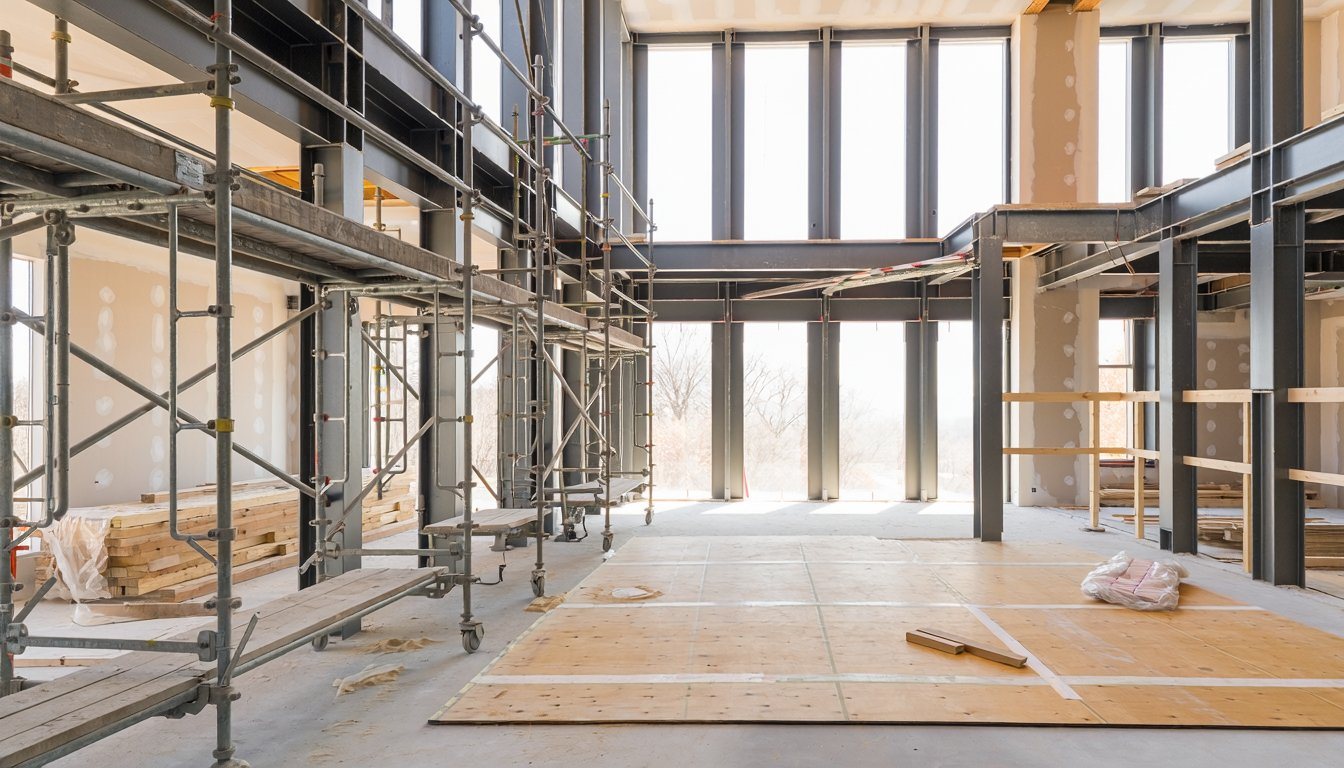
- Complexity. In our experience, the design choices that make a house feel high-end, such as irregular footprints, long open spans, large expanses of glass, and multiple rooflines, also take more engineering, more labor, and more time per square foot to build.
- The site. Some luxury sites are remote or hard to reach. Angi notes utility connections average about $20,400 but can reach $60,000 or more for remote properties.
Costs outside the build price
HomeGuide's range excludes land and site prep, and it's safest to read other per-square-foot figures the same way. Budget separately for the land, if you don't already own it; site work such as grading, clearing, and access; utility connections, which vary with distance and the local provider; and the foundation, which depends heavily on the soil and the slope. Our house foundation cost guide covers that piece. If you're adding onto an existing house rather than building new, our home addition cost guide and ADU construction cost guide are the better starting points, and if you're rebuilding after a fire, our fire rebuild cost guide covers the gap between rebuild cost and insurance. To run your own numbers with those extras included, try our home construction cost calculator.
Choosing your tier before you design
The most useful budget decision on a new house is made before any drawings exist: which tier are you building? Deciding up front whether the house is builder-grade, custom, or luxury gives your designer and builder a target, keeps the plan and the finish selections consistent with the budget, and makes contractor bids comparable. In our experience, it's much harder to pull a luxury design back to a custom budget after it's drawn than to design to the right tier from the start. Medici Construction Group is one licensed option for new house construction, holding California A, B and C-10 licenses under CSLB #1114433.
Frequently asked questions
How much does it cost to build a house?
It depends mainly on size and build tier. Angi reports a national average of about $322,924, with most projects between $138,769 and $530,862. Per square foot, HomeGuide puts builder-grade construction at $180 to $280 and custom at $280 to $450 or more, usually excluding land and site work.
What is the construction cost of a luxury house?
One luxury home platform puts custom luxury construction at $300 to $800 per square foot, and ultra-luxury at $1,000 or more. Design fees, premium finishes, architectural complexity, and difficult sites are what push luxury homes into those ranges.
Why do custom homes cost more per square foot?
Because they add costs a builder-grade home spreads out or avoids: a custom design and engineering, individually selected finishes, more complex framing and glazing, and often a harder site. Angi puts architect fees alone at $10,000 to $60,000.
Does the cost to build a house include land?
Usually not. HomeGuide's range excludes land and site prep, and it's safest to read other per-square-foot figures the same way. Budget separately for the lot, site work, utilities, and the foundation.
How long does it take to build a house?
It depends on how the house is built. Based on Census data, NAHB reports that in 2024 "homes built for sale required the shortest amount of time, 7.6 months from obtaining building permits to completion," while homes built by hired contractors took about 12 months, and owner-built homes about 15.1 months.
What is an allowance in a home construction contract?
It is a placeholder amount for items you have not chosen yet, such as cabinets, flooring, or fixtures. Building Advisor notes that if you pick more expensive materials than the allowance covers, the contract price is adjusted upward, and some contractors add markup to that adjustment.