Picture a buyer in Silver Lake who pays for a quick sewer inspection before closing, sees roots on the screen and calls a plumber. Two months later they find out the City of Los Angeles pays back up to $300 for a sewer lateral CCTV inspection, but only when a licensed and bonded sewer contractor does the work and the video shows the property address. The scope they paid for does not qualify.
That is the part most guides leave out. A sewer camera inspection is cheap next to what it can save you, and it is not part of a standard home inspection: InterNACHI notes that "performing a sewer scope inspection is not required by InterNACHI's Home Inspection Standards of Practice." This guide covers what the inspection costs in Los Angeles, what happens during it, what the video can show, how defects are graded, who owns which pipe across the LA area, and the rebates that can pay part of the bill.
Quick answers
- Price in LA: Angi's Los Angeles page lists a standard camera inspection at $230 to $460; HomeGuide's national figure is $125 to $500 with cleanout access.
- Time on site: Forbes Home says a typical job "often only takes a plumbing professional 30 to 60 minutes to complete."
- Rebates: up to $300 from LA Sanitation for City sewer customers, and a $150 sewer charge credit in Burbank.
- Whose pipe: yours. LA Sanitation says owners are responsible for their entire lateral.
- What it finds: roots, cracks, offset joints, sags, breaks, grease and collapsed sections, plus the pipe material.
- What to leave with: the full video, a written report and marks showing where each problem sits.
Sewer scope, sewer line inspection, sewer lateral inspection: same job, different names
A sewer camera inspection runs a waterproof camera on a cable through the pipe that carries waste from your house to the public sewer. The technician watches a live feed and records it. You will also hear it called a sewer line inspection, sewer video inspection, sewer lateral inspection or CCTV sewer inspection. Home inspectors call it a sewer scope, which InterNACHI's standards define as "a video inspection of the lateral sewer line from the house at or near the foundation to the municipality's or HOA's tap or septic tank, performed for a fee." Not sure which pipe is the lateral? See what is a sewer lateral.
The names overlap, but the scope of the job can differ. InterNACHI's standard says the inspector is "not required to...scope or inspect underfloor or in-house portions of the building drain or sewer system." In our experience, interior drains are therefore quoted as a separate drain camera inspection, and a contractor who is also pricing a repair usually runs the camera all the way to the city main.
What a sewer camera inspection costs
Los Angeles. Angi's LA page puts the average at $2,572, with a range of $527 to $4,618. The same page's line items run lower: a standard camera inspection at $230 to $460, an HD camera inspection at $460 to $910, and a specialty inspection at $910 to $2,280 or more. In our experience, the average likely reflects jobs that bundle cleaning or other work, so ask which kind a quote covers.
National figures spread widely:
| Source | Typical cost | Notes |
|---|---|---|
| HomeGuide | $280 average; $125 to $500 with cleanout access | $175 to $750 without a cleanout |
| Forbes Home | $125 to $500; about $285 for a basic inspection | $75 to $1,000 at the extremes |
| Angi | $995 average; $271 to $1,725 per visit | Includes pricier camera types and add-ons |
| Redfin (sewer scope for buyers) | $125 to $350 | Bundling with a home inspection may save money |
Access is the biggest price lever. HomeGuide's figures show what a cleanout is worth: $125 to $500 with cleanout access and $175 to $750 without one, because without a cleanout the crew may have to pull a toilet. Angi lists a video recording and report at $50 to $150 and locating problem areas at $40 to $100 as add-ons, and run length matters: under 50 feet at $175 to $250, 50 to 100 feet at $250 to $400, and over 100 feet at $400 to $800. In our experience, older LA houses with long setbacks tend to sit at the upper end.
Drain camera inspection cost for interior lines. In our experience, a camera run through interior drains or under a slab is priced separately from the lateral, and the same access and length factors apply. If you want both, ask for them as separate line items so you can compare quotes.
If the line has to be cleaned first. In our experience, a camera cannot get past a full blockage. Angi lists hydro jetting at $250 to $800, so ask for cleaning and inspection as separate line items.
Insurance. Usually not for the pipe itself. NerdWallet notes that if "the broken pipe is on your property, you're on the hook for repairs" under a standard policy. Optional service line coverage, typically $20 to $50 per year, can pay for repairs.
What happens during a sewer inspection, step by step
In our experience, a well-run inspection follows the same sequence:
- Find the access point. Ideally an outdoor cleanout near the foundation. Without one, the crew may need to remove a toilet or use a roof vent, which adds cost.
- Clear the line if needed. If water is standing or a clog blocks the camera, the line is cleaned first, then filmed.
- Run the camera. The operator pushes the camera head through the line, watching for defects and noting the distance from the entry point at each one.
- Locate from the surface. A small transmitter in the camera head lets the operator find the camera's position and depth from above, and mark the spot on the ground.
- Record and report. The video is saved, and the findings are written up with distances, locations and recommendations.
How to prepare. In our experience, the job goes faster and costs less when the cleanout is found and uncovered before the crew arrives, any gate or pet is taken care of, and heavy water use such as laundry is paused during the inspection. If you don't know where your cleanout is, it's often near the foundation on the side of the house closest to the street.
No cleanout? Adding one is often worth it, because every future inspection or cleaning becomes simpler. IAPMO's summary of the Uniform Plumbing Code calls for clearance of not less than 18 inches by 18 inches for piping 2 inches or smaller, and 24 by 24 inches for larger piping; see our sewer cleanout installation cost guide and our guide on how to install a sewer cleanout.
A good inspection also marks where each problem sits on the surface and how deep it is. EngineerFix notes that "residential lines are typically buried between 18 to 30 inches deep" in moderate climates. In our experience, depth and distance from the cleanout are what turn a video into a usable repair quote.

What a sewer camera finds
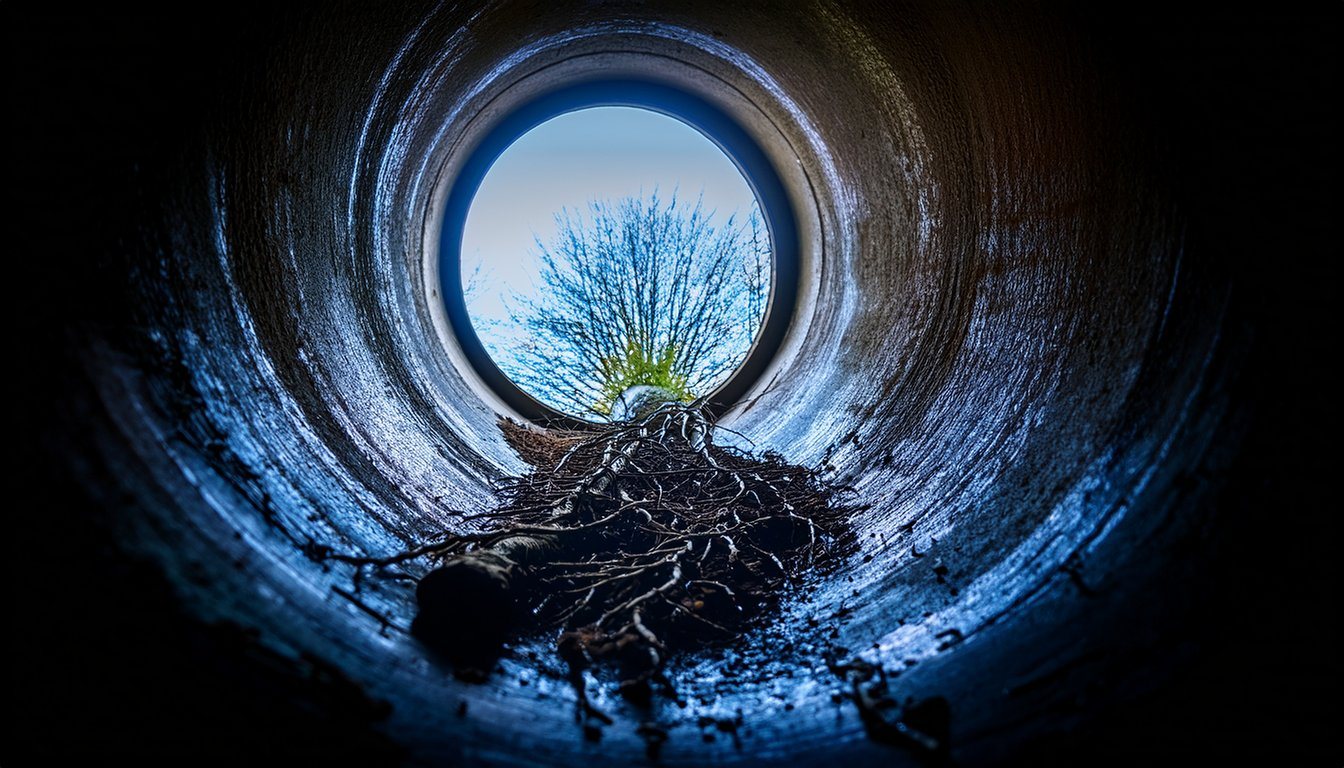
HomeGuide lists what inspectors find: cracks from aging pipes, rust and corrosion, offset pipes, pipe collapse and tree root intrusion, plus clogs from grease, hair and debris in sagging sections called bellies. The camera also shows the pipe material, which matters because HomeGuide says "Outdated Orangeburg and clay sewer pipes last 30 to 60 years, while PVC, cast iron, and copper sewer lines last 50 to 100 years." Here is what each common defect means:
- Roots. Fine hair-like roots through a joint, or a mass that blocks the pipe. The USDA Forest Service review notes root problems are more likely in "old systems and in cracked pipes." LA Sanitation says "Property owners must hire a licensed plumber to clear roots from private lines." Our guide to roots in clay sewer pipe explains what the root pattern tells you.
- Belly or sag. A low spot where water sits. Trenchlesspedia says "The only way to remedy a line belly is to excavate using conventional trenching methods" and replace the pipe with proper slope and bedding.
- Offset joint. Two pipe sections out of line. Trenchlesspedia warns that if a leak goes unrepaired long enough, "severe washout can lead to a manmade sinkhole."
- Cracks and fractures. In our experience, a hairline crack in otherwise sound pipe is watched or lined, while open fractures and missing pieces point toward repair. See our cracked sewer line guide.
- Corrosion and scale. In our experience, old cast iron shows up rough and scaly inside, which narrows the pipe and catches debris; our guide to cracked cast iron sewer pipe covers what to look for.
- Orangeburg deformation. Orangeburg is a fiber pipe; in our experience it shows up on camera flattened, oval or blistered. Wikipedia's entry says its useful life is "about 50 years under ideal conditions, but has been known to fail in as little as 10 years."
- Breaks and collapses. A section where the pipe wall is gone or the camera can't pass. See our collapsed sewer line guide.
- Grease and debris. In our experience, heavy grease buildup points to kitchen habits rather than pipe failure, though it often hides other defects until the line is cleaned.
What "fails" a sewer inspection
There's no universal pass or fail line for a home sewer scope. The video documents conditions, and what happens next depends on how serious they are and where they sit. Cities and utilities grade pipe defects using NASSCO's PACP coding system, where "Each defect observed is assigned a condition grade from 1 to 5, with 5 being the most significant defect grade and 1 being a minor defect grade." As one example, NASSCO notes that for a broken pipe, "if there is soil or a void visible behind the broken pipe wall (BSV or BVV), it is a grade 5."
In our experience, PACP grading is used mainly for municipal condition assessment, and a home inspector or rebate program won't necessarily grade your lateral that way. It's still a useful mental model: minor roots or a small crack sit at the low end, while breaks with voids, collapses and severe sags sit at the top and usually need repair.
What a good inspection report includes
In our experience, the report is what you'll use to get quotes, apply for rebates or negotiate a purchase, so it's worth checking before the crew leaves. You should leave with:
- The full video file, starting with the property address on screen if you plan to apply for the City rebate.
- A written report describing the pipe material, the condition and the location of each defect by distance from the entry point.
- Marks or measurements showing where problems sit along the line, and their approximate depth.
- Still images of the worst defects, which are easier to share than a long video.
In our experience, the video is the most valuable part. Keep a copy, because another contractor can quote from it and a future buyer may ask for it. A verbal verdict with no video is hard to act on.
Sewer inspection in Los Angeles: who owns which pipe
The lateral is the private pipe from your house to the public sewer main; the main is the public pipe, usually under the street. Across the LA area, agencies agree the lateral belongs to the owner, but they say it in their own words:
| Area | What the agency says |
|---|---|
| City of Los Angeles | LA Sanitation: "Property owners are responsible for the maintenance and repair of their entire lateral." |
| LA County Sewer Maintenance Districts | Public Works: "Homeowners are required to maintain the lateral from their home to the main sewer line, typically located in the street, or nearby easement." |
| Glendale | Public Works: "You own the waste pipe all the way up to the City's main line under the middle of the street including the connection at the main." |
| Burbank | Public Works describes the lateral as the part of your system that runs from your house to the public sewer main under the street, alley or easement; see its SLURP page. |
The County's districts cover a lot of ground. Public Works says the system "serves over 500,000 parcels and a population of over 2 million people within the unincorporated areas of the County, 37 cities, and two contract cities." It also notes that County laterals "typically range from four to six inches in diameter while the District's mainline is typically at least eight inches in diameter." If you're not sure which agency serves your address, your sewer bill or city public works department will tell you. Our guide to who is responsible for sewer line repair covers the question in more depth.
Glendale's FAQ also offers a simple test during a backup: "If the sewage stops backing up when all the water is turned off, then you should call a professional plumber as the source of the backup is likely in your private waste line." Our sewer backup guide covers what to do next.
The street section. In the City of Los Angeles, work between the property line and the main falls under a City S-Permit. The Bureau of Engineering says "Only a Bonded Sewer Contractor can apply for this permit and perform the work" when a new lateral must be built from the main.
LA-area rebates for sewer lateral inspections
City of Los Angeles CCTV rebate: up to $300. The City pays up to a $300 rebate to owners who pay sewer service charge to the City of Los Angeles.
- Who does the work. A licensed and bonded sewer contractor.
- Timing. The CCTV work must not have been completed more than 6 months before you complete the application, and rebates are paid on a first-come, first-serve basis, until annual allocated funds are exhausted.
- What you submit. The contractor's invoice with their license number, a copy of the CCTV video showing the property address at the start, and a CCTV inspection report, plus a recent DWP bill.
City of Los Angeles repair rebate: up to $2,500. If the camera finds damage, LA Sanitation offers up to a $2,500 rebate for the repair, and the application requires "a copy of the sewer lateral inspection video showing the address at the beginning of the video, as well as the damage to the sewer lateral needing repair" and a final CCTV report. Our guide on how to pay for sewer line replacement covers these programs alongside other options.
Burbank's SLURP credit. Burbank offers "a $150 rebate (in the form of a credit) on sewer service charges." It's limited to "single family residences and duplexes" (for duplexes, if the renters pay the sewer service charge), and the plumber has to clean and video the lateral all the way to the public main, with the address visible in the video. You submit the receipt, the video and the program form, and the City says packages are "reviewed the last week of each month."
In our experience, the rule that trips people up in both programs is the video: it has to show the address and cover the whole lateral, so tell the contractor up front that you plan to apply.
Older homes, hillsides and shared lines in LA
In our experience, a few conditions come up again and again on LA inspections:
- Older laterals. Many prewar and midcentury homes still have clay or cast iron laterals, and some have Orangeburg. Clay joints are where roots get in, and cast iron corrodes from the inside.
- Long setbacks and hillside lots. Lines that run a long way to the street, or down a slope, cost more to film and can have several changes in direction. Some hillside homes drain to a main behind the house or in an easement.
- Shared or easement laterals. Some older lots share a line with a neighbor, or the lateral crosses another lot. The camera can show where lines join, which helps sort out who owns what.
- Condos and HOAs. In a condo or townhome complex, the building's lines may be common property. Check the HOA documents before ordering work on a shared line.
If the video shows a problem
In our experience, the best next step is to get the video in front of two or three contractors and compare written scopes rather than accepting the first repair price. A clean pipe needs nothing but a copy of the video. Roots or grease in an intact pipe usually mean cleaning and prevention, a single cracked or offset joint is often a spot repair, and widespread cracking, bellies or a collapse point toward lining or replacement. Forbes Home notes that replacing a damaged section typically averages $2,500 and can run as much as $4,000, while replacing a whole sewer system can cost upwards of $20,000.
For the details, see our guides to sewer line replacement cost, trenchless sewer repair cost, pipe bursting vs pipe lining and choosing a sewer line repair company. This is general information, not legal advice; permit and rebate rules are set by your city.
Why cities care about your lateral
Your lateral connects to a very large public system. LA Sanitation says "The City operates more than 6,700 miles of public sewers" that "convey about 400 million gallons per day (MGD) of flow." Private laterals matter to that system because broken ones let groundwater and rain in. A 2005 staff report from the San Francisco Bay Regional Water Quality Control Board explained that "Sewer laterals in poor condition allow storm water and groundwater into the public sanitary sewer system. This additional water may overload pump stations and sewer pipes resulting in sewer overflows." The same report cited "One local study" in that region that found damaged private laterals contributed more than half of the extra water; that's Bay Area data, not LA, but it shows why cities offer rebates to get laterals inspected and fixed.
Sewer inspection before buying a house
A home inspection looks at the house; a sewer scope looks at the buried pipe that runs from the foundation to the public tap. Redfin lists what inspectors look for: broken or damaged pipes, major blockages, clogs, or debris, tree roots invading pipes, settling or sagging sewer lines, improper piping materials and installation issues. InterNACHI is clear about the limits: a sewer scope is "not technically exhaustive" and "will not identify concealed or latent defects."
Do you need one when buying? It's your choice, since InterNACHI's standards don't include it in a home inspection. In our experience, it's worth ordering on any older home, any home with large trees near the line, and any home where the seller can't say when the lateral was last replaced. Buyers negotiate best with the video plus a written repair quote based on it.
Is it required when you sell? Not in the City of Los Angeles. LADBS's list of requirements when selling includes smoke and carbon monoxide detectors and seismic gas shut-off valves, but no sewer lateral inspection. Some nearby cities differ: Rancho Palos Verdes recommends, but does not require, one around a sale.
Sewer inspection vs septic inspection
They look at different systems. A sewer inspection films the lateral that carries waste to a public sewer. A septic inspection checks an onsite system, which the EPA describes as "underground wastewater treatment structures that use a combination of natural and technological processes to treat wastewater from household plumbing produced by bathrooms, showers, kitchen drains and laundry." Most LA homes are on public sewer, but not all: LA Sanitation says "Approximately 13,000 residential, multi-family, and commercial/industrial properties within the City rely on OWTS." If you're considering a connection, see our guide on switching from septic to sewer.
When a sewer camera inspection is worth it
No City rule we know of requires an inspection on a schedule, but in our experience it is worth it in these cases:
- Before you buy an older home. InterNACHI says scoping "can reveal blockages, damage to the pipe system, and other problems, which are vital for homeowners and home buyers to be aware of."
- After repeat backups. LA Sanitation says "Over 50% of sewer backups are caused by tree roots and poured fats, oils, and grease (FOG)." A camera tells you which one you have; if a clog keeps returning, see our clogged sewer line repair cost guide.
- Every 10 years for older homes. This Old House says "Owners of older homes should have their main sewer line inspected this way at least once every 10 years."
- Before a remodel or addition. In our experience, adding bathrooms or an ADU is a good time to confirm the lateral can handle more use.
- Before you accept a repair bid. The video sets the scope, so every bidder should quote from the same footage.
Commercial sewer camera inspections
In our experience, commercial buildings, apartment complexes and restaurants often have larger and longer lines than a house. NASSCO says CCTV inspection "is one of the most effective methods used to determine the condition of existing and newly installed pipelines." Larger lines may call for a crawler camera, described below. In our experience, owners get more useful reports when they ask for a PACP-trained operator and a coded report.
How sewer inspection cameras work
Most residential inspections use a push camera. Envirosight, a camera maker, explains that "A push sewer camera is a small camera head that is fed into a lateral or drain line via a long cable." For bigger pipes, "Crawlers are sewer cameras on wheels or tracks, which move the instrumentation through sewers," and they can "typically crawl long distances, often more than 1000'."
Locating is what makes the video useful. Envirosight notes that "Modern sewer camera units usually have a sonde, or small radio transmitter, built in. These transmitters let operators trace the system's location underground." A sewer camera with a locator lets the operator stand over the camera head and mark it. As one example of the specs, RIDGID's SeeSnake Standard lists a 512 Hz sonde and a line capacity of 2 to 12 inches, and notes a "Self-leveling camera head keeps the image upright (certain models)."
Renting a sewer camera vs hiring a pro
HomeGuide says rentals run $120 to $225 per day and reach 150 to 200 feet. In our experience, a rental can show whether there's a problem, but it takes practice to push a camera through bends, read what you're seeing, and locate defects from the surface. A rental also won't meet the City rebate's requirement for a licensed and bonded sewer contractor, and in our experience it rarely gives a repair contractor enough to quote from.
Choosing who does the inspection
For the City rebate, hire a licensed and bonded sewer contractor and ask for an invoice that shows the license number and itemized CCTV cost. Check the license on the CSLB license lookup. In our experience, a company that inspects and also sells the repair should hand over the full video so another contractor can quote from it. Our guide to comparing sewer line repair companies covers choosing who does the repair.
A sewer camera inspection is one of the least expensive ways to learn the condition of the most expensive pipe on your property. Get the full video, make sure it meets the rebate rules if you plan to apply, and use it to compare any repair quotes. Medici Construction Group is one licensed option for sewer camera inspection and repair work in Los Angeles, holding California A, B and C-10 licenses under CSLB #1114433.
Frequently asked questions
How much is a sewer camera inspection in Los Angeles?
Angi's Los Angeles page lists a standard camera inspection at $230 to $460, an HD inspection at $460 to $910 and specialty work above that. National guides such as HomeGuide put a basic inspection at $125 to $500 with cleanout access. Ask which type a quote covers, and whether cleaning is included.
How long does a sewer scope take?
Forbes Home says a typical scope often takes a professional 30 to 60 minutes. In our experience, a missing cleanout, a long line or a clog that has to be cleared first are what stretch it, so mention any of them when you book.
Is a sewer camera inspection worth it?
Usually, especially on an older line. It costs a few hundred dollars, while Forbes Home puts whole-system replacement upwards of $20,000. In the City of Los Angeles, a qualifying inspection by a licensed and bonded sewer contractor can also earn up to $300 back from LA Sanitation.
Is a sewer scope part of a home inspection?
Not normally. InterNACHI says a sewer scope is not required by its Home Inspection Standards of Practice, so buyers order it separately. In our experience, many home inspectors offer it as an add-on, while plumbers and contractors call the same service a sewer camera or video inspection.
Can I get money back from the City for an inspection?
In the City of Los Angeles, LA Sanitation offers up to a $300 rebate for a sewer lateral CCTV inspection done by a licensed and bonded sewer contractor, with the video, report and invoice submitted on time. Burbank offers a $150 credit on sewer service charges for single-family homes and duplexes.
Who pays to fix a sewer lateral in LA?
The property owner. LA Sanitation says owners are responsible for their entire lateral, and LA County Public Works says homeowners maintain the lateral from the home to the main. The City's repair rebate of up to $2,500 can offset part of a qualifying repair.
Do you need a sewer inspection to sell a house in LA?
A sewer lateral inspection is not on LADBS's list of requirements when selling in the City of Los Angeles. Some nearby cities, such as Rancho Palos Verdes, recommend one around a sale. Buyers often order a scope anyway, so sellers sometimes get one first to avoid surprises.
Does homeowners insurance cover sewer line inspection or repair?
Standard policies usually don't cover the pipe itself; NerdWallet notes that if the broken pipe is on your property, you're on the hook for repairs. Optional service line coverage can help with repairs, so ask your insurer what it covers, including the inspection.