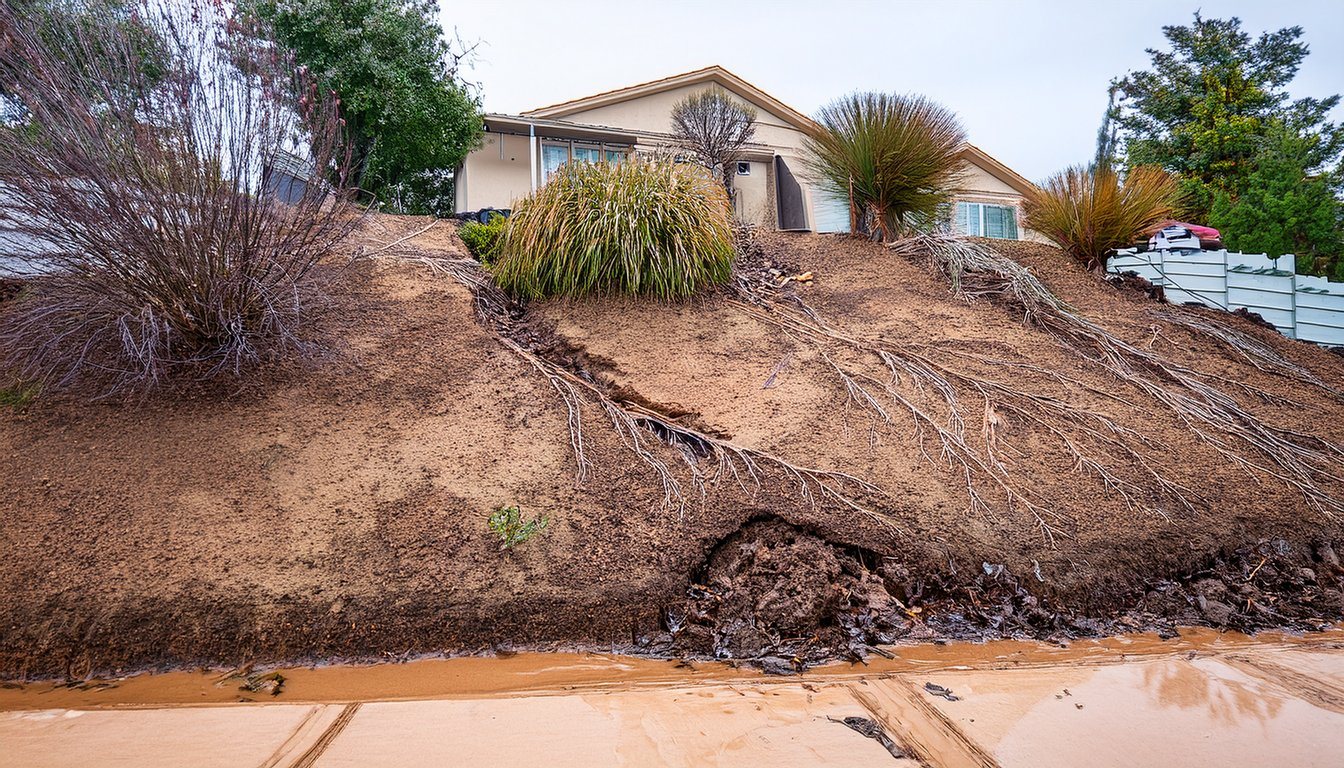
After a storm, there's soil on the patio, a fresh gully down the side of the hill and roots showing that weren't showing last year. Most advice starts with what to plant. On an LA hillside, the first fix is usually water. California's Office of Emergency Services puts it plainly: "Often, the single most important element that drives slope failures is the presence of excess water within the slope."
This guide starts with how to tell ordinary erosion from a slope that's moving. Then it covers four steps in order: control the water, cover the soil, break up the slope, and hold it. There's a separate section for owners in the 2025 burn areas.
Quick answers
- First step: get water under control. Fix leaks, cut back irrigation and keep roof and street runoff off the slope.
- Erosion or a slide? Rills and washed-down soil are erosion. New ground cracks, bulges, tilting trees or sticking doors can mean the slope is moving; call a professional.
- Cover bare soil: mulch, erosion control blankets or hydroseed, then deep-rooted native plants.
- Ice plant: not a good choice for slopes; its shallow roots and heavy leaves can slide in winter rain.
- Break up long slopes: fiber rolls (wattles) on the contour, and rock where water concentrates.
- Burn areas: debris flows can follow the first strong storm after a fire, and the risk can last for years.
First, is it erosion or is the slope moving?
Erosion is soil washing off the surface. In our experience, it looks like rills and small gullies, exposed roots, mulch and soil collecting at the bottom, and muddy water coming off the hill in a storm. It's a problem worth fixing, but it's usually not an emergency.
A slope that's moving is different. The U.S. Geological Survey lists warning signs that include "New cracks, bulges, or other deformation in the ground, roadways, or other surfaces", "Sticking windows or doors; new cracks in walls, ceilings, or foundations", and "Sagging or taut utility lines caused by leaning utility poles, deformed fences, or tilting of trees on a hillside." It also lists "Springs, seeps, or saturated ground in areas that have not typically been wet before."
If you see those signs, don't start digging or planting. Call the City or a geotechnical engineer first; our hillside stabilization guide covers what to do when a slope is moving. New cracks in the house are covered in our foundation cracks guide. The rest of this guide is for surface erosion.
Step 1: control the water
Water on and in the slope is what moves soil, so this step comes before any plants or products. Cal OES says "Excess water can enter the slope due to over-irrigation, broken sprinkler pipes or water mains," and that "Diverting as much storm water as possible away from the slope helps to prevent failures." USGS advises homeowners to "note the places where runoff water converges, increasing flow in channels."
In our experience, these are the fixes that matter most on LA hillsides:
- Find and fix leaks. A broken sprinkler line or a leaking pool can keep a slope wet all year. Look for green or soggy patches that don't match the watering schedule.
- Water less, especially in the rainy season. Turn slope irrigation down or off once the rains start.
- Keep roof water off the slope. Downspouts that empty onto the top of a hill send the whole roof's rain down one path. Pipe it to the bottom or to an approved outlet. Our yard drainage guide covers downspouts and grading, and our storm drain installation guide covers pipes and outlets.
- Stop water at the top. A small berm or swale at the top of the slope can catch runoff from a driveway or patio and carry it around the slope instead of over it.
Step 2: cover the bare soil
Bare soil washes away fastest. The goal is to keep rain from hitting it directly while plants get established.
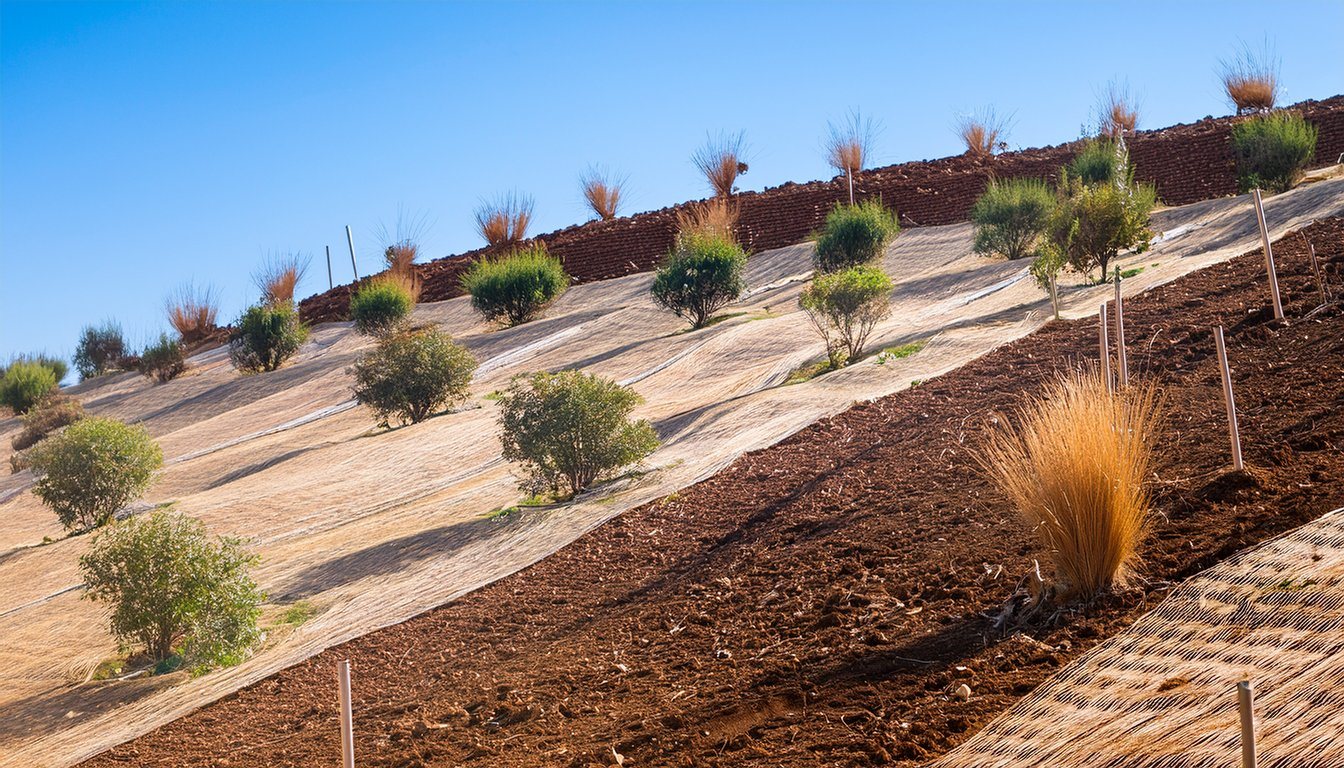
Mulch, blankets and hydroseed. Caltrans' erosion control toolbox lists treatments that "provide protection from raindrop impact and splash erosion", including rolled netting and blankets. In our experience, jute or coir netting pinned over mulch works well on steeper sections. Hydroseeding sprays seed, mulch and water together, and Angi puts it at "$0.07 to $0.26 per square foot."
Plants with deep roots. Cal OES says that for erosion control or slope stabilization, "it is important to use fast growing species that have extensive and deep root systems," and names "Coyote Bush, Manzanita, and California Sagebrush" as examples. In our experience, once established, natives like these need little summer water, which also helps Step 1.
Skip the ice plant. It's everywhere on LA slopes, but it's a poor erosion fix. The California Native Plant Society notes that "Most ice plant roots are shallow, 3 to 6 inches deep," and that in winter rains the plant can gain enough weight to "slide down the slope dragging top soil with it and exposing the soil beneath to rapid erosion."
Brush clearance without bare dirt. In LA's fire zones, brush clearance is required. LAFD's rules include "Grass shall be cut to 3 inches in height," with clearance required within 200 feet of structures. In our experience, cutting to height, rather than scraping a slope down to bare dirt, leaves roots holding the soil. Check with LAFD on what your lot requires before you clear.
Step 3: break up the slope
On a long slope, water picks up speed and cuts deeper as it goes. Breaking the slope into shorter sections slows it down.
Fiber rolls (wattles). The California Stormwater Quality Association's fact sheet explains that when fiber rolls are placed on slopes along the contours, "they intercept runoff, reduce its flow velocity, release the runoff as sheet flow, and provide removal of sediment from the runoff." The EPA adds that fiber rolls "reduce the erosive potential of stormwater on long or steep slopes." In our experience, they need to be trenched in and staked, with the ends turned slightly uphill, or water runs around them.
Installing fiber rolls so they work
Wattles fail most often because they're laid on top of the soil, so water runs underneath. The EPA's fiber roll fact sheet gives the basics: install them "along the contour of a slope, perpendicular to the direction of flow," "in trenches at least 2 inches deep," with stakes "every 4 feet" that "extend at least 12 inches below the ground surface." Turn the ends upslope so water can't sneak around them.
Spacing depends on steepness. For 8-inch rolls, the guidance it cites puts them 10 feet apart on a 1:1 slope, 20 feet on 2:1, 30 feet on 3:1 and 40 feet on 4:1 or flatter. After storms, check that the rolls are still anchored, and "When sediment accumulation reaches one-third of the height of the roll on the upslope side," clear the sediment. Split, torn or slumping rolls should be repaired or replaced. In our experience, pairing wattles with seed or plants just above each row lets roots take over as the rolls break down.
Check dams in small channels. Where water already runs in a groove, the EPA says "Check dams reduce erosion by reducing flow velocities." Don't use straw bales there: the EPA says they "cannot withstand high flows" and shouldn't go across ditches or other concentrated-flow areas.
Rock where water concentrates. Blankets and plants protect the open face of a slope. Pipe outlets and channel edges need something tougher. The EPA describes riprap as "a layer of large stones that protects soil from erosion in areas of high or concentrated flows," including at outlets for slope drains and storm drains.
Terraces. Caltrans lists stepped slopes among its treatments. In our experience, small planted terraces work on gentle slopes. Anything that holds back real soil height is a retaining wall and should be treated as one. For terrace and wall looks, see our retaining wall ideas.
Step 4: hold the slope
Surface fixes won't stop a slope that's too steep, too wet or already moving. That's when the work turns into engineering. The City's grading code lists the kinds of measures that can be required, including terracing, compaction, cribbing, retaining walls or buttress fills, slough walls, desilting basins, check dams, benching, wire mesh and guniting (LAMC Section 91.7007).
In our experience, retaining walls are the most common of these for homeowners. HomeGuide says a wall "costs $35 to $65 per square foot on average," but in LA, height, drainage and permits drive the price. Our retaining wall cost guide and retaining wall design guide cover both.
Permits. LADBS says a grading permit is required for any grading work in the hillside grading area, as well as removal and re-compaction or backfill. The code also sets extra rules for larger jobs:
- It treats October 1 to April 15 as the rainy season, when permitted grading over 200 cubic yards can't start until an erosion control system is approved.
- In hillside areas, excavation or fill of 250 cubic yards or more (LAMC Section 91.7006) requires a bond before the permit is issued.
- Soils and geological reports are required for larger grading work, with a 5,000 cubic yard threshold in the City code (LAMC Section 91.7006).
In our experience, most hillside walls and drainage projects need an engineer's design well below those volumes, so plan on one for anything structural.
If you're in a 2025 burn area
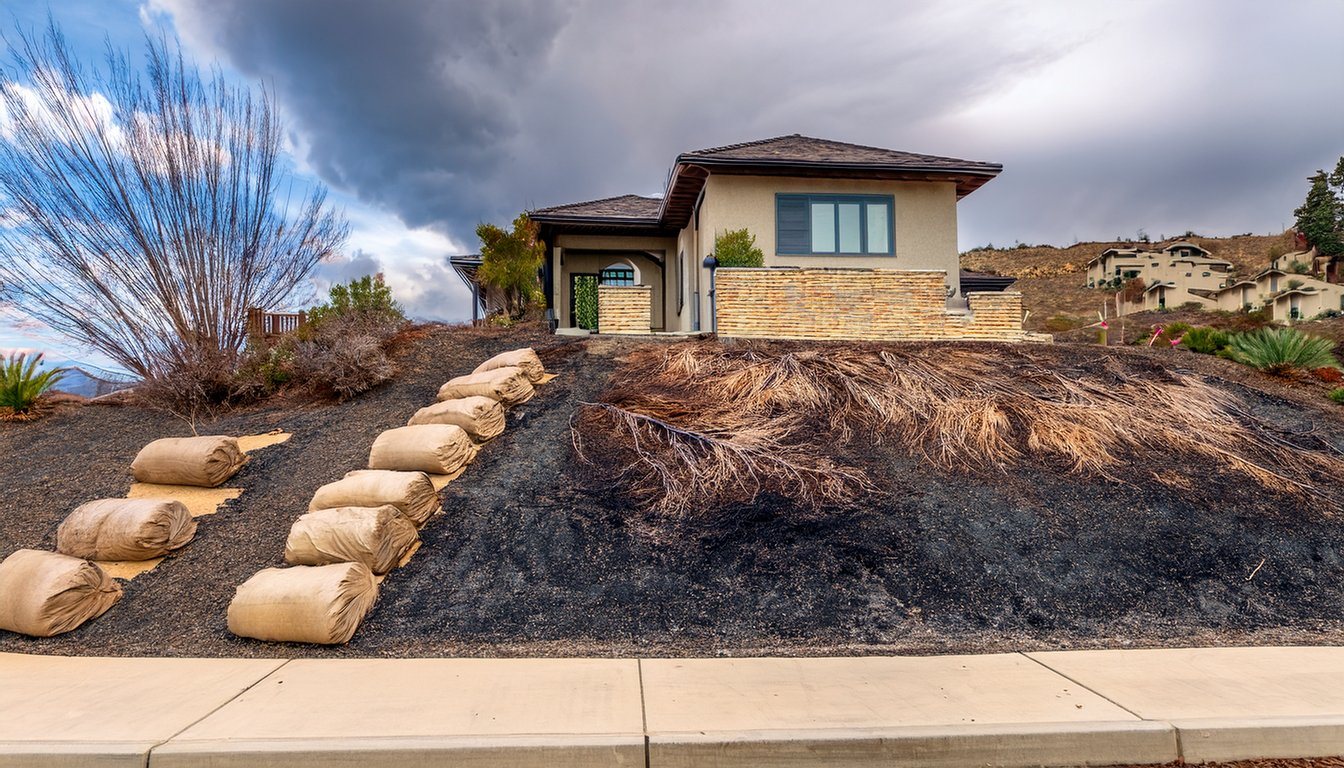
After a fire, bare, baked soil sheds water fast. USGS says post-fire debris flows "are typically triggered by short bursts of intense rainfall and can occur during the first storm following a wildfire," and that "Elevated debris-flow susceptibility may persist for several years." LA County Public Works warns that "Small, isolated mud and debris flows are possible in burn areas with less than two years of recovery."
The County tells burn-area residents to "Use sandbags to direct runoff and protect structures" and to "Clear drainage paths." LA County Fire's sandbagging instructions say to "Fill sandbags one-half full", to place them "with the folded top toward the upstream or uphill direction," and warn that "Sandbags will not seal out water." They guide water; they don't stop a debris flow. Follow evacuation orders when they come.
When to call a pro
Mulch, natives, wattles and fixing a leak are reasonable DIY work. In our experience, it's time to call someone when you see any of the USGS warning signs, when water from a neighbor's lot or the street is running onto your slope, when a wall is leaning or cracking, when the fix needs grading, pipes or a wall, or when erosion keeps coming back after you've tried the simple steps. Start with a geotechnical or civil engineer if the slope may be moving.
Check any contractor's license before you sign. Our guide on how to check a California contractor's license walks through it. Medici Construction Group is one licensed option for slope and drainage work, holding California A, B and C-10 licenses under CSLB #1114433. Whoever you hire, ask them to start with where the water goes.
Frequently asked questions
What is the best way to stop erosion on a slope?
Control the water first: fix leaks, reduce irrigation and keep roof and street runoff off the slope. Then cover bare soil with mulch, blankets or hydroseed, plant deep-rooted natives, and break long slopes up with fiber rolls.
What are the best plants for erosion control on a slope in Southern California?
Fast-growing plants with deep, extensive roots. Cal OES names coyote bush, manzanita and California sagebrush as examples. In our experience, natives also need little water once established, which keeps the slope drier.
Is ice plant good for erosion control?
No. Its roots are shallow, about 3 to 6 inches, and its leaves gain weight in winter rain, so it can slide off a slope and take topsoil with it.
Do I need a permit for erosion control on my hillside in Los Angeles?
In our experience, planting, mulch and wattles usually don't need one. LADBS requires grading permits for grading work in the hillside grading area, and retaining walls and drainage systems often need permits and an engineer's design.
How much does erosion control on a slope cost?
It depends on the fix. Angi puts hydroseeding at $0.07 to $0.26 per square foot, while HomeGuide puts retaining walls at $35 to $65 per square foot on average. Drainage work falls in between and depends on pipe length and outlets.
How long does debris-flow risk last after a wildfire?
USGS says elevated risk may persist for several years, and LA County notes small debris flows are possible in burn areas with less than two years of recovery. Debris flows can happen in the first strong storm after a fire.
How far apart should wattles be on a slope?
The EPA fiber roll fact sheet cites spacing for 8-inch rolls of 10 feet apart on a 1:1 slope, 20 feet on 2:1, 30 feet on 3:1 and 40 feet on 4:1 or flatter. Set them on the contour in a shallow trench and stake them about every 4 feet.