In our experience, a lot of commercial EV charging projects start in the wrong place. The owner picks a charger, sometimes orders it, and then learns from the load calculation or the utility that the building can't power as many ports as planned, or that the power is on the far side of the lot from where the chargers were supposed to go. The site plan changes, and so does the budget.
The charger is the last thing installed and usually the easiest decision to change. A commercial EV charger installation is really a sequence of steps, and the early ones, especially electrical capacity and the utility, decide what's possible in the later ones. Here's the order we work them in, and what each step locks in for the rest.
Quick answers
- Decide the site, how many ports you need now and later, and who will use them.
- Run a load calculation on the existing electrical service.
- Bring in the utility early to confirm how much power the site can get.
- Design the layout, draw plans and get the permit.
- Do the site work and install the equipment.
- Pass inspection, get energized and commission the chargers.
You can buy and own the chargers, or host chargers owned and run by a provider; our guide to commercial EV charging solutions compares those models, and our commercial EV charging station cost guide covers the budget.
Who owns each step
| Step | Owner | Contractor | Utility | Building department | Network provider |
|---|---|---|---|---|---|
| 1. Site and ports | Decides | Advises | - | - | - |
| 2. Load calculation | Supplies bills | Runs it | Meter data | - | - |
| 3. Utility capacity | Signs application | Prepares it | Answers | - | - |
| 4. Design and permit | Approves layout | Plans and submits | Service design | Reviews | - |
| 5. Site work and install | Keeps site available | Builds | Its side of the meter | Inspects | - |
| 6. Energize and commission | Accepts | Tests and hands over | Energizes | Final sign-off | Activates |
That split is how the projects we see usually run; on some sites, a provider or a utility program takes on more of it.
Step 1: Decide the site and the number of ports
Start with how the chargers will be used: employees, customers, tenants, a fleet, or the public. That decides how many ports make sense now and how many you may want later. Our commercial charging solutions guide covers how dwell time points to the type of charger.
Before you call anyone, have this ready:
- A site plan or parking layout, even a marked-up aerial photo.
- Recent utility bill history for the building's meter.
- Photos of the main electrical panel or switchgear, including the nameplates.
- Landlord or lease approval, if you're a tenant.
- How many ports you want now, how many later, and who will use them.
In our experience, where the chargers go is decided as much by the distance to the power and the accessible route from the spaces as by which spaces you'd like to give up.
What it locks in: the number of ports the design has to power, now and later.
Step 2: Check electrical capacity with a load calculation
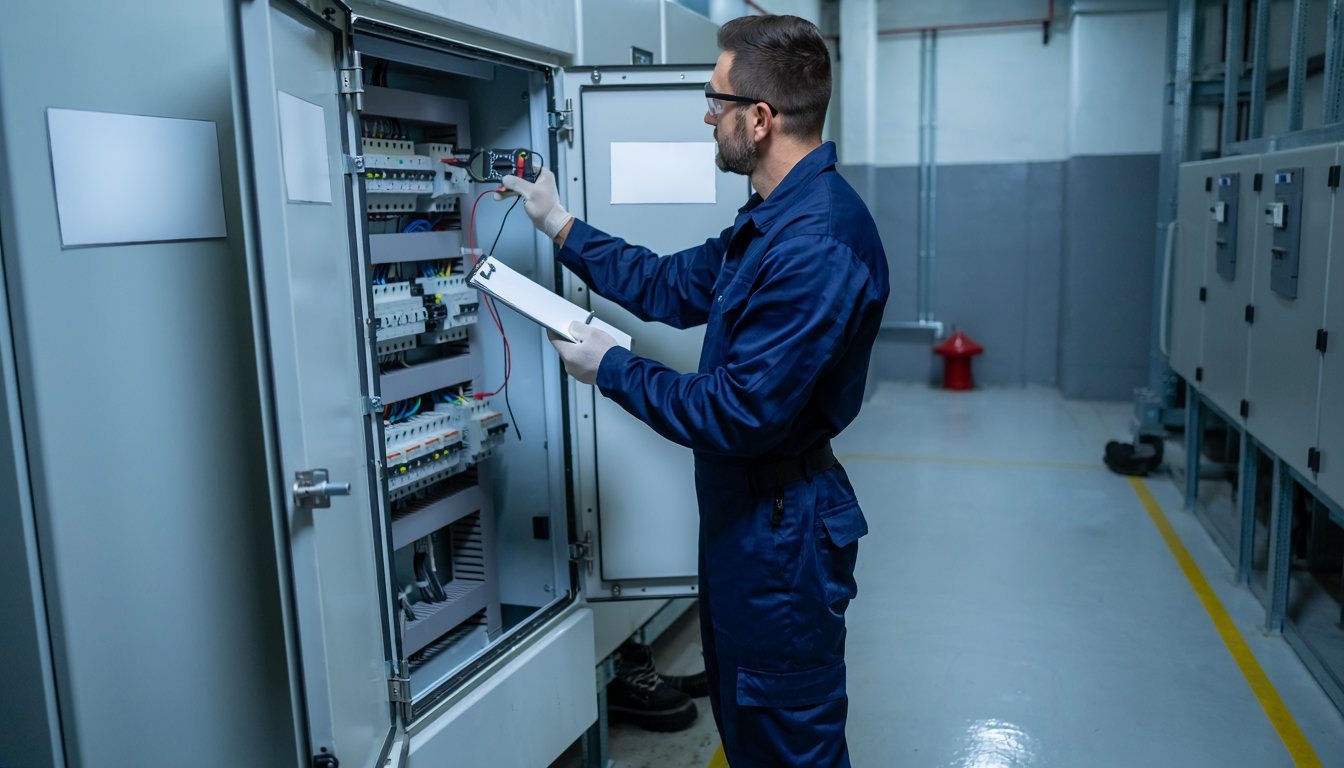
In our experience, this is the step that most often changes a plan. A load calculation takes the building's actual demand, from utility bills or meter data, and compares it with what the existing service can carry. What's left is the room available for chargers.
If there isn't enough room, there are three usual paths: load management, which shares the available power among the chargers so the total stays within limits; a service upgrade; or a separate new service just for charging. Each has trade-offs in charging speed, cost and schedule. Our electrical panel upgrade guide and our explainer on 400 amp service cover the upgrade side.
What it locks in: whether the project needs utility work, and how much.
Step 3: Bring in the utility early
In our experience, the utility has the final word on how much power the site can get. The federal site selection checklist published on DriveElectric.gov tells site hosts to "Engage with the area power utility partner to understand site limitations and costs related to electricity supply at the potential site location, including grid-level constraints." It also says: "Confirm that the utility can support the full power of the electricity required by the charging stations."
In the Los Angeles area, that's usually LADWP or SCE depending on the address. In our experience, when a project needs a new or upgraded service, the utility's own design and equipment on its side of the meter can set the schedule for the whole job, so the application goes in as early as the load calculation allows. The utility's answer can also move the chargers: the best spot on paper may be the one farthest from where the utility can deliver power.
What it locks in: the power available, where it enters the site and the schedule for any utility work.
Step 4: Design, plans and the permit
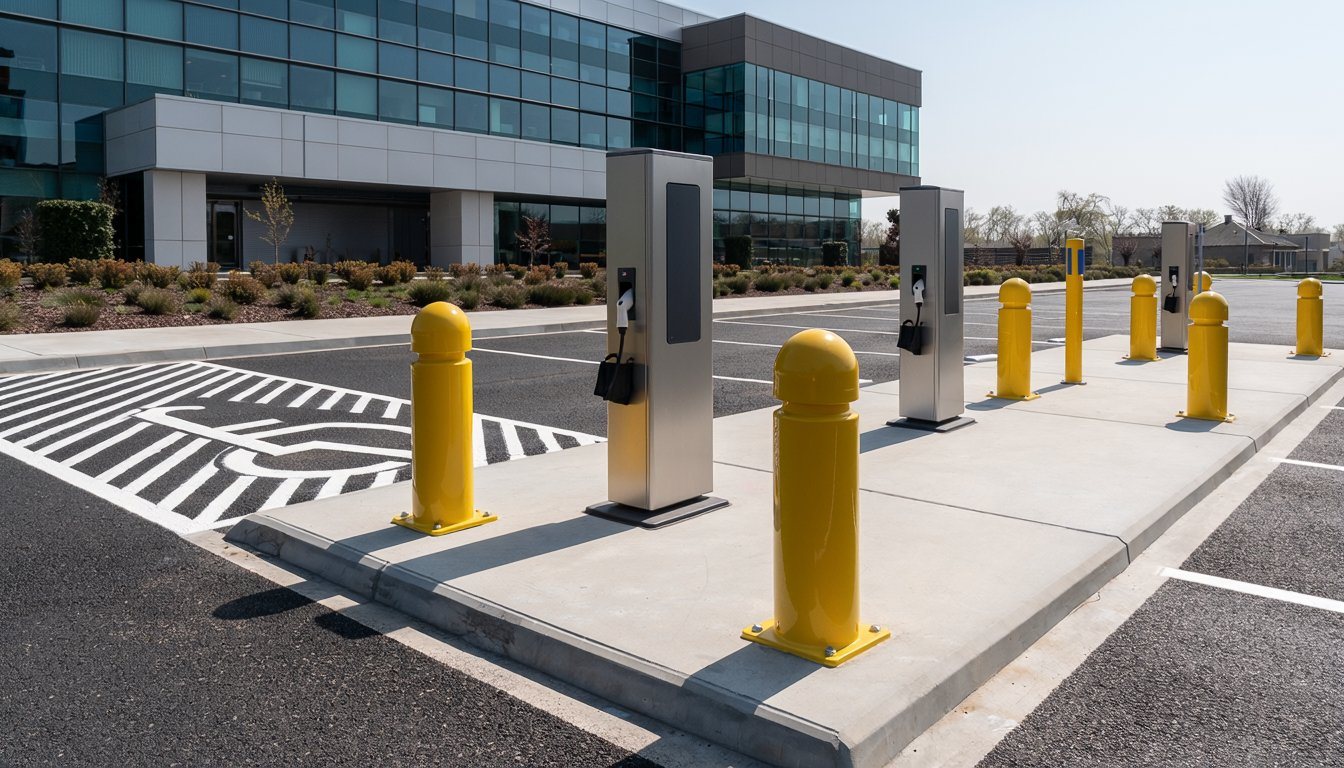
With capacity and the utility's answer in hand, the design can be finished. In our experience, a commercial plan set usually shows the site plan with charger locations, the accessible spaces and route, the conduit and trench path, single-line electrical diagrams, the load calculation, equipment specifications and any concrete pads or protective bollards.
According to the U.S. Department of Energy's Alternative Fuels Data Center, California requires cities and counties to expedite and streamline charging station permitting, and it summarizes one piece of that process: "1-25 stations: AHJs have 5 business days to deem an application complete or incomplete." It also lists practices such as "Creating a checklist of requirements needed for expedited review that is available and easily found on the city or county website". In our experience, a complete first submittal that follows the local checklist is the best way to use that process.
In our experience, accessibility is part of the review, not an add-on; our cost guide explains how accessible spaces are counted, and our guide to commercial EV charging hubs covers California's streamlined permitting in more detail.
What it locks in: the approved layout; changes after this point usually mean a revision.
Step 5: Site work and installation
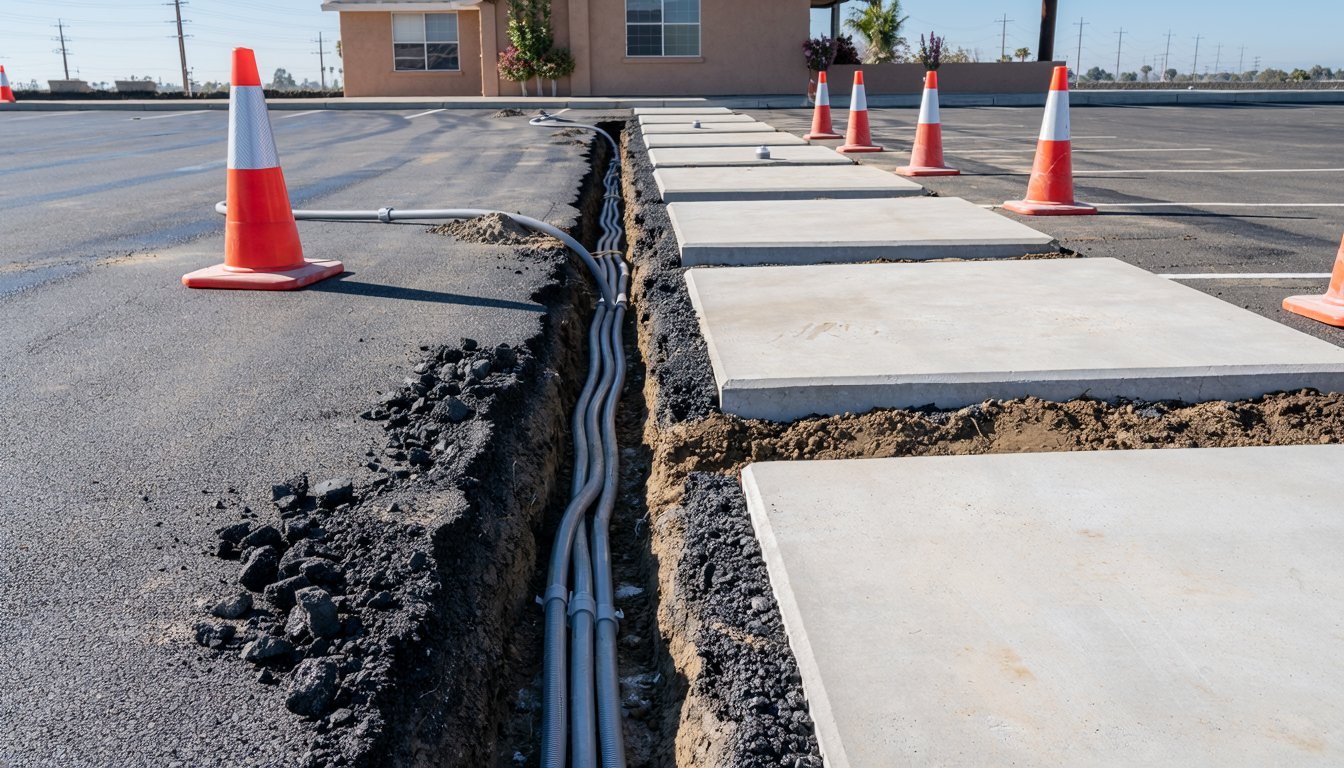
This is the part most people picture. In our experience, it usually includes cutting and trenching pavement, laying conduit, pouring pads, setting bollards or wheel stops, pulling wire, installing any new panel or service equipment, mounting the chargers, then patching, striping and signage. Trenching through existing concrete or asphalt is often the largest piece of site work; our guides to trenching for electrical conduit and underground conduit costs go deeper.
Who does the work matters on some projects. For charging equipment on the customer side of the meter that is "funded or authorized, in whole or in part" by the CPUC, the Energy Commission or the Air Resources Board, California Public Utilities Code section 740.20 requires installation "by a contractor with the appropriate license classification" and "at least one electrician on each crew, at any given time, who holds an Electric Vehicle Infrastructure Training Program certification." For ports supplying 25 kilowatts or more, it requires that "at least 25 percent of the total electricians working on the crew for the project, at any given time" hold that certification. The section doesn't apply to work by utility employees, to projects funded by Low Carbon Fuel Standard credits, or to single-family home chargers on an existing outlet. If you're using a utility program or grant, confirm the crew meets it before work starts.
What it locks in: the physical layout; moving a charger after the pad is poured means new trenching.
Step 6: Inspection, energization and commissioning
In our experience, the building department inspects in stages, typically before trenches are backfilled and again at the end. If a new or upgraded service is involved, the utility typically energizes it after the inspection is released. Then the chargers are commissioned: connected to their network if they're networked, set up for who can use them and how they pay, and tested by charging an actual vehicle.
Before the job closes, the owner should have the permit sign-off, as-built drawings, equipment warranties, network account access and a clear contact for maintenance and repairs. In our experience, those documents matter the first time a charger faults or the site adds ports.
It also helps to settle the site rules before opening day: which spaces are for charging only, how long a car can stay, and who handles a blocked or damaged charger. In our experience, clear signage and a named person on site prevent most of the early complaints.
What it locks in: the chargers go into service, and the site's records for every future change.
Where commercial installs stall
In our experience, delays and change orders come from a short list:
- Hardware bought before the load calculation and the utility's answer.
- A service upgrade discovered after the layout is set.
- Chargers placed far from the power, stretching the trench.
- An accessible route that doesn't work with the chosen spaces.
- Incomplete permit submittals that restart review.
- Funding requirements, such as crew certification, checked too late.
- No conduit left for future ports, so the next phase cuts the same pavement again.
Most of these trace back to doing the steps out of order.
The bottom line
A commercial EV charger installation goes best when the steps run in order: decide the site and ports, run the load calculation, get the utility's answer, design and permit, build, then inspect, energize and commission. The charger itself comes last. Medici Construction Group is one licensed option for commercial EV charger installations, holding California A, B and C-10 licenses under CSLB #1114433.
Frequently asked questions
Who can install a commercial EV charger in California?
In our experience, a licensed contractor holding the classification the project requires, typically C-10 electrical. If the project is funded or authorized by the CPUC, the Energy Commission or CARB, including many utility programs and grants, state law also requires at least one EVITP-certified electrician on each crew, and more for ports of 25 kilowatts or more.
Do I need to call the utility before installing chargers?
In our experience, yes, and early. The utility has the final word on how much power the site can get and whether a service upgrade or new equipment on its side is needed. That answer can change how many chargers fit and where they go, so it's worth having before the design is finished or equipment is ordered.
Can my existing electrical service handle EV chargers?
Sometimes. A load calculation compares the building's actual demand, taken from utility bills or meter data, with what the service can carry. If the room left over isn't enough, the options are load management that shares the available power among chargers, a service upgrade, or a new service for the chargers alone. In our experience, the load calculation should come before choosing hardware.
Do I need a permit for a commercial EV charger?
In our experience, yes. Commercial charger installations need an electrical permit, most jurisdictions also require plan review, and accessible spaces and routes are part of what gets reviewed. California law directs cities and counties to streamline charging station permitting, and the Department of Energy notes a short completeness-check window for smaller projects; your building department confirms what applies.
What happens after the chargers are installed?
The work is inspected, the utility energizes any new service, and the chargers are commissioned: connected to their network if they're networked, configured for access and payment, and tested with a vehicle. In our experience, the owner should also receive the as-built drawings, permit sign-off, warranty and network account details, and a maintenance contact before the job is closed out.
Can I install EV chargers in phases?
Yes. In our experience, the cheapest time to plan for future ports is during the first trench: running extra conduit and sizing the pathway for later chargers avoids cutting the same pavement twice. The electrical capacity for those future ports still has to be available or planned, which is part of the utility conversation.
Who does what on a commercial EV charger project?
The owner decides the site, the number of ports and how they'll be used; the contractor handles the load calculation, design, permit and construction; the utility handles service capacity and energization; the building department reviews and inspects; and a network provider activates networked chargers. The table near the top of this guide lays out each step.