On our jobs, the first crew at an emergency sewer call is rarely doing the repair. Sewage is surfacing in the yard or backing up the moment someone runs water, and the job in front of them is to stop it, make the site safe and find out what broke. The permanent fix, and the paperwork that goes with it, comes after the spill is under control and the line has been filmed.
That's the gap in most emergency sewer repair advice: it treats the emergency and the repair as one job. They're usually two. This guide covers what counts as an emergency, how a line gets stabilized, how the permanent fix is chosen, how the rules treat urgent work in the street, and who does what.
Quick answers
- First thing to do: stop using water in the house and keep sewage away from people, pets and storm drains.
- What the first visit usually does: restores flow, contains the spill and films the line.
- The permanent fix: a spot repair, trenchless repair or replacement, chosen from the video.
- Street work in LA: the City's code lets emergency street excavation start before the permit, with an application the next regular business day.
What counts as a sewer emergency
For work in the public right-of-way, the City of Los Angeles excavation code gives a useful definition. It describes emergency work as "immediate and unplanned action that must be taken to alleviate a hazardous condition, which represents an immediate threat to life, health, safety, or property."
In our experience, these are the signs that a broken sewer line has crossed that line:
- Sewage surfacing in the yard, at the cleanout or in the street.
- A backup that returns right away after the line is cleared, which usually points to a break rather than a clog.
- A sinkhole or sudden depression over the sewer line.
- A line broken during other work, such as digging for a fence, a utility or a foundation.
- Sewage reaching a gutter or storm drain.
In our experience, a slow drain or a line that needs occasional cleaning is urgent but usually plannable. Our collapsed sewer line guide covers how to tell the difference when the pipe has failed. If sewage is inside the house, start with our emergency sewer backup guide.
Stabilize first
The first goal is to stop the damage from spreading. San Luis Obispo County's disaster-response guidance puts the household part simply: "If a sewer or septic line blockage is suspected or obvious, discontinue discharge of wastewater in house or building drains and do not flush toilets." It lists "Portable camp toilets, R-V toilets, porta-potties, etc." as alternatives while the system is down.
On the crew's side, what we see on a typical emergency call is some combination of:
- clearing the line so waste can flow again, if the pipe is intact enough to carry it;
- relieving pressure at the cleanout so sewage stops backing into the house;
- containing sewage on the surface and keeping it out of gutters and drains;
- barricading any hole or sinkhole so no one steps or drives into it;
- on larger or longer failures, temporary pumping to move waste around the broken section.
Stabilizing isn't the repair, but it buys the time to do the repair right. Paying for a full replacement while sewage is still on the ground and nobody has filmed the line is, in our experience, the most expensive way to handle a sewer emergency.
Find the break
Once flow is restored, the line gets filmed. A camera shows where the break is, how far from the cleanout, how deep, and whether the rest of the pipe is sound. That video is what separates a spot repair from a full replacement, and it's what every other contractor will need if you want a second opinion. Our sewer camera inspection guide covers what the footage shows and what a good report includes.
On our jobs, a camera sometimes can't get through: the pipe is collapsed or packed with soil. In that case the break is usually located from the surface by the point where the camera stops, and the first excavation both exposes the problem and becomes the access point for the repair.
Choose the fix: spot repair, trenchless or dig
The permanent repair depends on what the video shows. One city's lateral inspection program, Santa Barbara's, describes when a small fix is enough: "Point repairs, or spot repairs, can work when the existing pipe is in good condition but there are only few, distinct repair locations." It recommends replacement "if there are several locations or defects that would make the replacement the best option."
In our experience, the choices break down like this:
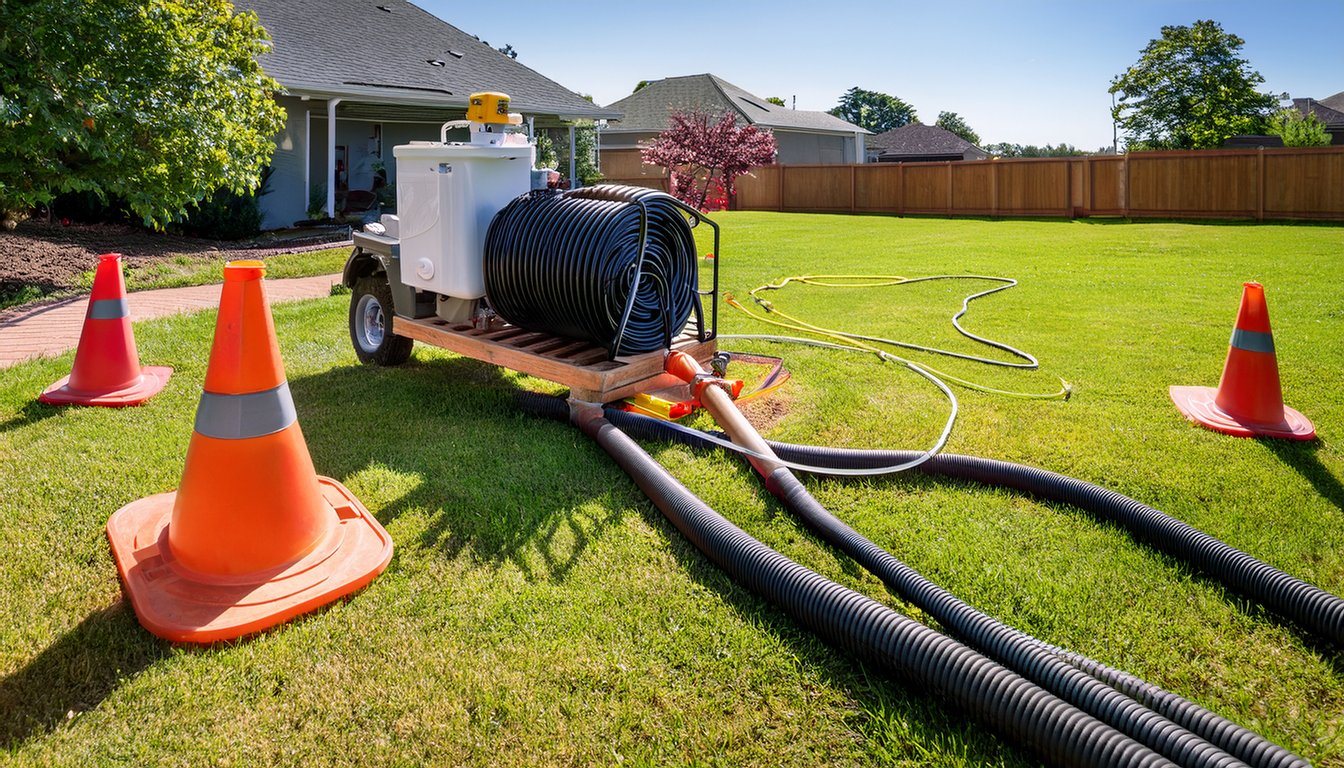
- Spot repair. Dig at the break, cut out the damaged section and join new pipe with repair couplings. Often the fastest permanent fix when the rest of the line is sound.
- Lining. A new pipe is formed inside the old one. It avoids most digging but needs a pipe that's round enough and clear enough to line.
- Pipe bursting. A new pipe is pulled through the old one, breaking it outward. It needs access pits at each end.
- Open trench replacement. The whole line is dug up and replaced, usually when the pipe has collapsed in places, sags or has failed along its length.
Can it be done without digging up the yard? Often partly. On our jobs, lining and bursting avoid a long trench but still need access points, and a collapsed section usually has to be dug at that spot before anything can pass. Our guides to pipe bursting and trenchless sewer repair explain when each method fits.
On our jobs, the emergency visit often ends with a spot repair or a stabilized line, and a trenchless repair of the rest is scheduled after, because lining and bursting need the pipe cleaned, filmed and measured first.
When the break is in the street
A break between the property line and the city main adds another layer. In Los Angeles, work on the house connection in the public right-of-way falls under the Bureau of Engineering's S-Permit, and a Bonded Sewer Contractor is required to do that work.
For emergencies, the City's excavation code for the public right-of-way allows the work to start first. It says the person doing emergency work "shall apply for a permit therefor on the next regular business day following the day on which such excavation was commenced." The application has to include documentation "confirming the nature and scope of the work required and verifiable information related to the event(s), actions, inactions or proximate causes of the required emergency excavation."
That rule is written for excavation in the street. A repair on private property is a separate question, so confirm with LADBS or the Bureau of Engineering which permit applies to your job. This is general information, not legal advice.
Sewage outside: containment and reporting
A broken lateral isn't just a household problem. The State Water Board notes that "Private laterals spills are caused from failures in sewer pipes that tie private businesses and homes into the public sewer system." Where the sewage goes matters. Cal OES's fact sheet says an unauthorized discharge of sewage into or onto state waters "must be reported to Cal OES", and that "Upon such notification, Cal OES will then immediately notify the appropriate Regional Water Quality Control Board".
A spill contained in a yard may fall outside that, but a spill that reaches a gutter, storm drain or creek is a different matter. In our experience, the practical rule is to keep sewage out of anything that drains to the street, block the path with sand or a berm if you can do it safely, and mention any drain involvement when you call for help.
Who does what in a sewer emergency
Who offers emergency sewer line repair depends on what broke and where. In our experience, the help comes from three places:
- Drain and plumbing companies clear lines, relieve backups and run cameras. Many handle spot repairs on private property.
- Sewer and excavation contractors dig, repair and replace laterals, including work in the street where the right permit and bonding are required.
- The city or sewer district handles problems in the public main.
When you call, ask what the company can do on the first visit, what it would hand off, and whether it can do street work if the break turns out to be there. Our guides on who to call for a sewer backup and hiring a sewer backup plumber cover the first call in more detail.
What to get in writing, even in an emergency
Urgency makes it easy to agree to anything. In our experience, a short written scope protects you:
- what the stabilization visit includes, and what it doesn't;
- a copy of the camera video once the line can be filmed;
- which part of the line the permanent repair covers, and the method;
- who pulls which permits, including any street permit;
- how the work is priced, and how unexpected conditions are handled;
- what the warranty covers.
For the permanent repair, it's fair to take the video to more than one contractor. Our guide to choosing a sewer line repair company covers how to compare bids.
An emergency sewer repair goes best when it's handled as two jobs: stabilize now, then fix it right from the video. Keep sewage out of drains, get the line filmed, and match the repair to what the camera shows. Medici Construction Group is one licensed option for sewer line repair and street connection work in Los Angeles, holding California A, B and C-10 licenses under CSLB #1114433.
Frequently asked questions
Do you need a permit for emergency sewer repair?
It depends where the work is. The City of Los Angeles excavation code for the public right-of-way lets emergency street excavation start and requires a permit application on the next regular business day. Work on private property is a separate question, so confirm with LADBS or the Bureau of Engineering before assuming either way.
Can a broken sewer line be fixed right away, or only stabilized?
Often only stabilized at first. On our jobs, the first visit restores flow and stops sewage reaching the surface; the permanent repair follows once the line has been filmed and the right method is chosen. A single break in otherwise sound pipe can sometimes be repaired on the first visit.
Can an emergency sewer repair be done without digging?
Sometimes. In our experience, lining and pipe bursting avoid most digging, but they need access pits and a pipe the equipment can work in. A collapsed or badly sagging section usually has to be dug up and replaced, at least at that spot.
Is a spot repair enough?
It can be. One city's lateral inspection program says point repairs can work when the pipe is in good condition with only a few distinct repair locations, and that replacement makes more sense when there are several defects. The camera video decides which applies.
Who fixes a broken sewer line under the street?
It depends which pipe broke. The public main is the city's; in Los Angeles, work on a house connection in the street requires a Bureau of Engineering S-Permit and a Bonded Sewer Contractor.
What should I do about sewage coming up in the yard?
Stop using water in the house and keep people and pets away. Cal OES's fact sheet says an unauthorized discharge of sewage into or onto state waters must be reported, so keep sewage out of gutters and storm drains and mention any drain involvement when you call for help.
Who offers emergency sewer line repair?
Three kinds of help: drain and plumbing companies that clear lines and run cameras, sewer contractors that excavate and repair laterals including street work, and the city or district for the public main. Ask each what it can do on the first visit and what it would hand off.